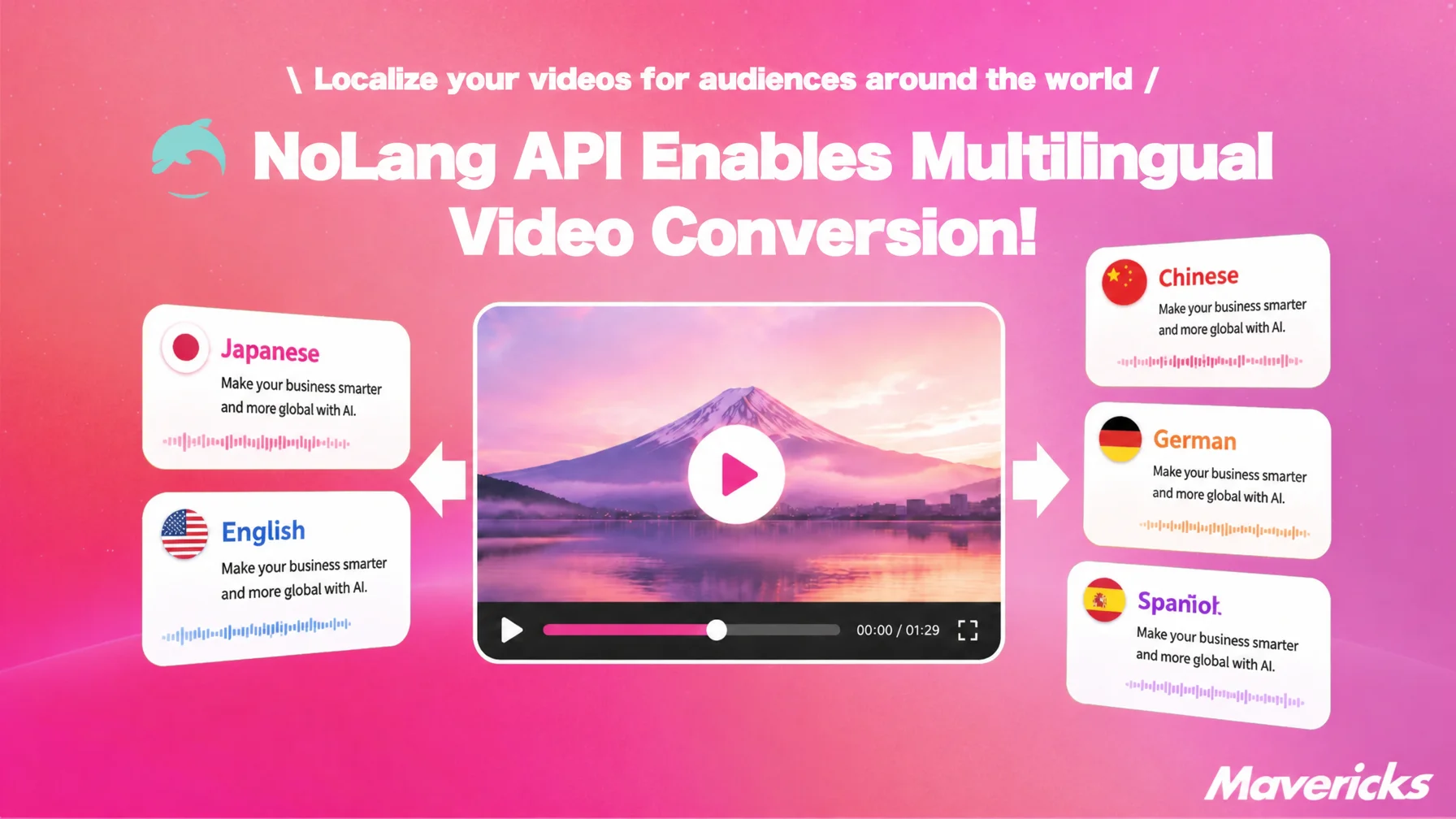
Mavericks, Inc., the company behind the AI video generation service NoLang, has added a language conversion feature to the NoLang API. It supports up to 34 languages, and a single video can be turned into several language versions in one batch. Companies that run content for overseas audiences can replace the per-language conversion they used to repeat by hand with batch processing driven by a program, which lightens the workload and shortens the time it takes to publish or update a video. When product information or training material changes, each language version can be regenerated quickly, so multilingual content stays affordable to produce and maintain while the pace of overseas rollout increases.
The high cost of multilingual video that holds back global expansion
Japanese digital sales channels aimed at overseas consumers keep expanding. According to the Ministry of Economy, Trade and Industry’s “FY2024 Market Survey on Electronic Commerce,” cross-border e-commerce purchases from Japanese businesses by Chinese consumers reached 2.6372 trillion yen, up 8.5% year on year1. Purchases by US consumers also grew, to 3.1397 trillion yen (up 6.0% year on year). Product descriptions, user guides and support content are increasingly expected to reach buyers in their own language.
The cost of that localization is significant on a global scale as well. Nimdzi Insights’ “The 2025 Nimdzi 100” put the worldwide market for language services, including translation and localization, at 71.7 billion US dollars in 2024. It is projected to grow to 75.7 billion US dollars in 2025, up 5.6% year on year2. At the level of an individual project, the guideline rates published by the Japan Translation Federation (JTF) for its member companies put Japanese-to-English translation at 20 to 30 yen per Japanese character3. For video, narration recording, subtitle burn-in and re-editing are added on top of that, once for every language.
In other words, taking one video into 10 languages means running the whole translation, recording and editing sequence 10 times. NoLang has offered a language conversion feature that replaces those steps with AI, but converting videos one at a time in the management screen means more and more manual clicks as the number of source videos reaches the dozens and the target languages reach several. Update the content, and the same work starts over. To automate this repetitive part of multilingual rollout with a program, Mavericks added language conversion for videos to the NoLang API.
Converting an existing video, narration and subtitles included, into another language
The NoLang web app already had a feature that converts a finished video into another language with one click, from the convert button on the video playback screen. This update makes that same language conversion callable from the NoLang API. The point is that a program can now invoke the process that previously required someone to press a button on screen.
Specify the video to convert and the target language, and a new video based on the existing one is created automatically in the background, with narration and subtitles replaced in the language you chose. The source video is left untouched. That makes it possible to keep a Japanese master video and build up derivative versions in English, Chinese and other languages alongside it.
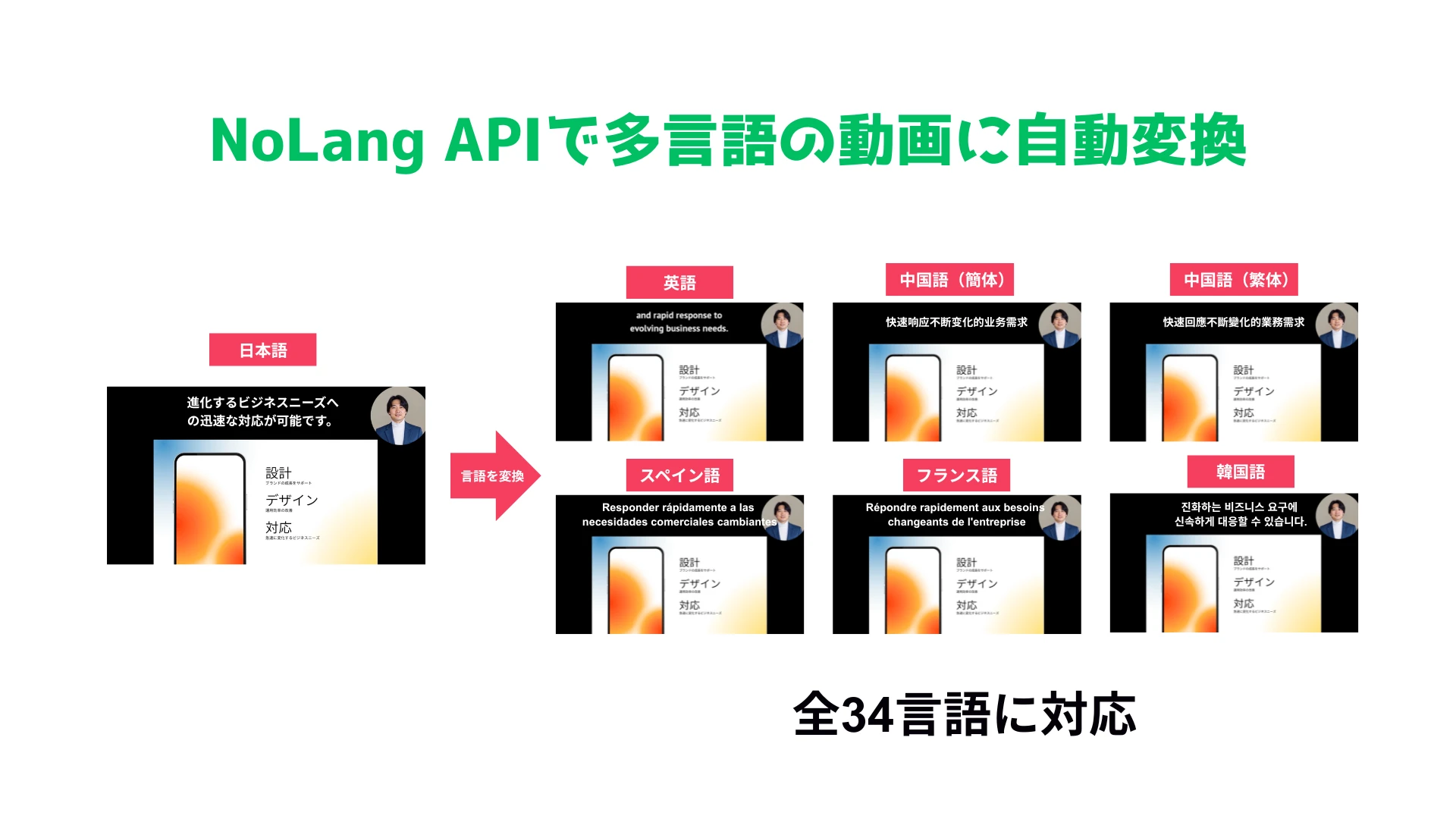
The source is not limited to videos generated through the API. Any video you own or can view, including one created in the web app, can be converted. Multilingual rollout that used to be handled one video at a time on screen can be replaced with batch processing or with calls from your own systems. The same mechanism also handles conversion of a video’s aspect ratio, not only its language.
See the detailed API documentation (in Japanese)From one Japanese video to 34 languages, generated in a single batch
The target languages listed in the developer documentation are Japanese, English, Chinese (Simplified), Chinese (Traditional), Korean, Spanish, French, German, Italian, Portuguese, Russian, Hindi, Bengali, Indonesian, Thai, Vietnamese, Tagalog, Malay, Burmese, Nepali, Mongolian, Turkish, Swedish, Danish, Finnish, Polish, Czech, Slovak, Dutch, Romanian, Croatian, Bulgarian, Ukrainian and Greek: 34 languages in total.
With a single source video, a program can be told to run the conversion into all 34 of those languages at once. Working from the list of available languages, generating all 34 versions in one pass takes only a very simple program. A training course, product explainer or manual video produced in Japanese can be rolled out to all 34 languages by an automated job overnight. The work of pressing the convert button once per language becomes a single program run.
Multilingual conversion at about 250 yen per minute, roughly 1/36 to 1/54 the cost of outsourced translation
Language conversion is charged as credit consumption based on the length of the source video (1 credit = 2.5 yen, purchased in advance). The rate table on the “Pricing” page of the API documentation lists 100 credits (250 yen) for a video of roughly 30 seconds to 2 minutes and 200 credits (500 yen) for roughly 3 minutes. From there it is 300 credits (750 yen) for roughly 4 minutes, 400 credits (1,000 yen) for roughly 5 minutes and 500 credits (1,250 yen) for roughly 6 minutes. Converted to a per-minute figure, that works out at roughly 250 yen.
Using a standard Japanese narration pace of about 450 characters per minute, the outsourced rate for Japanese-to-English translation of 20 to 30 yen per Japanese character3 alone comes to 9,000 to 13,500 yen per minute. Given that narration recording and subtitle burn-in are charged separately on top of that, conversion through the NoLang API comes to roughly 1/36 to 1/54 of that cost.
Education, cross-border e-commerce, internal manuals and other fields
Language conversion in the NoLang API fits a wide range of situations that call for video in more than one language: education and training, cross-border e-commerce, product support and internal knowledge sharing.
In education and training, lectures and training videos produced in Japanese can be rolled out automatically into the languages used by employees at overseas sites and by international students. When the number of languages learners need grows, adding them to the list of conversion targets is enough, which avoids placing a new order with a translation company every time an overseas office opens or new international students arrive.
In cross-border e-commerce and product support, product explainers and how-to guides can be converted and distributed in the languages of the target markets in a single pass. Videos for each market can be updated together when a product page is revised or a sale begins, so producing multilingual content does not squeeze the schedule.
For internal knowledge sharing, operational manual videos can be prepared in the native languages of foreign employees. When a manual is revised, every language version can be regenerated together with a simple program, so the latest information reaches the organization quickly instead of being held up by per-language edits and re-editing.
What comes next
Mavericks plans to keep expanding the NoLang API toward an environment that automates not only video generation but conversion, updating and day-to-day operation as one continuous flow. Tighter integration with corporate business systems is intended to support more efficient use of video.
Footnotes
-
Ministry of Economy, Trade and Industry, “FY2024 Market Survey on Electronic Commerce” (published August 26, 2025; in Japanese). Cross-border e-commerce purchases from Japan by Chinese and US consumers. ↩
-
Nimdzi Insights, “The 2025 Nimdzi 100”. The global language services market is estimated at 71.7 billion US dollars in 2024 and 75.7 billion US dollars in 2025, up 5.6% year on year. ↩
-
Japan Translation Federation, “Guideline Translation Rates” (in Japanese). Guideline rates for JTF member companies; Japanese-to-English translation is 20 to 30 yen per Japanese character. ↩ ↩2