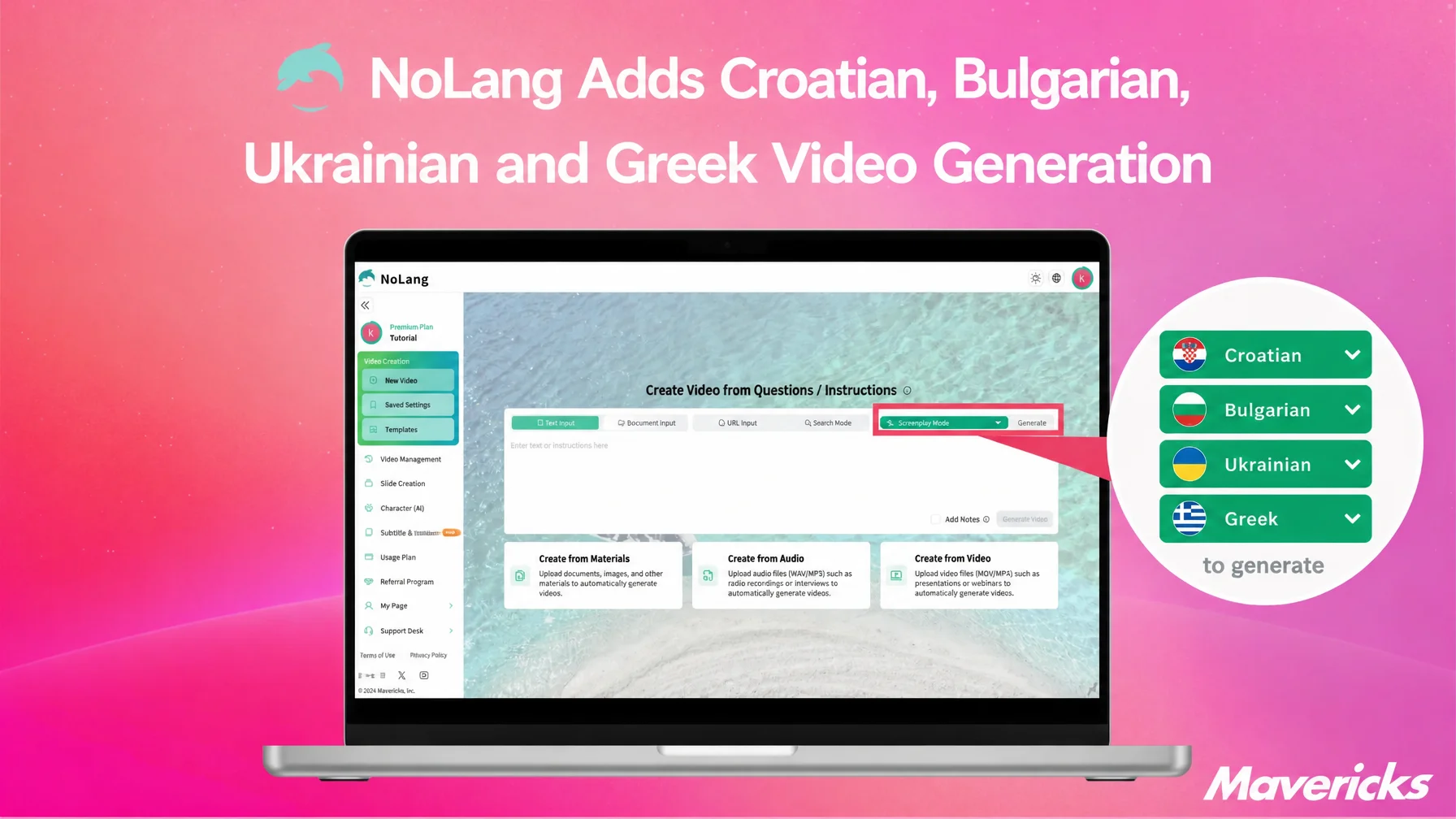
Mavericks, Inc., the company behind the AI video generation service NoLang, has added four Eastern European and Balkan languages to NoLang’s video generation: Croatian, Bulgarian, Ukrainian and Greek. Selecting one of them from the language menu is enough to turn a Japanese document into a video with narration and subtitles in that language, and the running time is adjusted automatically to the speaking pace. For companies and local governments that want to strengthen tourism promotion or IR disclosure for the region, this removes the need to arrange a translation agency or a voice talent for every video.
Try NoLangLocal-language content drives buying decisions, and cost is the barrier in Europe
When companies and public bodies deliver information to residents and customers abroad, language is a well-known barrier to understanding and to purchase. A CSA Research (Common Sense Advisory) survey of 8,709 consumers in 29 countries found that 76% prefer to buy products with information in their own language, and 40% will not buy from sites that are only in other languages1. The data shows how directly local-language content affects whether information reaches people, is understood, and leads to action, and that holds just as much for audiences in Croatia, Bulgaria, Ukraine and Greece.
Cost is a shared management issue for Japanese companies operating in Europe. The 2025 Survey on Business Conditions of Japanese Companies Operating Overseas (Europe edition) by the Japan External Trade Organization (JETRO), conducted from August 20 to September 19, 2025 among 1,449 Japanese companies in Europe with 778 valid responses, a response rate of 53.7%, reports that companies in Europe, including Eastern Europe, face a high-cost structure, digital regulation and many other management challenges2. Against that backdrop, producing video content for Croatia, Bulgaria, Ukraine and Greece in-house still means outsourcing translation and recording narration, which takes time and money, and the same burden returns with every language added.
With that in mind, Mavericks has continued to widen NoLang’s language coverage, and this update adds four languages from the Eastern European and Balkan region.
NoLang video generation now covers four Eastern European and Balkan languages at the click of a button
This update adds four languages to video generation in NoLang: Hrvatski (Croatian), Български (Bulgarian), Українська (Ukrainian) and Ελληνικά (Greek). These are the first Eastern European and Balkan languages NoLang supports.
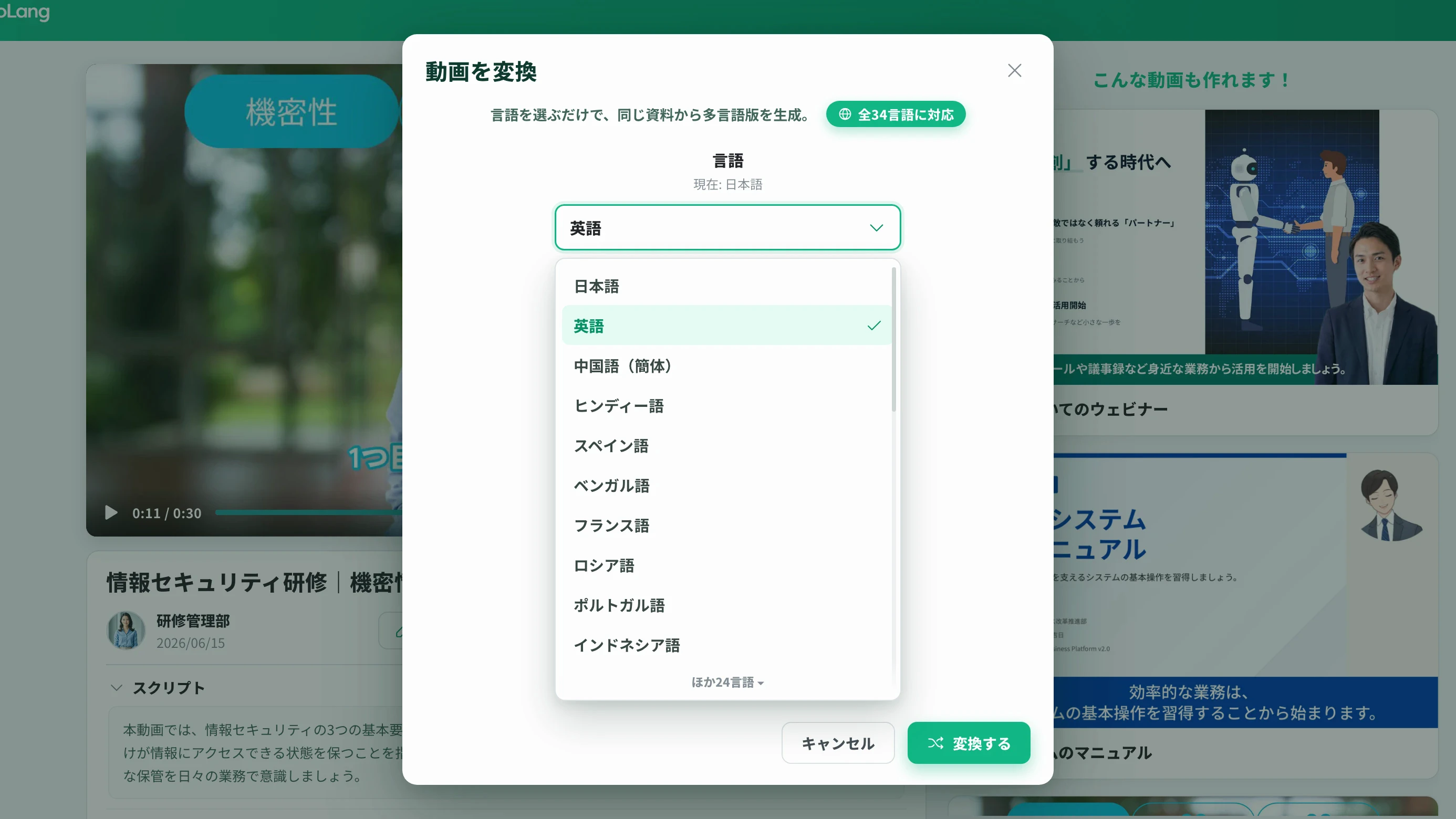
The workflow is simple. In the language setting menu on the video generation screen, select one of the four new languages as the language to generate in, and the video is created in that language right away. The same language menu appears in every video generation mode NoLang supports, including text input, PDF documents and audio files, so teams can start producing videos for the region without changing how they already work.
Upload a Japanese document and get a video in an Eastern European or Balkan language
NoLang generates videos in which an avatar explains the content, from a range of inputs: typed text, questions and instructions, documents such as PDFs, and audio or video files with sound. Choose Croatian, Bulgarian, Ukrainian or Greek as the output language and a Japanese script or document becomes a video with a script, narration and subtitles in that language.
The four new languages also work with the PDF-based generation modes, Present documents, Summarize documents and Analyze materials. Uploading an existing Japanese document such as financial results, product materials or public information is enough to produce explanatory, summary and analytical videos ready to publish for audiences in the region.
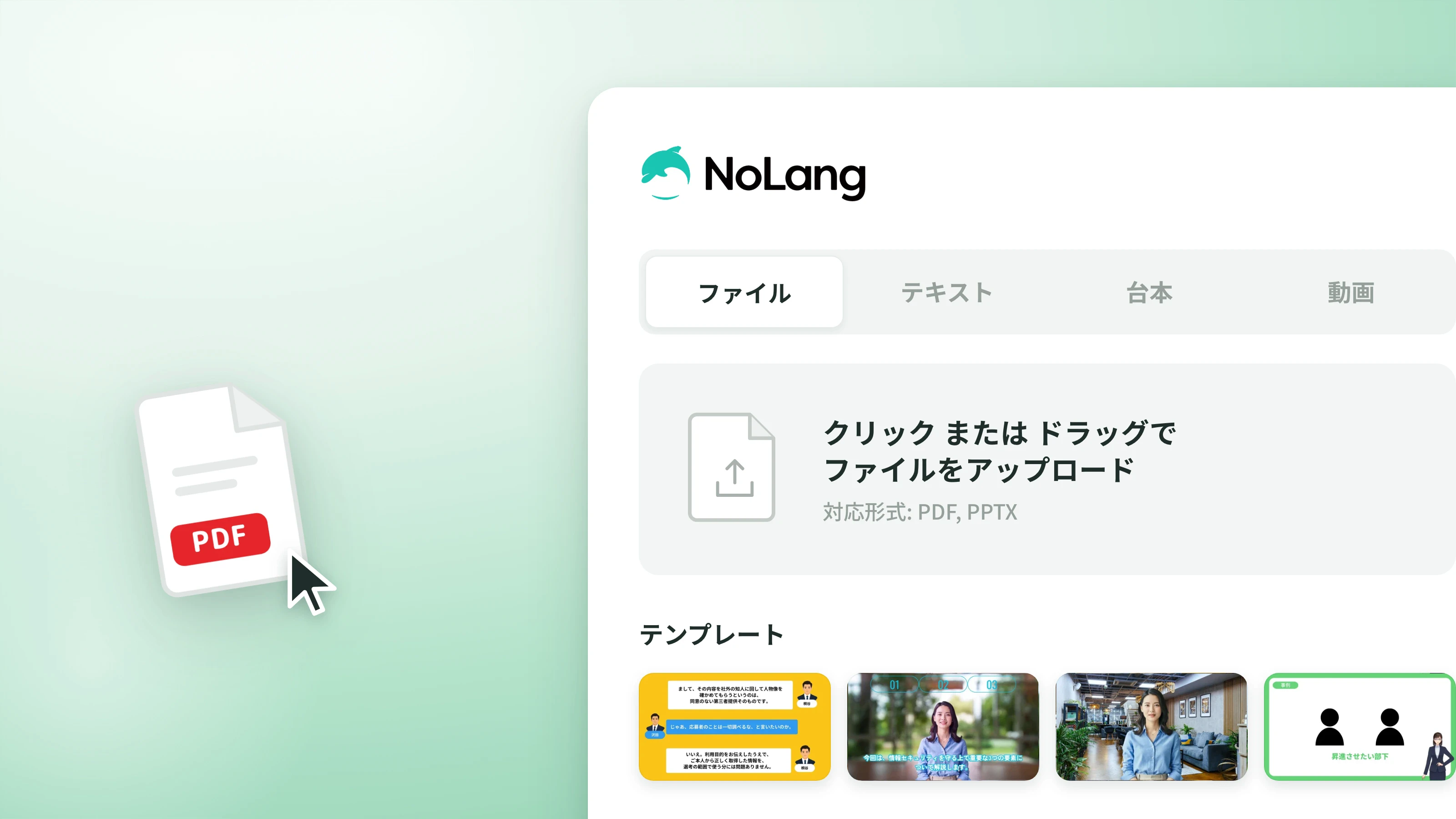
Videos that have already been generated can be converted to Croatian, Bulgarian, Ukrainian or Greek in one click, using the convert button on the viewing screen. A video already made in Japanese does not have to be rebuilt from scratch.
Latin and Cyrillic scripts render correctly, and length adjusts to the speaking pace
Subtitles shown in the video render correctly and without breakage, with fonts that cover each writing system: Latin script for Croatian, the Greek alphabet for Greek, and Cyrillic for Bulgarian and Ukrainian.
NoLang also calculates the narration playback time and the expected length of the video from the standard speaking pace of each language during generation, and that mechanism now covers the four new languages as well. Playback time is adjusted for differences in character count and word grouping between languages, so narration and subtitles run at a natural tempo instead of dragging or sounding rushed.
Four ways to use it, from tourism promotion to IR disclosure
With these four languages, Japanese material already at hand can be turned into videos for concrete situations right away.
The first is multilingual promotional video for inbound tourism. Entering the text of existing tourism guides or brochures produces a promotional video with narration and subtitles in Croatian, Bulgarian, Ukrainian or Greek. Greek-speaking visitors are a particularly strong audience for video at the stage when they are considering a trip to Japan, and reaching them no longer requires outsourced translation or a narration session.
The second is multilingual information on daily life and public services for foreign residents. Local governments and companies can upload the administrative brochures and living guides they already have and generate videos explaining that information in Croatian, Bulgarian, Ukrainian or Greek. Making it easier for foreign residents to reach the information they need gives this use a clear public value.
The third is IR disclosure for overseas investors. Uploading a Japanese PDF such as financial results and choosing Croatian, Bulgarian, Ukrainian or Greek as the output language produces an explanatory video for investors in those markets.
The fourth is product videos for cross-border e-commerce. Entering text or documents covering product specifications and usage produces a product video with narration and subtitles in the local language, ready to publish on e-commerce product pages or in social media ads.
What comes next
Mavericks will continue to add languages that users ask for, along with the native languages of foreign communities growing rapidly in Japan. The goal is to serve as infrastructure for multilingual video production centered on Japan and Asia, and to support communication across language barriers.
Footnotes
-
CSA Research (Common Sense Advisory), “Can’t Read, Won’t Buy - B2C” (a survey of 8,709 consumers in 29 countries; 76% prefer to buy products with information provided in their own language, and 40% will not buy from sites available only in other languages) ↩
-
Japan External Trade Organization (JETRO), “2025 Survey on Business Conditions of Japanese Companies Operating Overseas (Europe edition)” (in Japanese) (conducted August 20 to September 19, 2025; 1,449 Japanese companies operating in Europe surveyed, 778 valid responses, a response rate of 53.7%, covering 14 countries in Western Europe and 11 in Central and Eastern Europe) ↩