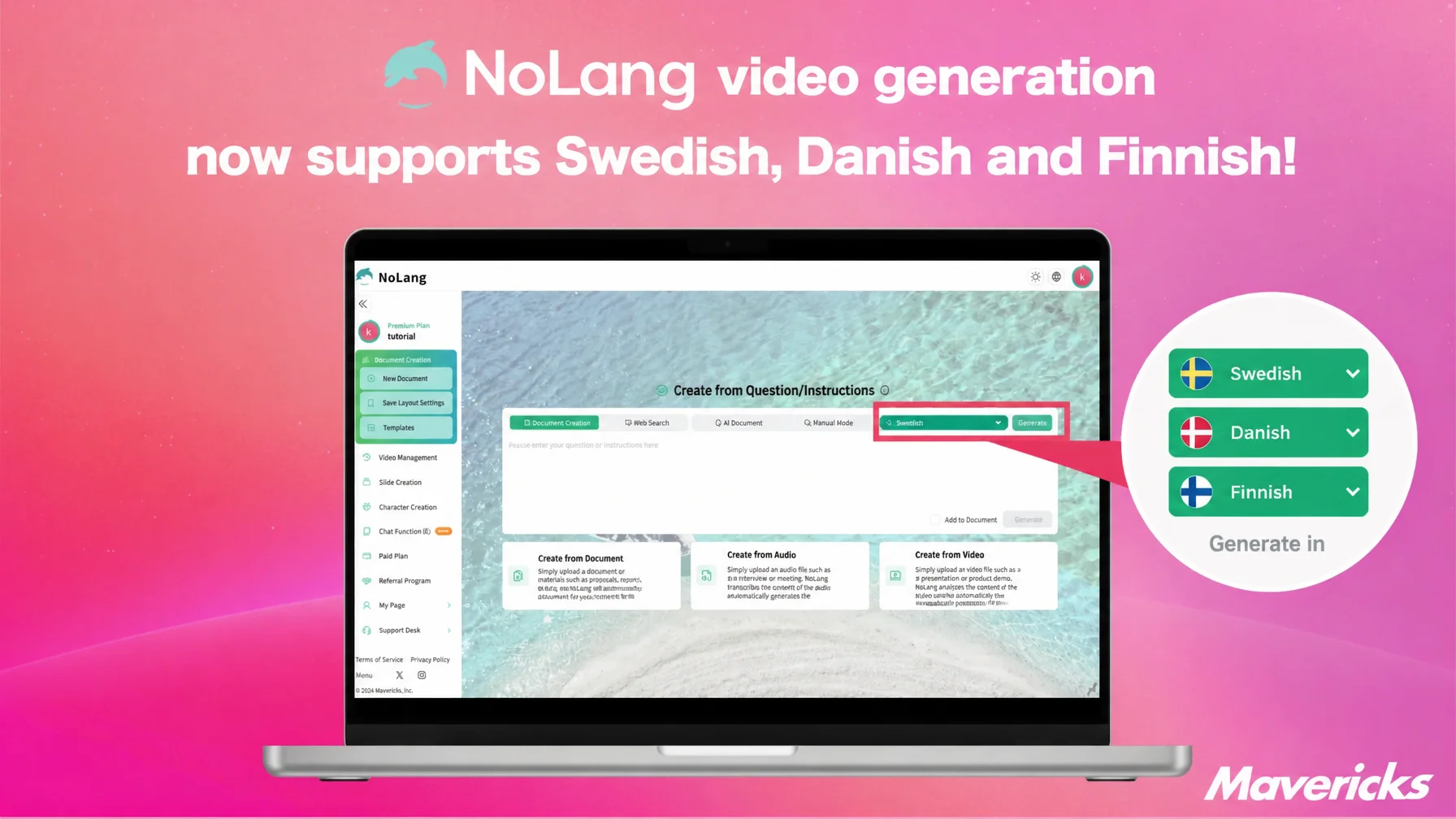
Mavericks, Inc., the company behind the AI video generation service NoLang, has added three Nordic languages to NoLang’s video generation feature: Swedish, Danish, and Finnish. Selecting one of them from the language menu is enough to turn a Japanese document into a video with narration and subtitles in that language, and the running time is adjusted automatically to the speaking pace of the language. For companies that want to strengthen IR, marketing, and e-commerce communication for the Nordics without arranging translation agencies or voice talent, this is a way to make video production faster.
Try NoLangGrowing demand for local-language video in the digitally advanced Nordics
Sweden, Denmark, and Finland are among the most digitally connected countries in the world. According to World Bank statistics, internet usage reached 95.7% of the population in Sweden (2023) and 99.8% in Denmark (2024), both at the top of the global ranking1. As companies and public bodies work to reach residents and customers in these markets, digital content matters more every year, yet content available only in Japanese or English can go only so far.
Language is a well-documented barrier to understanding and purchasing in global markets. In a CSA Research (Common Sense Advisory) survey of 8,709 consumers in 29 countries, 76% said they prefer to buy products with information in their own language, and 40% said they will not buy from sites in other languages only2. Communicating in the local language is directly tied to comprehension and action.
Localizing content for overseas markets is not easy, however. The Japan External Trade Organization (JETRO) survey “FY2025 Survey on Business Conditions of Japanese Companies in Europe” (conducted August 20 to September 19, 2025, covering 1,449 Japanese companies operating in Europe, with 778 valid responses for a 53.7% response rate) reports that companies in Europe, the Nordics included, face a range of management issues such as a high cost structure and compliance with digital regulations3. In that environment, localizing a video or a document usually means outsourcing to a translation agency and booking a voice actor each time, and the burden in time and cost falls hardest on companies without a dedicated localization team.
Video has drawn attention as one way past this. Because it conveys content intuitively across language barriers, it is used for IR disclosure to overseas investors, marketing abroad, and cross-border e-commerce, and those use cases keep expanding. With similar demand expected in the highly digitalized Nordic markets, Mavericks continues to expand the languages NoLang supports.
NoLang video generation now supports three Nordic languages
With this update, NoLang’s video generation feature adds three languages: Svenska (Swedish), Dansk (Danish), and Suomi (Finnish).
The operation is simple. On the video generation screen, users pick one of the three new Nordic languages from the language menu, and NoLang creates an avatar video in that language. Nothing about the existing workflow changes, so teams can start producing video for the Nordics right away.
Upload a Japanese document and get a Nordic-language video
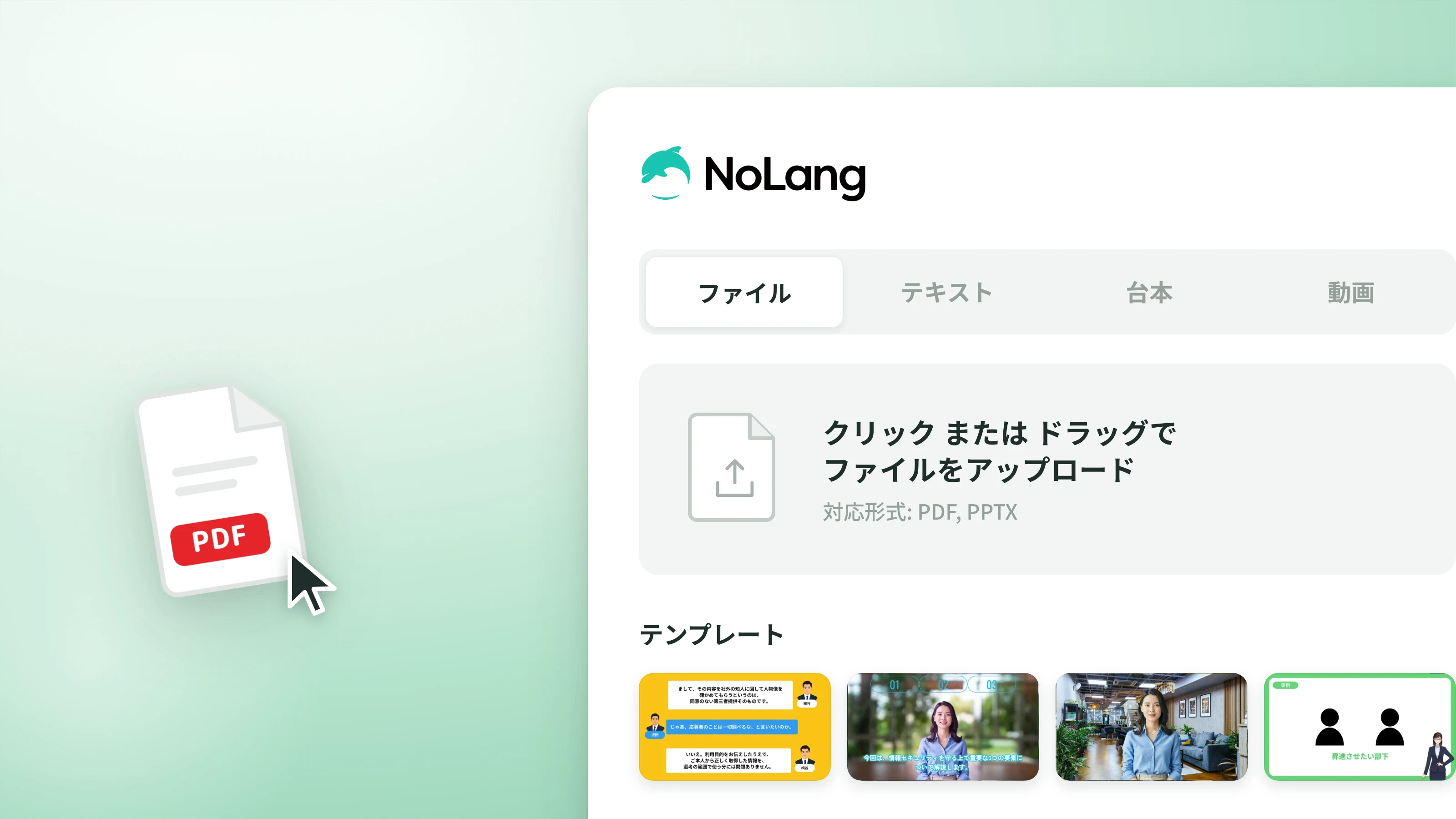
The language selection applies to every video generation mode NoLang supports, including text input, PDF documents, and audio files. NoLang generates avatar explainer videos automatically from a range of inputs, such as questions and instructions in text, scripts, documents like PDFs, and audio or video files with sound. Choosing Swedish, Danish, or Finnish as the output language produces a finished video with a script, narration, and subtitles in that language, based on the original Japanese draft or document.
The PDF-based modes, “Present documents,” “Summarize documents,” and “Analyze materials,” also support the three new Nordic languages. Existing Japanese documents such as earnings materials or product materials can be uploaded and turned directly into explainer, summary, or analysis videos for the Nordics. For example, uploading a Japanese earnings presentation and selecting Swedish as the output language produces an explainer video that can be published to local investors as it is, with no translation agency and no voice talent to arrange.
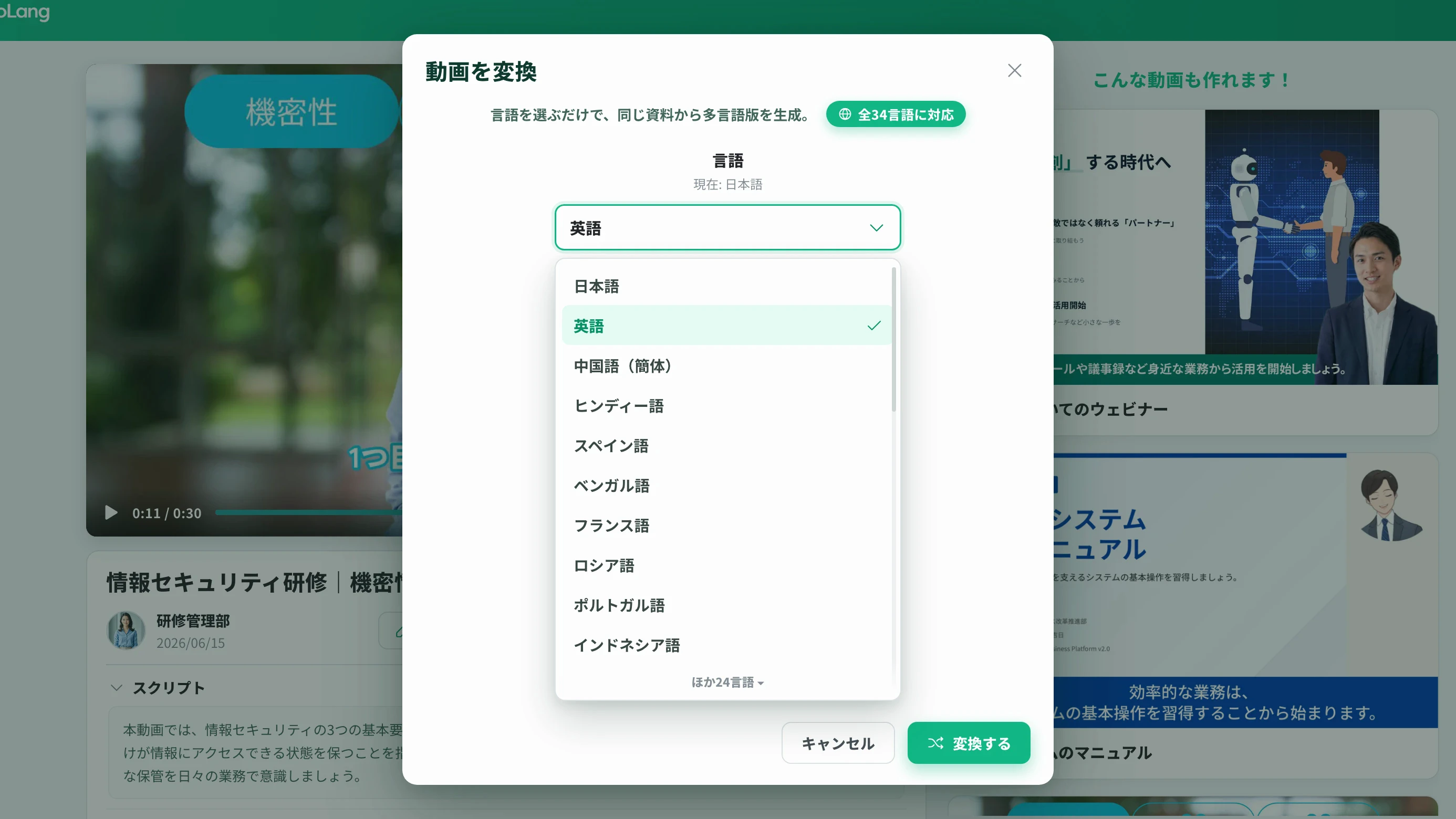
NoLang can also convert a video that has already been generated into another language. Using the convert button below the video playback screen, a video generated in Japanese can be converted into Swedish, Danish, or Finnish.
Video length adjusts automatically to each language’s speaking pace
Subtitles displayed in the video render correctly, without broken glyphs, thanks to font support for the Latin script used in Swedish, Danish, and Finnish.
NoLang also calculates the narration playback time and the expected video length automatically from the standard speaking pace of each language, and that feature now covers Swedish, Danish, and Finnish as well. Different languages need different amounts of text and different phrasing to convey the same content, and because playback time accounts for those differences, the result avoids unnatural padding or rushed delivery, and narration and subtitles run at a natural tempo. Generating a Swedish video from a Japanese draft, for instance, produces a length that already reflects the difference in text volume, so there is no need to adjust playback speed or subtitle timing by hand afterward.
Four ways to use NoLang
With support for the three Nordic languages, NoLang can turn Japanese material a company already has into videos for specific, practical purposes.
The first is IR disclosure video for overseas investors. A Japanese earnings presentation or integrated report in PDF can be uploaded as is, and selecting Swedish, Danish, or Finnish as the output language produces an explainer video for local investors. No translation agency or voice talent is involved, so the video can be published quickly to match the timing of an earnings announcement.
The second is marketing video for overseas audiences. Existing company profiles, product catalogs, and service descriptions can be used as input to create brand videos and product videos for the Nordic market. That speed helps in situations that demand it, such as setting up a local subsidiary or exhibiting at a trade show.
The third is product video for cross-border e-commerce. Text or documents covering specifications and usage produce a product video with local-language narration and subtitles, ready to publish on e-commerce product pages or in social media ads.
The fourth is multilingual onboarding video, or getting-started guides. Uploading an existing Japanese manual or operating guide produces a getting-started video for users and partners in the Nordics, helping local users get up to speed while keeping the support workload down.
Companies that have relied on outside translation agencies and voice talent for overseas video can now prepare Nordic-market video with internal resources alone, simply by uploading the Japanese documents they already have. Even without a dedicated translation and localization team, communicating with the Nordic market becomes practical.
Looking ahead
Mavericks will continue to add languages that users ask for, as well as the native languages of foreign communities growing rapidly in Japan. As an infrastructure for multilingual video production centered on Japan and Asia, NoLang will keep supporting communication across language barriers.
Footnotes
-
World Bank, “Individuals using the Internet (% of population)” (Sweden 95.7% [2023], Denmark 99.8% [2024]) ↩
-
CSA Research, “Can’t Read, Won’t Buy” (survey of 8,709 consumers in 29 countries; 76% said they prefer to buy products with information in their own language, and 40% said they will not buy from sites in other languages only) ↩
-
Japan External Trade Organization (JETRO), “FY2025 Survey on Business Conditions of Japanese Companies in Europe” (in Japanese) (conducted August 20 to September 19, 2025; 1,449 Japanese companies operating in Europe surveyed, 778 valid responses, 53.7% response rate) ↩