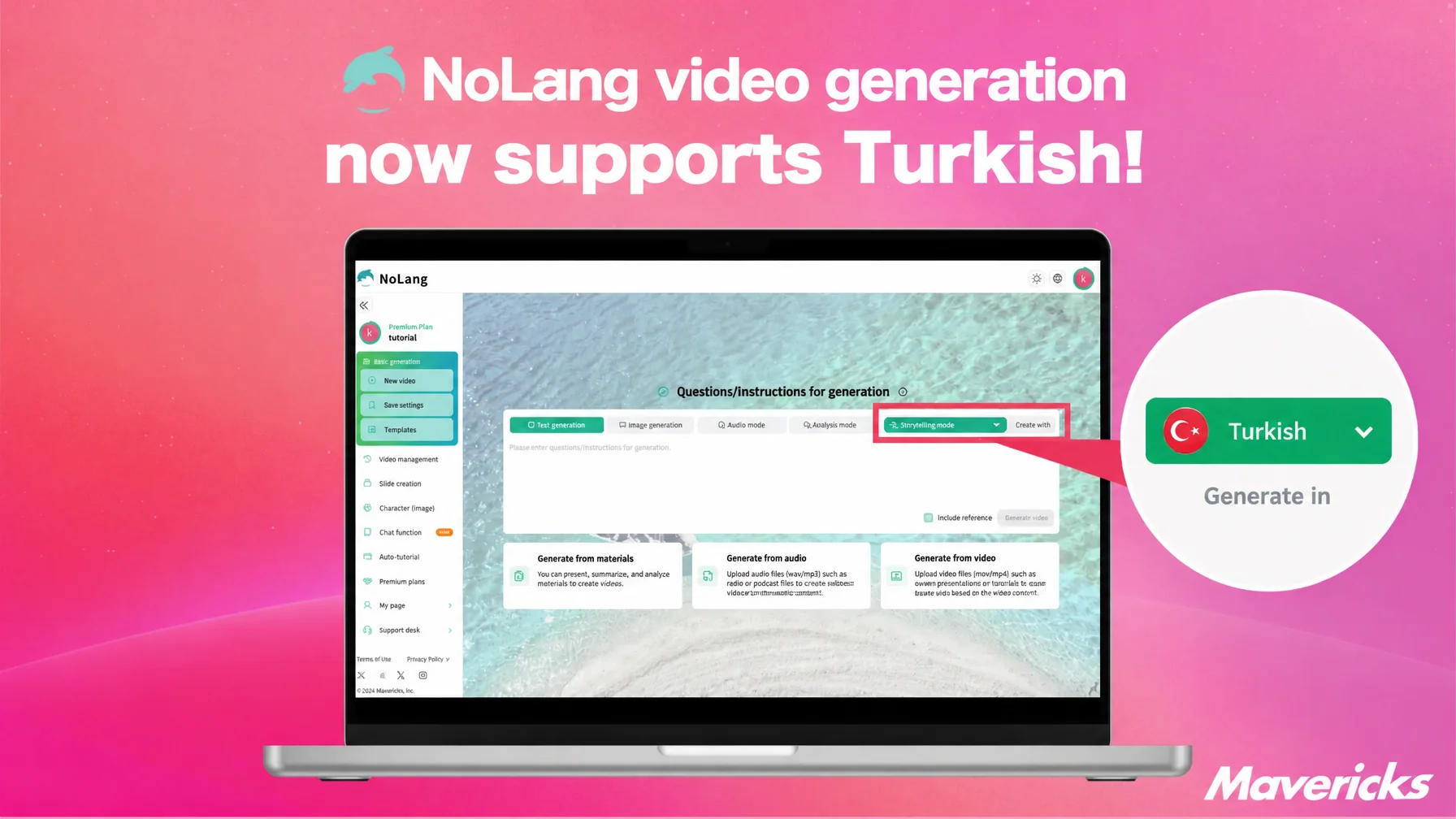
Mavericks, Inc., the company behind the AI video generation service NoLang, has added Turkish to the output languages available in NoLang. Simply choosing Turkish from the language menu produces a video with Turkish narration and subtitles directly from Japanese documents or scripts, and videos that have already been created can be converted to Turkish with a single click. For companies that want to move quickly on IR disclosure, product introductions or cross-border e-commerce aimed at the Turkish market, this removes the need to commission a translation agency or book a voice actor before a video can go out.
Create a video with NoLangA fast-growing Turkish market, where the language barrier slows expansion
Turkey is a large market with a population of roughly 88 million as of 20251, and its e-commerce market grew 52.2% year over year in 20252. B2C e-commerce alone is forecast to reach 11.7 billion US dollars by 20293, which makes Turkey a growth market that Japanese companies can no longer ignore.
The obstacle to capturing that growth is language. In a CSA Research (Common Sense Advisory) survey of 8,709 consumers across 29 countries, 76% said they prefer to buy products with information presented in their own language, and 40% said they will not buy from a site available only in another language4. Turkish uses the Latin alphabet but has relatively few English speakers, so whether local-language content exists has a direct effect on how well users understand a message and whether they act on it.
The same picture appears in the Japan External Trade Organization (JETRO) “FY2025 Survey on Business Conditions of Japanese Companies Overseas (Middle East edition),” conducted in September 2025: more than 80% of Japanese companies operating in Turkey expect to be profitable, and 49.1% said they plan to expand their business over the next one to two years5. Yet when those companies actually try to produce Turkish videos and documents for the local market, each one requires an outside translation agency and a narration recording session, and the resulting cost and lead time often hold back the pace of expansion.
Mavericks, Inc. has added standalone Turkish support to NoLang for exactly this situation, where a rapidly growing market and the burden of the language barrier arrive together.
Türkçe (Turkish) added as an output language in NoLang
With this update, NoLang adds “Türkçe” (Turkish) to its output languages.
The operation is simple: select “Türkçe” from the Output Language menu on the video generation screen, and NoLang creates a video with Turkish narration and subtitles. The setting is available in every video generation mode NoLang supports, including text input, PDF documents and audio files.
Because Turkish is now one of the options, video content aimed at Turkey’s large population and market can be produced entirely within NoLang.
Upload a Japanese document and a Turkish video comes out
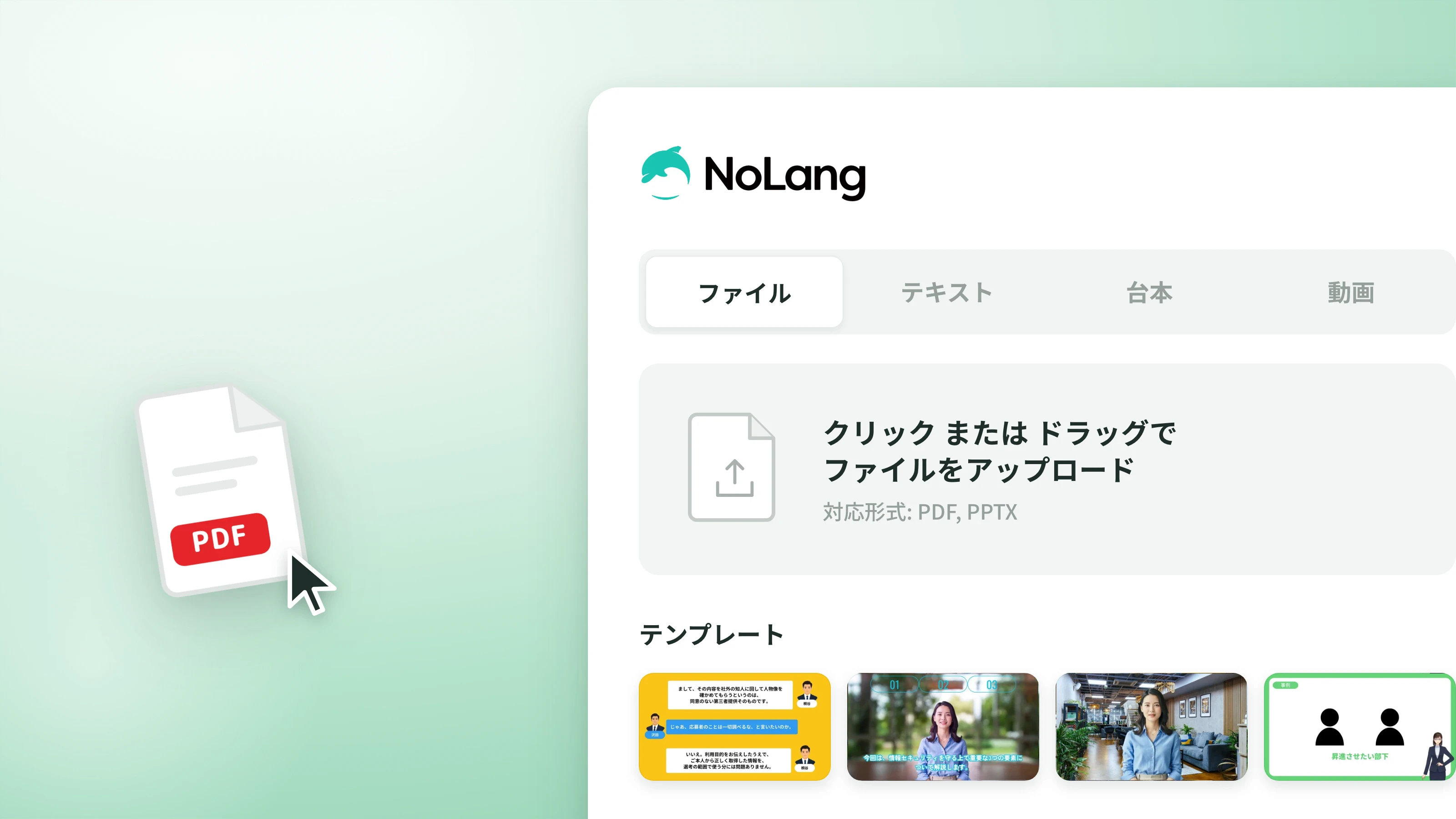
NoLang generates videos in which an avatar explains the material, taking its input from a typed question or instruction, a document such as a PDF, or an audio file or video file with audio. Selecting Turkish as the output language produces a video with a Turkish script, narration and subtitles based on the original Japanese script or document.
Turkish also works in the PDF-based generation modes — Present documents, Summarize documents and Analyze materials — so existing Japanese materials such as financial results decks and product documents can be turned into videos for the Turkish market as they are.
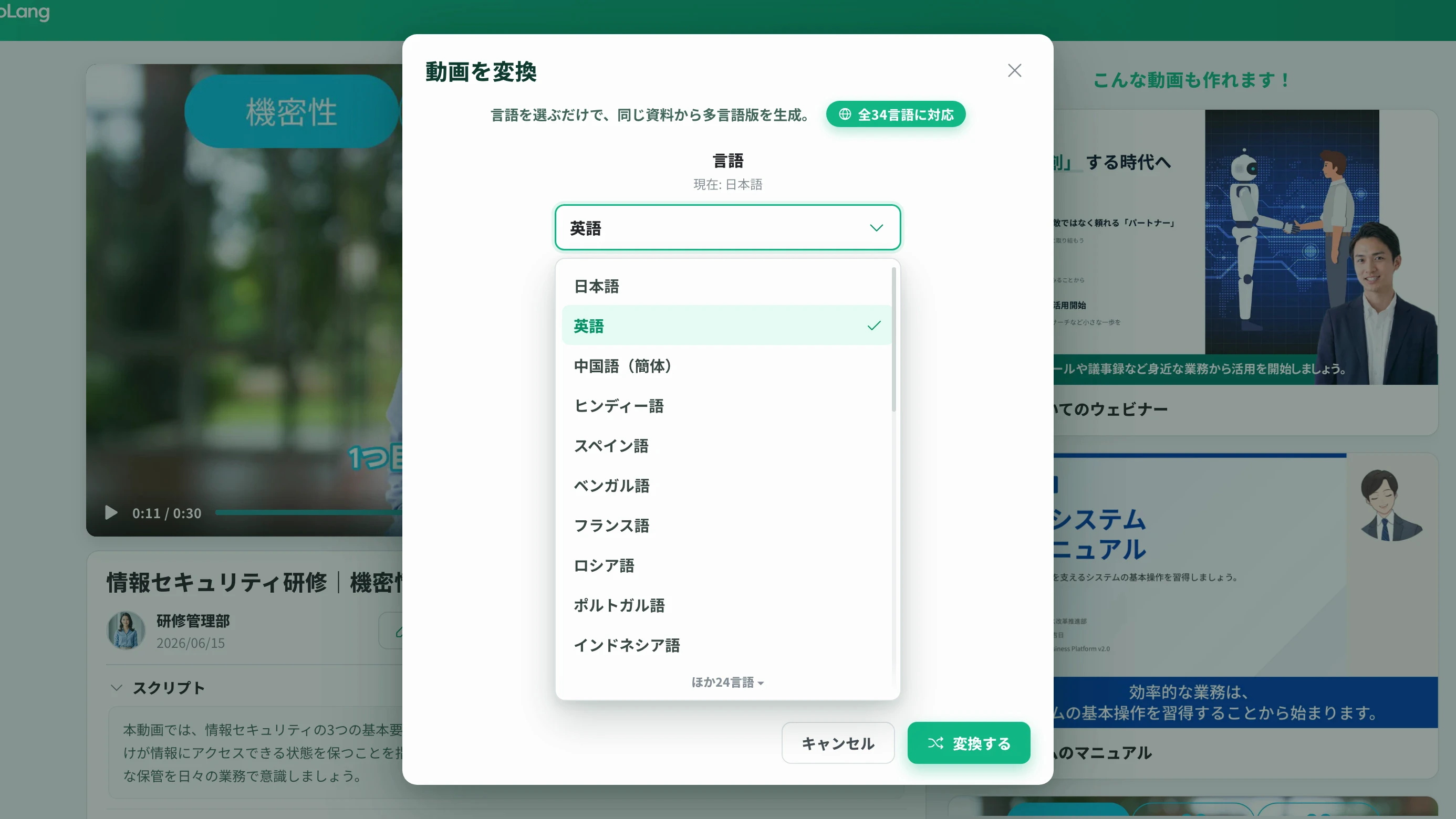
Videos that have already been generated can also be converted to Turkish with one click, using the conversion button on the viewing screen. There is no need to rebuild a finished Japanese video from scratch for a Turkish audience.
Turkish Latin characters supported, with video length calculated automatically
Subtitles displayed in the video render correctly, without breaking, thanks to fonts that cover the Turkish Latin alphabet, including characters specific to Turkish such as ı, ğ, ş and ç.
NoLang also adjusts narration playback time and the expected length of the video automatically, based on the standard number of characters spoken per minute in each language, and that mechanism now covers Turkish as well. This prevents narration that drags or races depending on the language, so narration and subtitles run at a natural pace.
Four use cases: IR disclosure, product introductions, cross-border e-commerce and onboarding
With Turkish support, NoLang can turn Japanese material that companies already have into videos for specific situations right away.
The first is IR disclosure video for investors in the Turkish market. Uploading an existing Japanese PDF such as a financial results deck and selecting Turkish as the output language produces an explanatory video for Turkish investors. No translation agency or voice actor is involved, so the video can be published quickly enough to match the timing of an earnings announcement.
The second is product and service introduction video for Turkey. Entering an existing company profile, product document or service description is enough to create brand and product videos for the Turkish market. That also covers situations where speed matters, such as establishing a local subsidiary or exhibiting at a trade show.
The third is product video for cross-border e-commerce. Feeding in text or documents that describe product specifications and usage produces a product video with Turkish narration and subtitles, ready to publish on an e-commerce product page or in social media advertising.
The fourth is multilingual onboarding video for local employees and partners. Uploading an existing Japanese manual or operating guide is enough to prepare a getting-started video for staff and partners in Turkey, which helps local teams get up to speed while keeping the support workload down.
Learn more about training videosBecause Turkish videos can be prepared straight from Japanese material on hand, without commissioning a translation agency or arranging a narrator, companies can communicate with the Turkish market without slowing down their expansion.
Looking ahead
Mavericks, Inc. will continue to add support for languages that users ask for most, as well as the native languages of foreign communities whose presence in Japan is growing quickly. As an infrastructure for multilingual video production centered on Japan and Asia, NoLang will keep supporting communication across language barriers.
Footnotes
-
DataReportal, “Digital 2025: Turkey” (Turkey’s population is estimated at roughly 88 million as of 2025) ↩
-
CEP-Research, “Turkish e-commerce market surges +50%” (Turkey’s e-commerce market grew 52.2% year over year in 2025) ↩
-
“Turkey B2C Ecommerce Databook Report 2025” (Turkey’s B2C e-commerce market is projected to reach 11.7 billion US dollars by 2029) ↩
-
CSA Research, “Can’t Read, Won’t Buy” (72.1% of consumers said they spend most of their time on websites and content written in their own language) ↩
-
Japan External Trade Organization (JETRO), “FY2025 Survey on Business Conditions of Japanese Companies Overseas (Middle East edition)” (in Japanese) (conducted in September 2025; more than 80% of Japanese companies in Turkey expect to be profitable and 49.1% plan to expand their business over the next one to two years) ↩