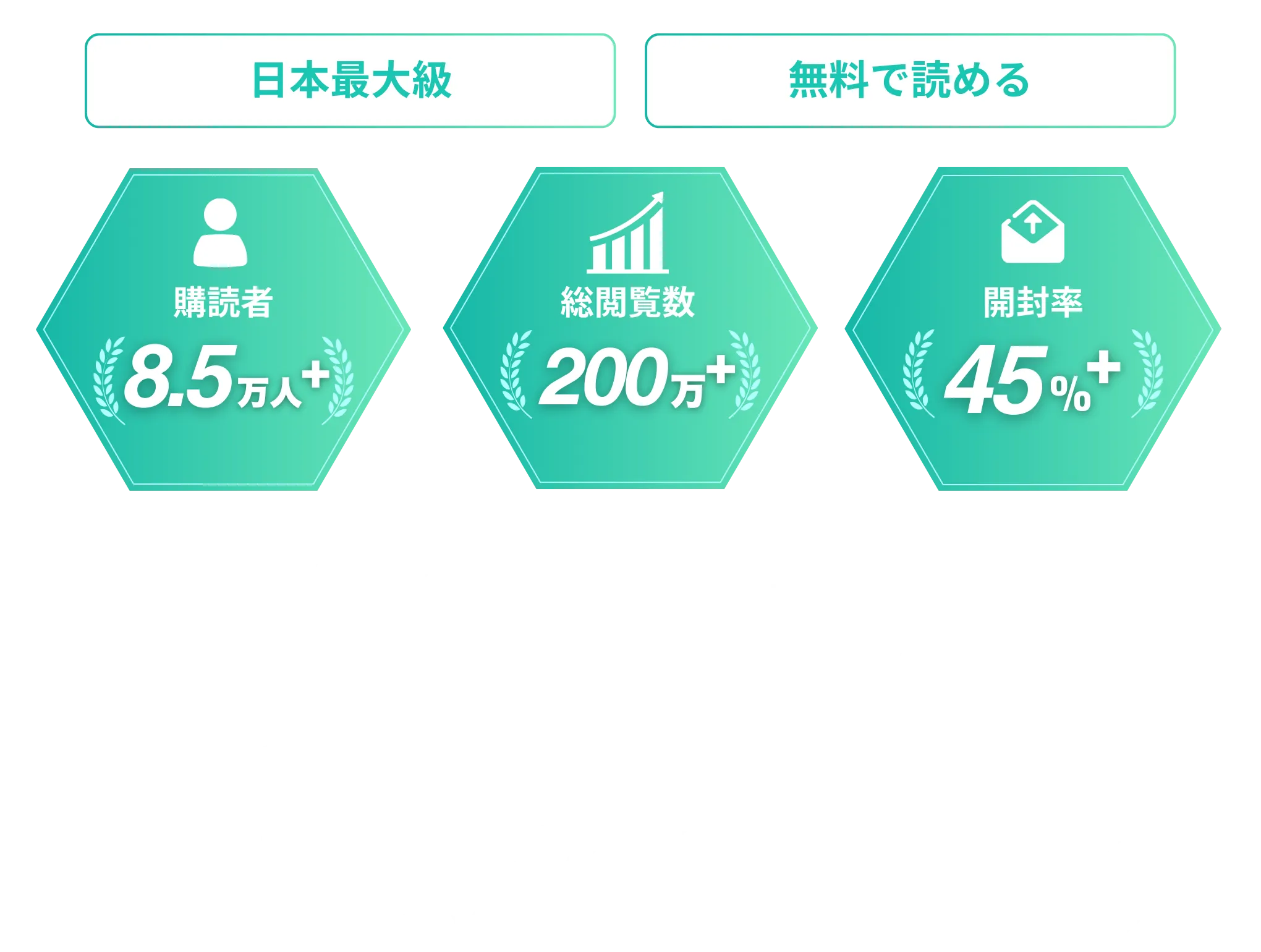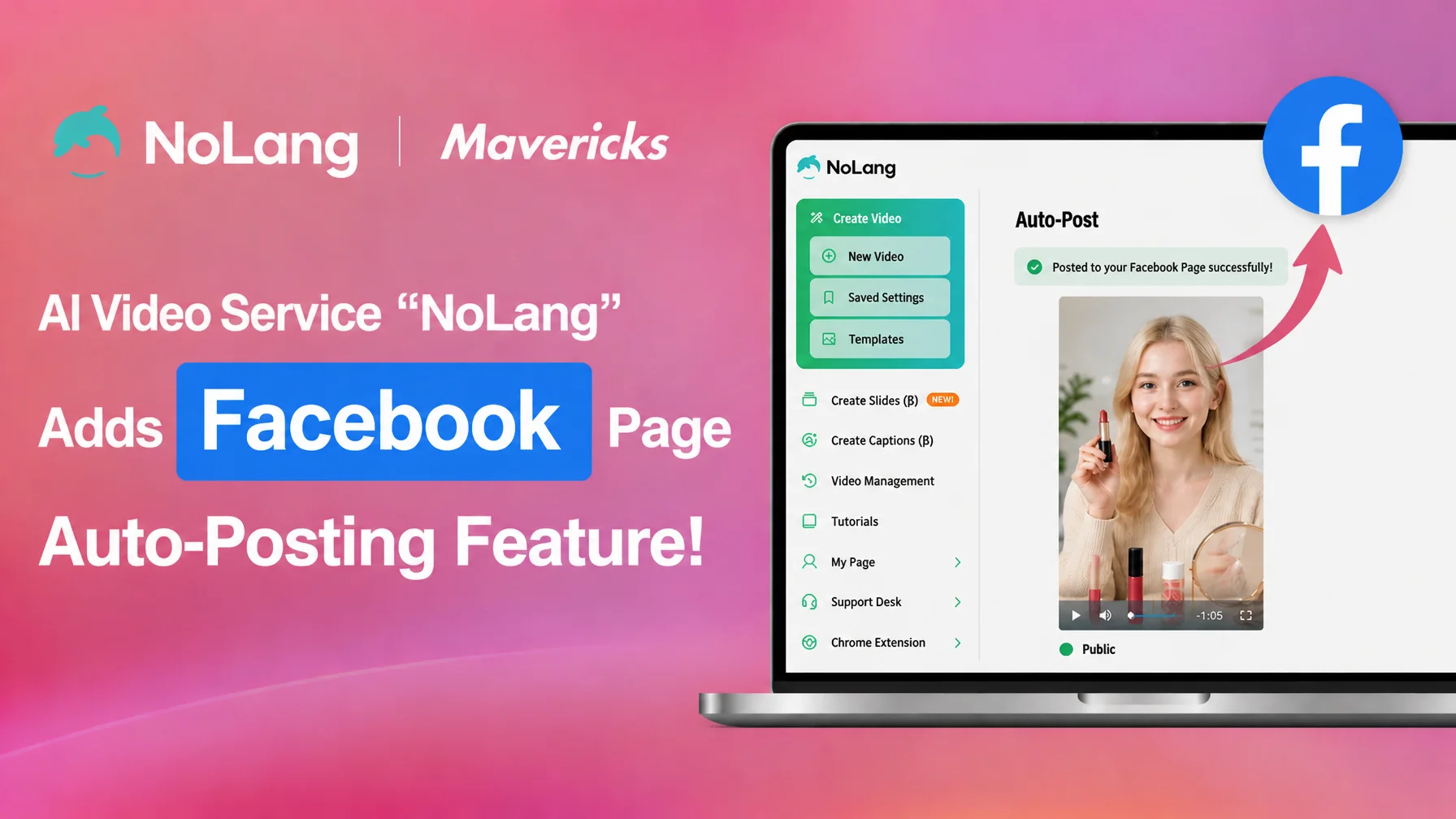
Mavericks, Inc., which operates NoLang, one of Japan’s largest homegrown AI video generation services1, has launched Facebook Page integration, a feature that posts videos generated in NoLang directly to a Facebook Page. Everything from automatic AI video generation to posting and visibility settings on a Facebook Page now happens inside NoLang. Facebook uses real names, so it is widely treated as a trustworthy publishing channel for corporate IR, recruiting and B2B marketing. With this feature, a company can keep publishing information on Facebook without specialist video production skills or outsourcing budgets, which cuts both production cost and day-to-day workload.
◼️26 million users in Japan: the demand for video on a real-name social network
Facebook has roughly 26 million monthly active users in Japan and ranks alongside LINE, YouTube and Instagram as one of the country’s main social networks2. Its defining difference from other platforms is the real-name policy, which makes posts more credible and has turned it into a primary channel for corporate IR, recruiting, B2B marketing and local business. A survey by the Institute for Information and Communications Policy of Japan’s Ministry of Internal Affairs and Communications puts usage highest among people in their thirties at 44.4%, giving Facebook a position no other social network holds as a route to executives, managers and business professionals3.
Globally, Facebook has more than three billion daily active users and remains one of the world’s largest social media platforms. A report by Manamina (VALUES, Inc.) shows B2B companies such as MonotaRO, DENSO and NEC using their Facebook Pages for differentiated content — product usage guides, technical information, employee interviews and trade show announcements — and earning high engagement4.
Corporate use of Facebook, however, runs into a structural problem: publishing new content continuously. In a survey of 2,134 people responsible for corporate social media, about half named a shortage of internal resources as their biggest challenge5. Facebook’s algorithm favors video, which draws more engagement and wider reach than text or image posts, but producing video continuously is expensive. Outsourcing a short-form video typically costs 10,000 to more than 100,000 yen per video including planning, shooting and editing, ranging up to 80,000 to 300,000 yen for advertising work, and handing over ongoing operation to an agency costs 50,000 to 300,000 yen per month6.
To address that problem, the AI video generation service NoLang today launched Facebook Page integration, which allows videos to be posted straight to a Facebook Page. Automatic AI video generation and Facebook publishing now happen on a single platform, cutting production cost and operating workload at the same time. Even small and mid-sized companies without specialist video skills or an outsourcing budget can publish and market on Facebook on an ongoing basis.
◼️One stop from generation to a Facebook post
NoLang’s Facebook Page integration posts a video generated in NoLang directly to a Facebook Page without leaving the screen. Publishing a video to a Facebook Page used to mean downloading the video file and uploading it again from Facebook’s Page management screen; that manual sequence now completes inside NoLang.
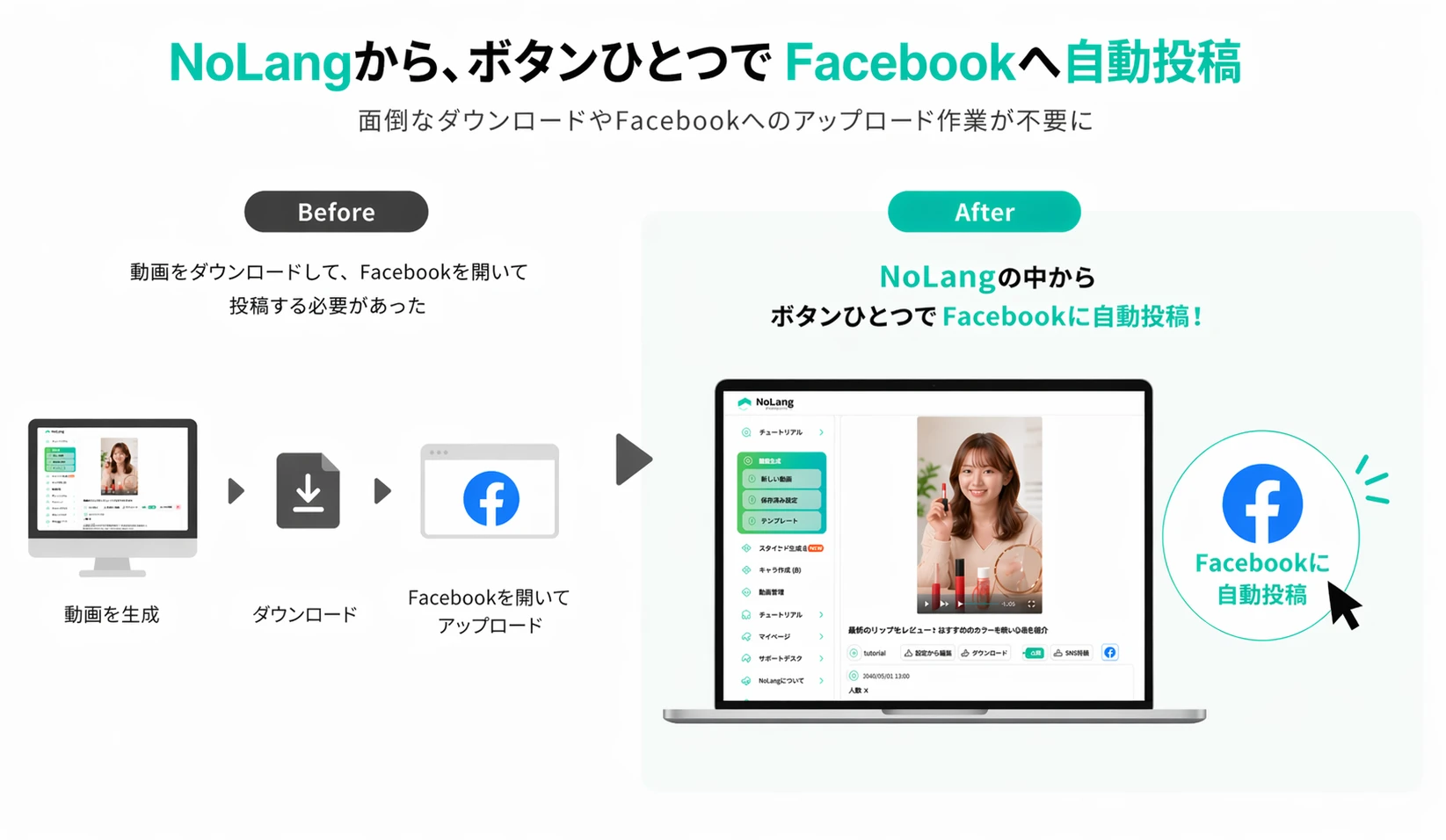
Setup takes one OAuth connection between NoLang and a Facebook Page the user administers; after that, posting takes a single click. Companies that manage several Facebook Pages can choose the destination Page, write the caption and set visibility in NoLang, then upload from there.
NoLang also ships a wide range of templates, from 16:9 landscape formats to layouts for business documents, covering everything from restrained videos that sit naturally in a Facebook timeline to product introductions. Swapping in text and assets is enough to finish a video suited to a B2B or corporate brand in a short time, with no video production expertise.
◼️Four ways to use Facebook with NoLang
NoLang’s Facebook Page integration builds on the credibility Facebook gains from real names and its strong reach among business audiences, and it fits a variety of business situations.
The first is B2B product and service introduction videos. Facebook reaches business audiences aged 30 and over particularly well and works as a channel for addressing decision makers. With NoLang’s templates, a company can finish B2B videos — feature introductions, customer examples, technical explanations — in a short time without specialist video skills. Turning specialized information into video communicates value that text and images alone could not convey, in a setting readers trust.
The second is IR, recruiting and company introduction content. NoLang generates videos automatically from PDFs and text, so existing corporate material such as financial results decks, recruiting brochures and company profiles can become video quickly. Facebook is a medium where official corporate information is readily trusted, which makes it possible to deliver professional video content to stakeholders and job candidates on a continuing basis.
The third is immediate distribution of press releases and news videos. NoLang can generate a video summarizing the contents of a web page from its URL alone. Turning a company’s own press releases or industry news into video from a URL and posting it to a Facebook Page delivers timely information to followers in an easy-to-follow form.
The fourth is multilingual content. NoLang supports 18 languages in total, so generating the same content in several languages and posting it to a Facebook Page extends reach to Facebook’s more than three billion users worldwide, as well as to overseas offices and business partners. For companies with overseas bases, or those publishing for inbound and international markets, this substantially lowers the operating burden.
◼️How to use Facebook Page integration
Facebook Page integration is available on the NoLang Premium plan and the Business plan, and a video is posted in the following steps.
- From the social media linking button on the screen, select Facebook as the upload destination and connect the account. This connection is only required the first time; once authentication is complete, the account information is kept automatically and no further linking is needed.
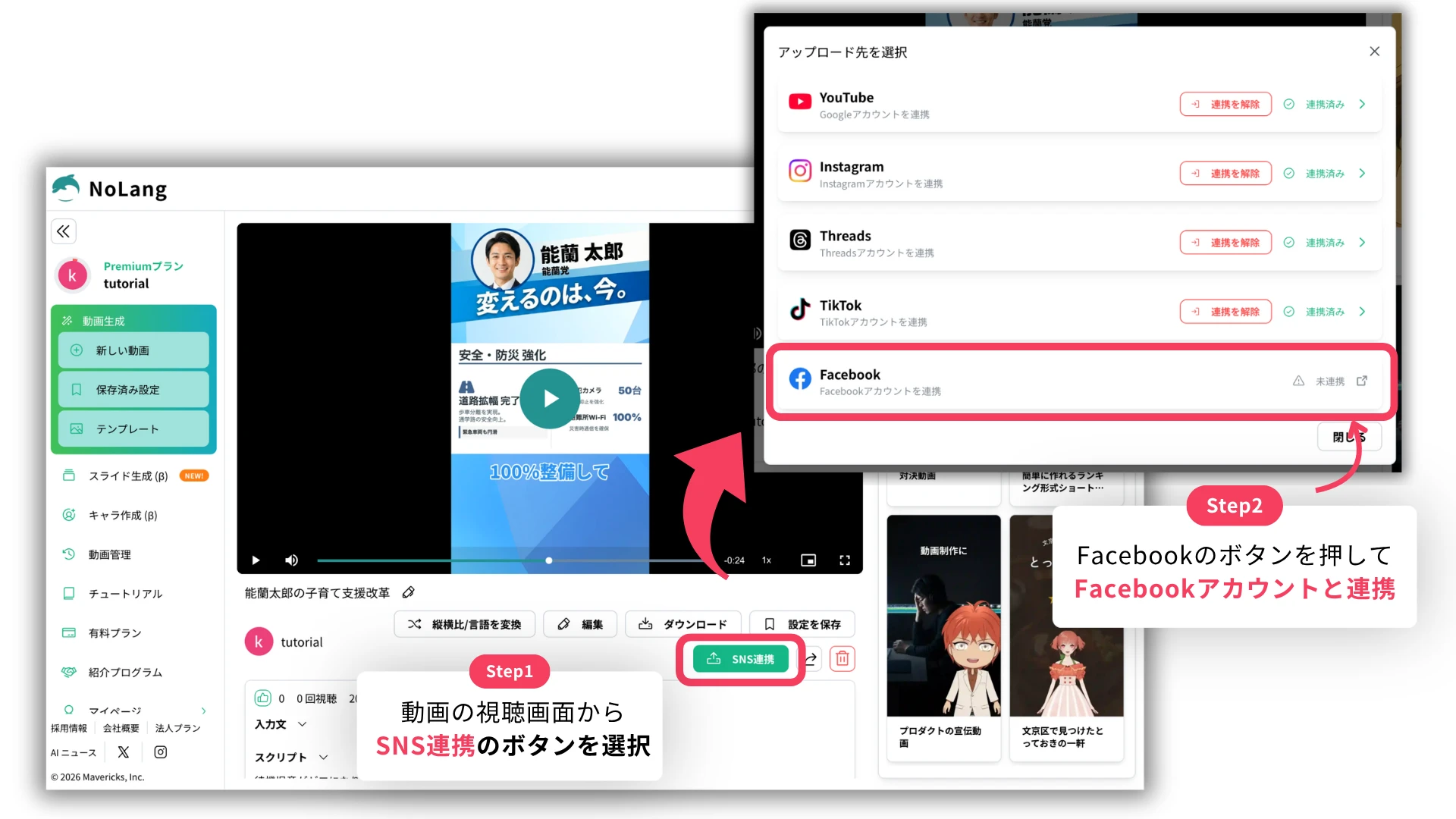
- Enter a description for the post and click the Upload button, and the post is complete.
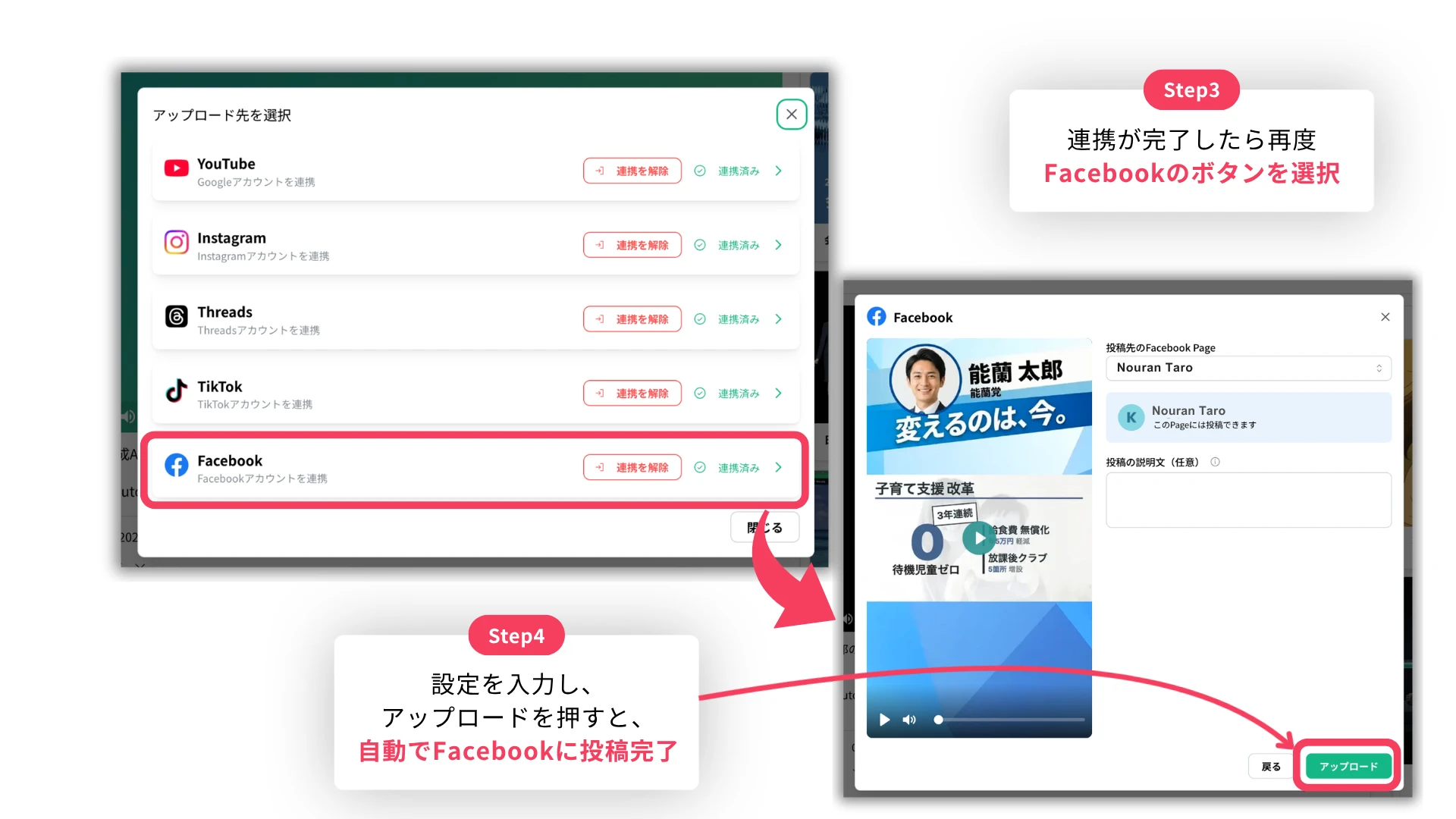
The whole sequence, from generating the video to posting it, stays inside NoLang, so there is no switching between tools and video distribution to a Facebook Page takes very little time.
What comes next
Starting with this Facebook Page integration, Mavericks plans to keep strengthening the features that connect video production and video distribution. Work ahead includes making distribution results visible, through post-publication performance analysis and links to engagement data.
NoLang will continue to develop beyond video generation into a platform that supports the whole path from content planning to distribution and day-to-day operation. As infrastructure covering the full cycle of video use — production, distribution and measurement — it aims to make corporate video marketing more efficient and more effective.
Footnotes
-
Based on the number of registered users of AI video generation services in Japan. As of December 2025, Mavericks research ↩
-
comnico, “Ranking of popular social networks in Japan and abroad by user numbers, April 2026 edition” (in Japanese) ↩
-
Institute for Information and Communications Policy, Ministry of Internal Affairs and Communications, “Survey report on usage time of information and communications media and information behavior” (FY2023, in Japanese) ↩
-
Manamina (VALUES, Inc.), “Six examples of B2B companies using Facebook: how MonotaRO, NEC, DENSO and others do it” (published May 2019, latest data referenced, in Japanese) ↩
-
KnowledgeBox, “A thorough survey of corporate social media operations and results” (2,134 corporate social media marketers, May 2025, in Japanese) ↩
-
VideoWorks, “Typical outsourcing costs for short-form video production” (in Japanese) ↩