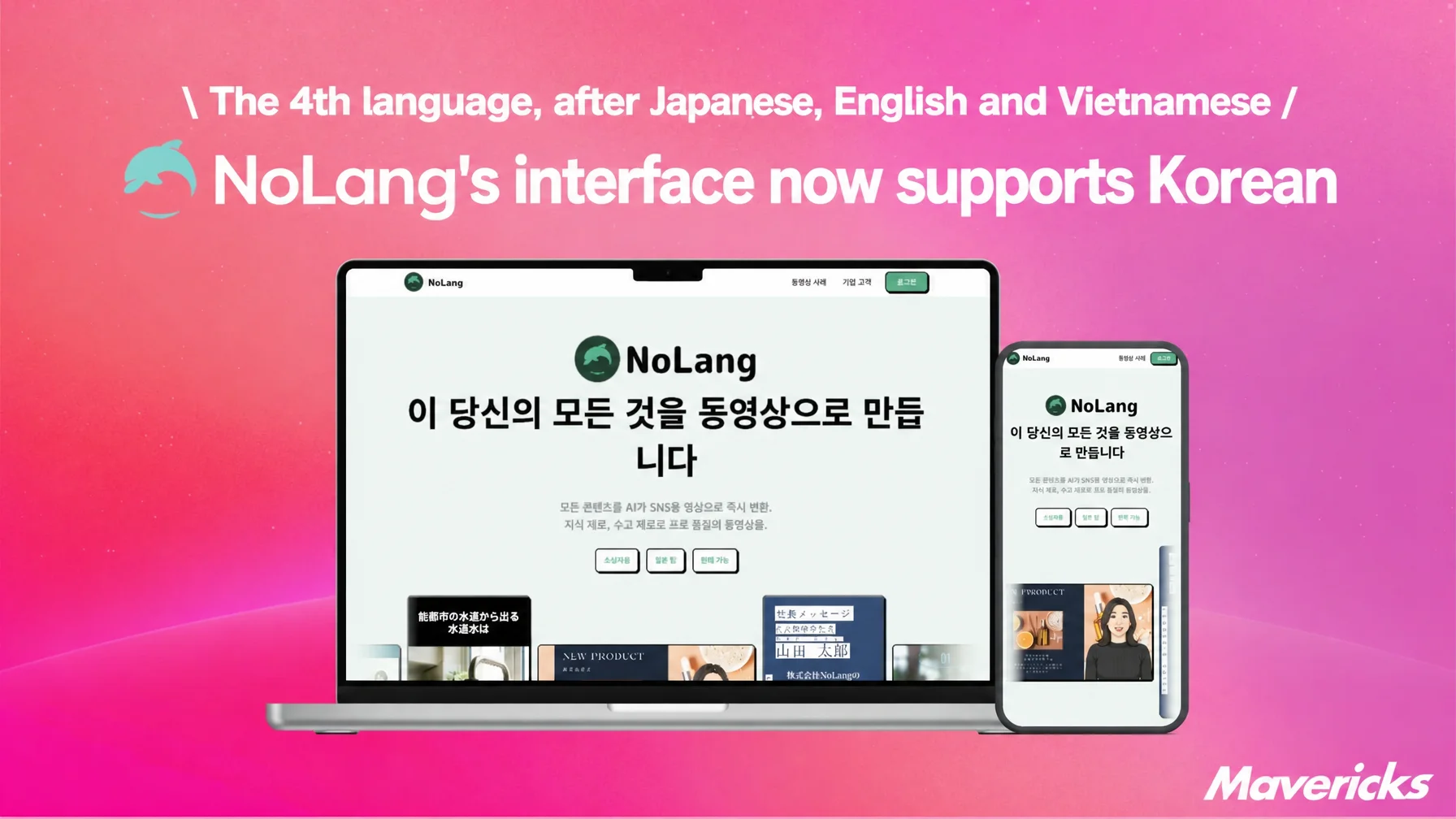
Mavericks, Inc., the Japanese company behind the AI video generation service NoLang, has added “한국어” (Korean) to the display languages of the NoLang interface. Korean joins Japanese, English, and Tiếng Việt (Vietnamese), bringing the interface to four languages. Combined with the Korean script generation, narration synthesis, and subtitle and font support that NoLang already offers, this makes it possible for the first time to work entirely in Korean from the interface through to the finished video. Korean-speaking creators and companies operating across Japan and Korea can now produce high-quality videos in their own language, without translation work or a two-person workflow.
Demand for Korean content is growing, but the tool itself is a barrier
Korean has roughly 77.2 million speakers worldwide1 and is one of the most accessible overseas markets for Japanese companies and creators. In 2025, about 9,459,600 visitors from Korea came to Japan, the largest number of any country or region2. Korea’s e-commerce market is worth around 160 billion dollars (about 24 trillion yen)3, and the K-POP industry is projected to reach about 17.8 billion dollars (about 2.67 trillion yen) in 20254. Demand for Korean-language content keeps rising year after year.
What is easy to overlook is that producing Korean content and operating a video production tool in Korean are two different problems. Narration and subtitles can be produced in Korean, but if the menus and buttons of the tool itself stay in a foreign language, Korean native speakers are shut out of production simply because they cannot read the screen. Teams then have to pair someone who understands Korean with someone who can operate the tool. Training costs and the time spent checking what each menu means add up, and this has been a major obstacle to bringing Korean content production in-house.
NoLang adds “한국어” (Korean) as its fourth interface language
Against that background, Korean has now been added to the display languages of NoLang. Alongside the three existing options, Japanese, English, and Tiếng Việt (Vietnamese), Korean becomes the fourth choice, and the NoLang interface now supports four languages.
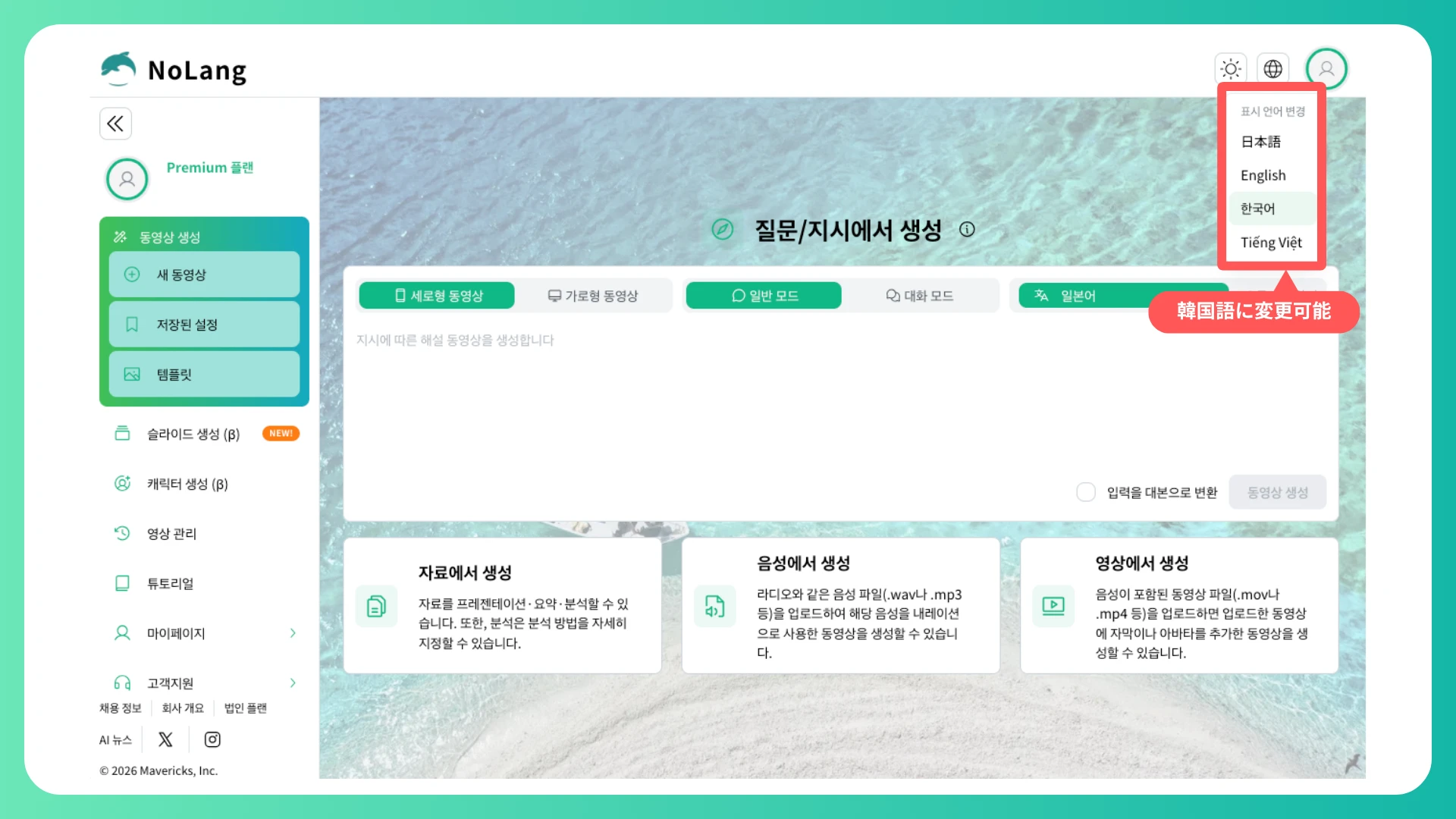
Switching languages is simple. Clicking the globe icon at the top right of the screen brings up a choice of “English / 日本語 / 한국어 / Tiếng Việt”. The display language changes on the spot, so Korean speakers can start creating videos from their very first visit to NoLang, with no translation tool or dictionary in between. For people who held back because they could not read the language of the tool, the barrier to getting started is gone.
Everything from the interface to video generation now works in Korean
The main value of this update is that the Korean interface joins the Korean generation features NoLang already had. The tool itself, the script, the narration, the subtitles, and the fonts are now all available in Korean, which for the first time makes a production environment that runs entirely in Korean.
Korean-speaking users can go from login to publishing a video in their own language, without passing through Japanese or English at any point. There is no need to look words up or ask a bilingual colleague what a menu means, which both speeds up production and cuts translation costs. When a Korean head office and a Japanese subsidiary use NoLang as a shared tool, each member works with the same screens in their own language, so joint production across a global team runs more smoothly than before.
From creators in Korea to companies working across Japan and Korea
The Korean interface widens what NoLang can be used for. Companies and individual creators in Korea can produce product introduction videos, internal training videos, and short social media videos in Korean and publish them to their home market. For marketers at Japanese companies targeting Korea, it is now practical to produce tourism promotion videos, product introductions, and brand story videos in Korean at volume, aimed at the roughly 9.45 million Korean visitors to Japan each year and a steadily growing cross-border e-commerce market.
For individuals and labels promoting K-POP and Korean culture, NoLang can serve as a base for producing artist introductions, song commentary, and fan content in Korean for an audience of some 150 million Korean-culture fans worldwide. Korean communities in Japan and educational institutions can use it to bring Korean-language announcements, language learning material, and cultural videos in-house. Global companies with offices in both countries can have their Japanese and Korean teams create videos together using the same tool in their respective languages, keeping the brand message consistent while localizing it. Local governments and tourism associations working on inbound travel can also have staff from Korea create tourist guides and facility introductions for Korean visitors directly in their own language.
What comes next
With this update, NoLang supports four interface languages: Japanese, English, Vietnamese, and Korean. Mavericks will continue to add supported languages as part of its global expansion strategy.
Footnotes
-
Record China, “Korean is used by 77.2 million people worldwide, the 13th most spoken major language” (in Japanese) (announced by Korea’s National Institute of Korean Language) ↩
-
Japan National Tourism Organization (JNTO), “Korean market: statistics on visitors to Japan” (in Japanese) (2025 preliminary figures) ↩
-
LIFE PEPPER, “Analysis report on Korea’s e-commerce market” (in Japanese) (market size as of 2024) ↩
-
Market Research Future, “K-POP event market report” (in Japanese) (industry forecast as of 2025) ↩