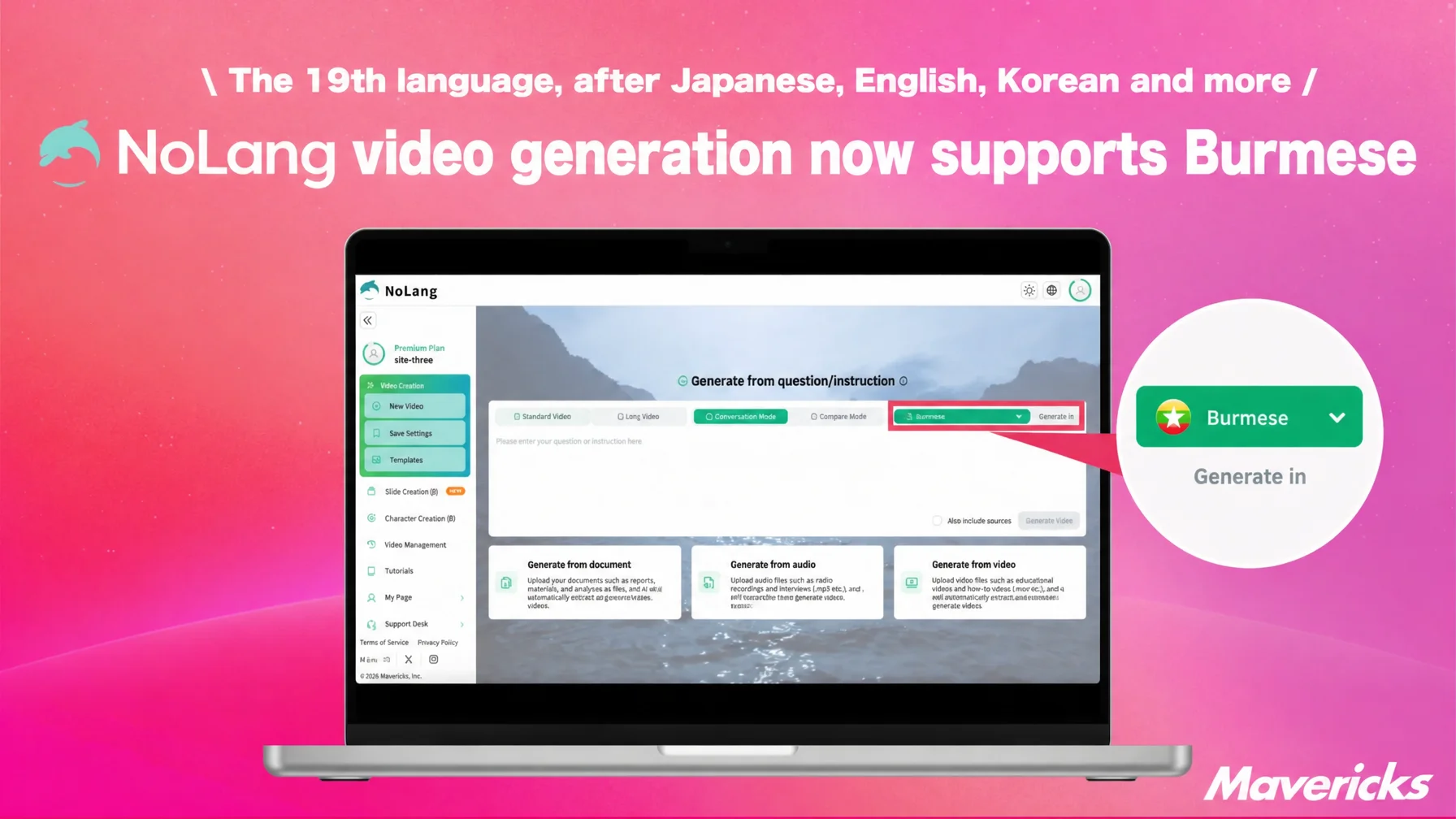
Mavericks, Inc., the Japanese company behind the video generation AI NoLang, has added Myanmar (မြန်မာဘာသာ), also known as Burmese, to the languages NoLang can generate videos in. It joins Japanese, English, Korean, Vietnamese and others as the 19th supported language. Users type a prompt in Japanese, and the AI produces the Myanmar script, the Myanmar narration audio and subtitles rendered in the Myanmar script font in a single pass. Companies, local governments and schools can now produce internal training videos for Myanmar technical intern trainees and Specified Skilled Workers, public information for Myanmar residents, and marketing videos for the Myanmar market in-house, without going through a translation agency or local staff.
Demand for Myanmar-language video is growing fast: 160,000 residents, up 45% year on year
Myanmar (Burmese) is the official language of the Republic of the Union of Myanmar, used widely by its roughly 54 million people, and it is spoken as a first language by more than 33 million people worldwide. The language is now gaining ground inside Japan as well. According to the Immigration Services Agency’s statistics on foreign residents, about 160,362 Myanmar nationals were living in Japan as of the end of June 2025, the eighth largest group by nationality. That is an increase of about 45.4% from the same point a year earlier, the sharpest rise among the major nationalities1. The Ministry of Health, Labour and Welfare’s employment survey for foreign nationals, covering the end of October 2024, shows the number of Myanmar workers rising about 61% year on year and about 220% over the past five years, the highest growth rate of any nationality2. Intake of Specified Skilled Workers has also grown quickly in nursing care, food service, food and beverage manufacturing and building cleaning, pushing Myanmar into the top three nationalities3.
At the same time, the infrastructure that local governments and companies use to communicate in Myanmar lags well behind English, Chinese and Vietnamese. A Tokyo Metropolitan Government survey on multicultural coexistence found strong demand among Myanmar-speaking residents to receive information in their native language, yet only a limited number of local governments and companies can meet it4. Myanmar is also treated as a priority language in the occupational safety and health training materials that the Organization for Technical Intern Training and the Ministry of Health, Labour and Welfare provide for foreign workers5. Even so, producing Myanmar-language video materials tailored to a specific workplace has meant hiring a Myanmar translator, a narrator and a subtitle editor separately, which is difficult to justify in both cost and staffing.
This NoLang update answers exactly that gap: demand is rising quickly, but organizations on the ground have had no practical way to produce Myanmar-language video in-house.
NoLang video generation now supports Myanmar, its 19th language
With this update, Myanmar (မြန်မာဘာသာ) joins the languages NoLang can generate videos in. It follows Japanese, English, Korean, Vietnamese, Chinese (Simplified and Traditional), Thai, Indonesian and Hindi, among the languages added step by step so far, bringing the total to 19.
Users enter the theme and content of the video they want as a prompt, and the AI writes the Myanmar script, generates Myanmar narration audio and adds subtitles in the Myanmar script, producing the finished video end to end. A Japanese-speaking staff member who cannot read or write Myanmar can give instructions in Japanese and still end up with video content ready for a Myanmar-speaking audience.
Uses range from trainee education to local government and companies expanding into Myanmar
Myanmar-language video support opens up a wide range of uses in Japan and abroad.
The first is internal training video for Myanmar technical intern trainees and Specified Skilled Workers. Turning work rules, safety and health training, task manuals and harassment prevention training into video in the workers’ native language delivers content that did not fully land in Japanese or English. Ministry of Health, Labour and Welfare statistics indicate that the rate of work-related deaths and injuries per thousand foreign workers is about twice the average for Japanese workers, so safety education in the native language directly supports accident prevention. In nursing care, food service, food and beverage manufacturing, construction and building cleaning, where intake of Myanmar workers is expanding rapidly, producing Myanmar-language training video in-house has become an urgent management issue.
The second is public information for Myanmar residents. Local governments can publish video in Myanmar on garbage disposal rules, disaster preparedness, childcare support, health checkups and administrative procedures, delivering in a short time information that is hard to convey through printed material or text alone. It can sit alongside plain Japanese as another piece of multicultural coexistence infrastructure.
For companies expanding into Myanmar or marketing to the Myanmar market, headquarters in Japan can quickly produce brand videos, product introductions and recruiting videos for local subsidiaries and roll them out locally without a translation agency. Advertising and social media programs can also produce a steady stream of content that reaches Myanmar speakers. Educational institutions, Japanese language schools and sending organizations can create teaching materials in Myanmar covering pre-departure orientation, everyday manners in Japan and medical and emergency response, which helps learners understand the material and stay with their programs.
Even a staff member who works only in Japanese can go straight from a prompt to video content of a quality suited to Myanmar-speaking viewers.
Looking ahead
With Myanmar support, NoLang can now generate videos in 19 languages. Mavericks will continue to add languages that users ask for, as well as the native languages of foreign communities whose presence in Japan is growing quickly. As infrastructure for multilingual video production centered on Japan and Asia, NoLang will keep supporting communication across language barriers.
Footnotes
-
Immigration Services Agency, “Number of foreign residents as of the end of June 2025” (in Japanese) (about 160,362 Myanmar residents, eighth by nationality, up about 45.4% year on year) ↩
-
Ministry of Health, Labour and Welfare, “Summary of notifications on the employment of foreign nationals, as of the end of October 2024” (in Japanese) (47,498 Myanmar workers, up 61% year on year, up about 220% over five years) ↩
-
Global Saiyo Lab, “Intake of Specified Skilled Workers by nationality” (in Japanese) (Myanmar third by nationality, rising sharply in nursing care, food service, food and beverage manufacturing and building cleaning) ↩
-
Tokyo Multicultural Portal Site, “Survey report on providing information to foreign residents” (in Japanese) ↩
-
Ministry of Health, Labour and Welfare, “Occupational safety and health measures for foreign workers” (in Japanese) and Organization for Technical Intern Training, “Safety and health training materials” (in Japanese) (multilingual materials including Myanmar) ↩