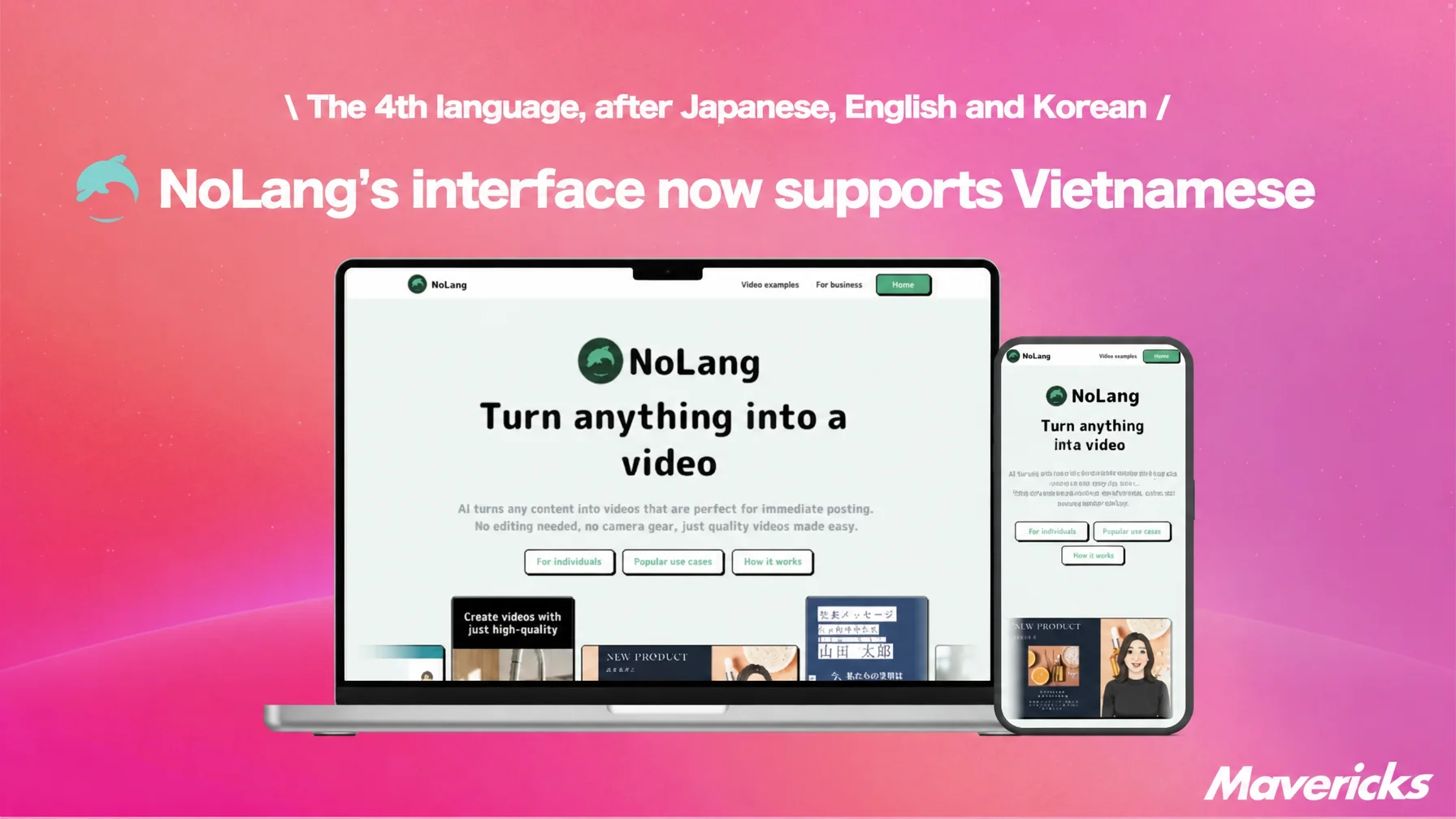
Mavericks, Inc., the Tokyo-based company behind the video generation AI NoLang, has added “Tiếng Việt” (Vietnamese) to NoLang’s display languages. Together with Japanese, English and Korean, the interface is now available in four languages. Combined with the Vietnamese script generation, narration voice synthesis and tone-mark-ready subtitle fonts that NoLang already offered, this makes it possible for the first time to work entirely in Vietnamese, from the operating screen through to the finished video. Vietnamese-speaking creators, Vietnamese subsidiaries of Japanese companies and Japanese employers of foreign workers can now produce high-quality videos in their own language, without translation work or a two-person workaround.
A market of roughly 100 million people, 630,000 residents in Japan, and rising demand for Vietnamese content
Vietnam has a population of about 100.3 million and remains one of the fastest-growing economies in ASEAN, having raised its 2025 GDP growth target to 8.0-10%1. In Japan, the number of Vietnamese residents reached approximately 634,361 at the end of 2024, the second largest group after Chinese nationals2, and Vietnamese visitors to Japan hit a record of roughly 678,600 in 20253. Vietnam’s own e-commerce market is expected to grow to around 31 billion US dollars (about 4.9 trillion yen) in 20254. Demand for content delivered in Vietnamese has never been higher.
In practice, though, the interface stood in the way. Vietnamese staff at subsidiaries in Hanoi or Ho Chi Minh City preparing a product video for head office, a Vietnamese team leader producing safety training for technical intern trainees, a Vietnamese creator in Japan making information videos for the community: if the menus and buttons of the production tool stay in Japanese or English, a native Vietnamese speaker simply cannot read the screen. The usual outcome was a two-person setup in which someone who reads Japanese operated the tool while the Vietnamese speaker contributed only the script and the narration, splitting a process that should finish on site into rounds of back-and-forth with a translator.
Removing that language barrier at its root means putting the production tool’s own interface into the user’s native language.
NoLang’s interface now supports “Tiếng Việt” (Vietnamese)
Against that background, “Tiếng Việt” (Vietnamese) has been added to the display languages of the video generation AI NoLang. It joins the three languages supported until now, Japanese, English and Korean, as a fourth option, bringing NoLang to four interface languages.
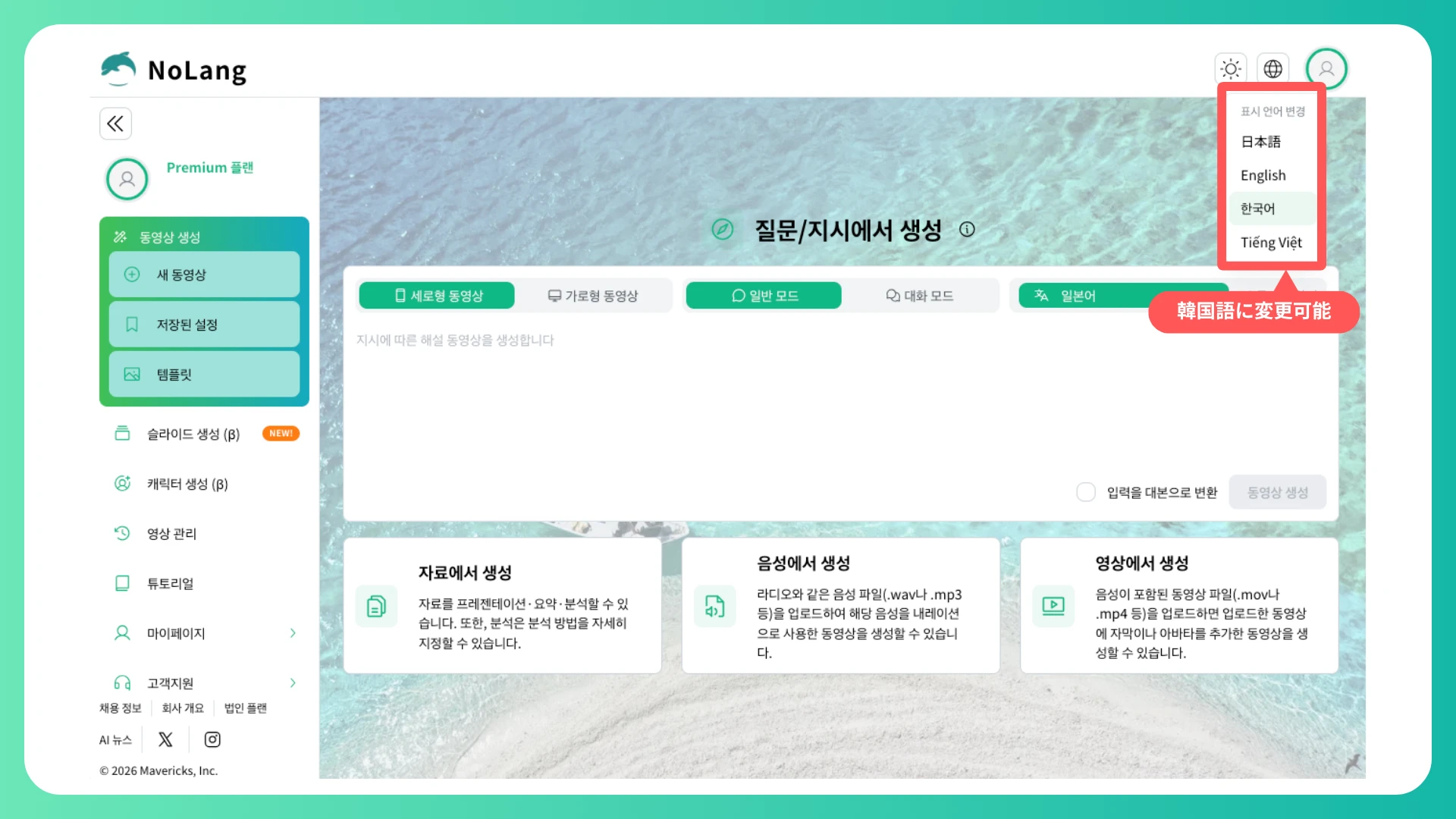
Switching languages is simple. Clicking the globe icon at the top right of the screen brings up a choice of English, 日本語, 한국어 and Tiếng Việt. The display changes on the spot, so Vietnamese speakers can start producing videos from their very first contact with NoLang, without a translation tool or a dictionary in between. For people who previously held back because they could not read the language of the tool, the barrier to getting started is gone.
Everything from the operating screen to the finished video, all in Vietnamese
The greatest value of this Vietnamese interface support is that it combines with the Vietnamese generation features NoLang already had. The production tool (UI), the script, the narration, the subtitles and the fonts are now unified in Vietnamese, so a production environment that runs entirely in Vietnamese exists for the first time.
Vietnamese speakers can go from login to publishing a video without passing through Japanese or English at any point. There is no need to look up a dictionary or ask a bilingual colleague what a menu item means, which translates directly into faster production and lower translation costs. When a team at a Vietnamese head office and a Japanese subsidiary use NoLang as a shared tool, each member works on the same screen in their own language, making joint production across a global team smoother than before.
From Vietnamese subsidiaries to communities in Japan: a wider range of uses
Vietnamese interface support opens up NoLang’s range of applications considerably. Companies and individual creators in Vietnam can produce product videos, internal training videos and short social videos in Vietnamese and deliver them to a domestic market of roughly 100 million people and to major platforms such as TikTok, Facebook and YouTube. Marketers in Japan targeting Vietnam now have an environment for producing tourism, product and brand-story videos in Vietnamese at volume, aimed at the roughly 670,000 Vietnamese visitors to Japan and at the fast-growing Vietnamese e-commerce market, which is expected to become the second largest in ASEAN by 2030.
The same applies to Japanese companies expanding into Vietnam or running local subsidiaries. Employee training, internal announcements and product manual videos for sites in Hanoi, Ho Chi Minh City and elsewhere can be edited and revised by local staff in Vietnamese, while the Japanese head office still leads. Shifting a workflow that depended on translation agencies or bilingual staff in Japan toward the front line is a significant benefit. In the context of communicating with the Vietnamese community in Japan, municipalities and support organizations can deliver guidance on administrative procedures, daily-life information and disaster preparedness directly as Vietnamese videos to the roughly 630,000 Vietnamese residents, the second largest group by nationality.
Internal training at Japanese companies that employ foreign workers is another area with room to grow. About 518,000 Vietnamese people work in Japan, 25.3% of all foreign workers and the largest group by nationality, so producing safety training, work manuals and compliance training in-house as Vietnamese videos leads directly to lower accident risk and faster onboarding. For inbound tourism work at municipalities and tourism associations, local staff and Vietnamese residents can create sightseeing guides, facility introductions and multilingual information in their own language. Educational institutions and Japanese language schools can use it to produce study materials, school guides and orientation videos in Vietnamese for Vietnamese students and technical intern trainees. And for companies looking at ASEAN, Vietnamese is one of the region’s major languages, which makes producing Vietnamese content in-house a strong first step into Southeast Asia.
Looking ahead
With this update, NoLang now supports four interface languages: Japanese, English, Korean and Vietnamese. Mavericks will continue to expand the range of supported languages as part of its global strategy.
Footnotes
-
Worldometer, “Vietnam Population (2025)” (in Japanese) / VIETJO Vietnam News, “Vietnamese government raises 2025 GDP growth target to over 8%” (in Japanese) ↩
-
Immigration Services Agency of Japan, “Number of foreign residents as of the end of 2024” (in Japanese), figures as of the end of 2024 ↩
-
JNTO Japan National Tourism Organization, “Statistics on visitors to Japan” (in Japanese) / Honichi Lab, “Statistics on Vietnamese visitors to Japan in 2025” (in Japanese) ↩
-
VIETJO Vietnam News, “Size of Vietnam’s e-commerce market in 2025” (in Japanese) / JETRO Business Briefs, “Trends in Vietnam’s e-commerce market” (in Japanese) ↩