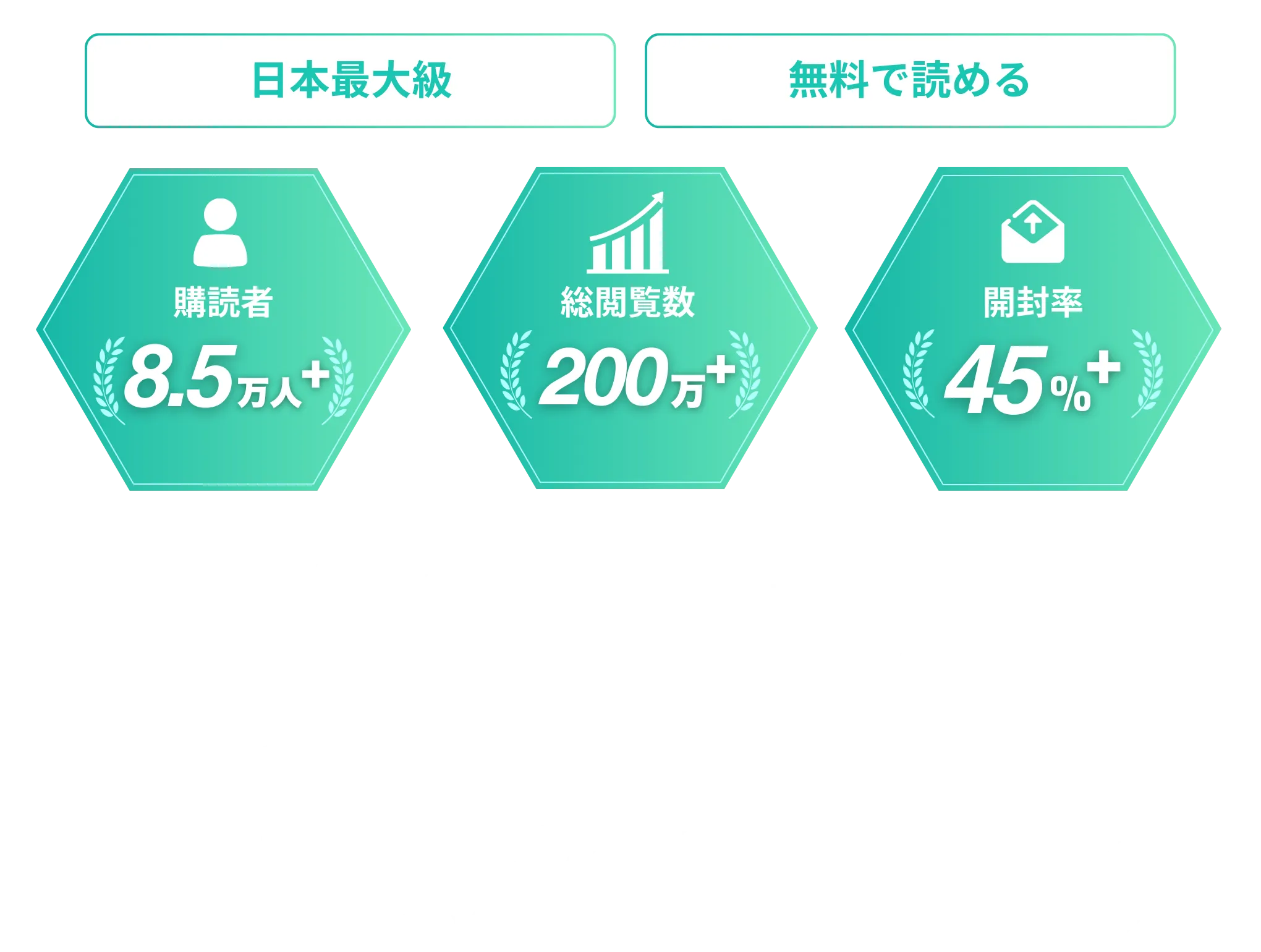
Mavericks, Inc. (Bunkyo City, Tokyo; Representative: Shota Okuno), the Japanese company behind the AI video generation service NoLang, is expanding its solutions for marketing, including the global expansion efforts of its customers. Since its release in July 2024, NoLang has grown quickly, passing 150,000 registered users and 60 corporate customers1. Companies simply feed in the text and document assets they already hold, such as large volumes of white papers or Japanese sales materials, and NoLang automatically generates a high-quality video with an AI avatar and narration in as little as a few seconds. By summarizing long white papers, delivering videos personalized for each customer, and generating multilingual videos on the spot, NoLang converts documents and text that readers have to work through into video content they can simply watch. That lifts landing page conversion rates, improves email open rates, and makes low-cost test marketing overseas possible, contributing directly to revenue growth.
Try NoLang for YourselfTurning existing content assets into video with NoLang to maximize marketing results
NoLang is an AI video generation service, the first of its kind in Japan according to Mavericks’ own research, that produces a high-quality video in as little as a few seconds from text, PDF or PPTX documents, or a website URL. Since its release in July 2024, registered users have passed 150,000 and more than 60 companies now use the service, making it one of the largest generative AI products in Japan1.
Video is now a standard part of marketing, and the variety and volume of video used across social media, advertising, and UGC grows every year. To support that shift, Mavericks offers a way to reuse existing content assets by converting them into video through NoLang.
For example, a long white paper or deck can be condensed into roughly 30 seconds of video that conveys why the document is worth downloading, lowering the psychological barrier to a download. Connected to a company’s own CRM data, NoLang can generate videos in which an AI avatar speaks to each customer by name and addresses their specific interests. Japanese text and sales materials can also be turned fully automatically into videos with native-quality narration in other languages.
These videos turn information that used to require active reading into content people can take in passively. Lowering the cost of getting the information keeps prospects from dropping off and helps them understand the content. The presence of a person, represented by an AI avatar, also builds trust and conviction in what is otherwise a purely digital touchpoint. The result is concrete business outcomes: higher landing page conversion rates, better email open rates, and faster test marketing in overseas markets.
Use case 1: Maximizing conversion rates by turning white papers and website content into video
Distributing white papers and publishing article content on a website are central to lead generation in marketing, but both share the same two problems: the psychological hurdle for the user and a high drop-off rate. There is a limit to how much value text and still images on a landing page or blog post can convey, and many prospects leave right before they download a document or click an affiliate link. NoLang addresses this by converting existing documents and web articles into video instantly, either with one click in the Chrome extension or by dragging and dropping a file.
Why teams choose NoLang: professional quality produced in-house in tens of seconds
Unlike general video production tools, NoLang starts by having AI analyze a document or text and build the structure. No specialist editing skills are required. If there is a white paper in PDF form or a web page to explain, the video is finished through the following simple flow.
How video creation works with NoLang
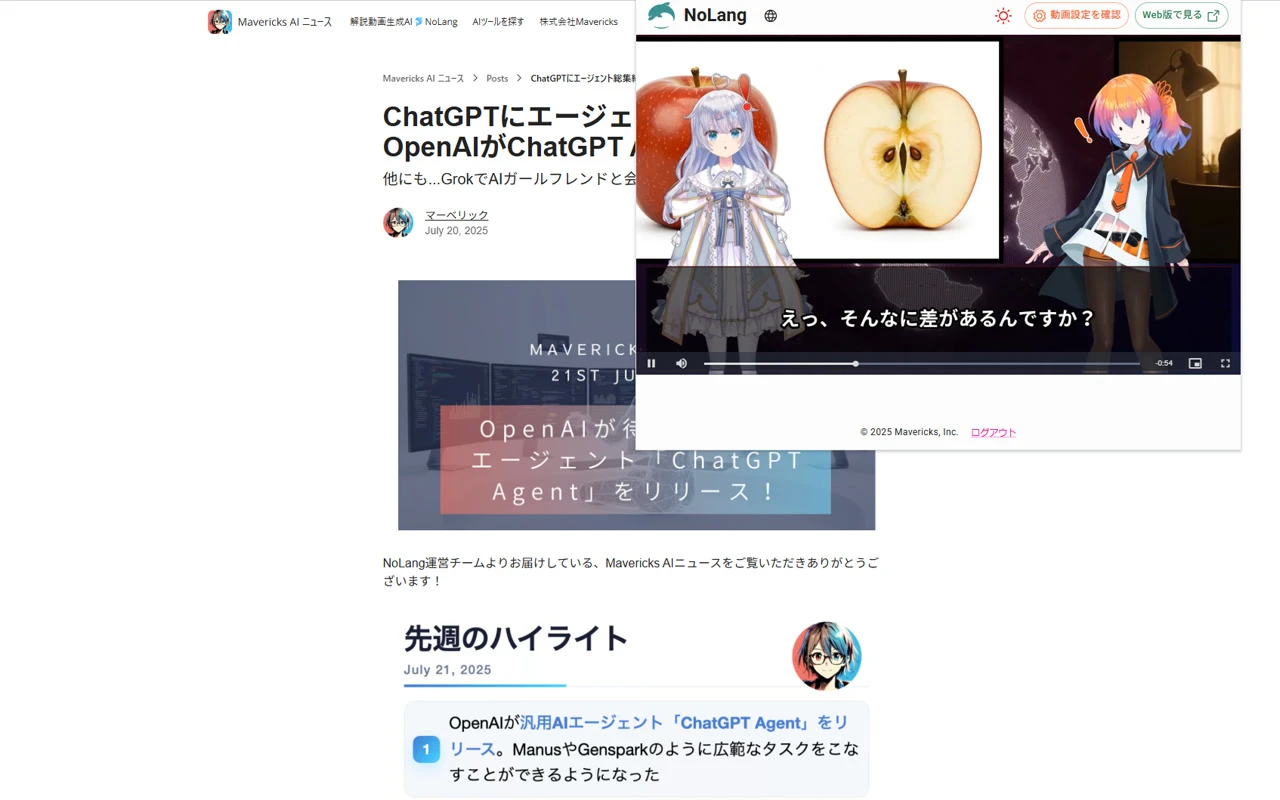
- Provide the source information: open an article in the browser with the Chrome extension, enter the URL of a product page in the prompt field, or upload a PDF document to NoLang. That is all the preparation needed.
- AI analysis and generation: the AI extracts the key points from the document or text and generates the structure, script, and narration. The video is finished in tens of seconds.
- Editing and export: captions and images can be fine-tuned if needed, and a single button converts the video into a vertical short-form video.
Results after adoption
Video makes the substance of the content and the benefits it offers concrete, using a passive medium instead of asking people to read. Users can then move on to a form or a product page with confidence, which is expected to raise landing page conversion rates and increase time on site for web media. NoLang stands out for its high-fidelity AI avatars that behave like real presenters, its template feature for creating UGC-style videos, and its wide range of natural voices with real intonation. Unlike a plain slideshow, it can convey the credibility of an expert explanation or the familiarity of an influencer review, so it holds the viewer’s interest across a wide range of uses, from establishing trust in B2B documents to prompting purchase intent in affiliate articles.
Because production effort drops sharply, teams can produce many versions of a video with different messaging for different targets and run fast A/B testing cycles. Switching the length between 30 seconds, one minute, and two minutes to compare retention, or changing the gender and age of the narration to find the right tone for a target audience, is straightforward. In newsletters and social media, video can be expected to deliver far higher click-through rates than text links, reactivating acquisition channels while reusing existing content assets.
Use case 2: Automated delivery of personalized video per customer through CRM integration, dramatically improving engagement and conversion
Email marketing and newsletters have traditionally relied on uniform, text-centric mass sends. Open rates fall as customers are flooded with information from every direction, and drop-off is high because the content does not feel relevant to them. A long message that does not match a recipient’s needs is not seen as worth reading and gets buried without ever being opened.
Using the NoLang API integration with data held in a CRM, companies can fully automate the generation and delivery of personalized video emails matched to each customer’s attributes and stage of consideration. In practice, the AI avatar can greet the customer by name in the video, or present the plan and case studies that best fit their industry and purchase history, creating a strong sense that the message was made for them.
Speaking to the individual captures attention immediately and dramatically improves email open rates and click-through rates. It also drives high conversion in areas where text-based approaches got no response, such as reviving dormant customers and upselling or cross-selling to existing ones, contributing directly to revenue. This is made possible by the flexible API integration in NoLang and by real AI avatars that reproduce natural, human-like behavior. Even thousands or tens of thousands of individual videos can be generated in bulk, cheaply and quickly, making personalized video marketing practical where manual video production made it impossible on cost and effort.
Use case 3: Converting existing Japanese videos into English and other languages instantly for low-cost overseas test marketing and inbound demand
Many companies treat overseas expansion and capturing inbound demand as urgent, yet the language barrier holds back their creative output. With video in particular, simply adding translated subtitles is hard to read on a small smartphone screen and tends to make viewers leave. The conventional alternative, arranging native speakers for each language and re-recording narration and re-editing, takes considerable cost and time, so multilingual marketing is often abandoned as not worth the investment.
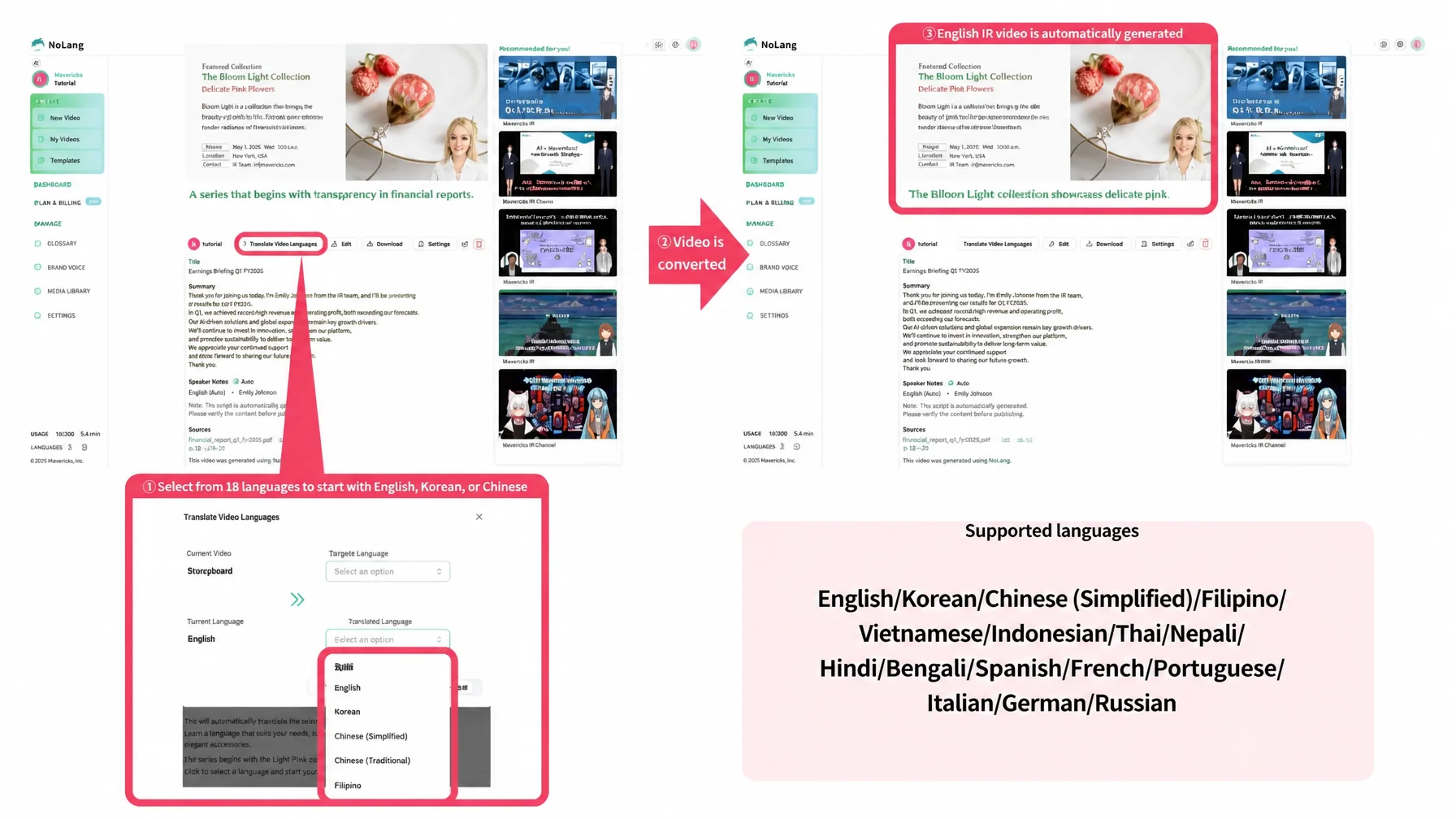
NoLang solves this by taking a domestic product or promotional video created in NoLang and generating a version in another language instantly, at the press of a button. It supports 18 major languages, including English, Chinese (Simplified and Traditional), and Korean, as well as Vietnamese, Thai, and Spanish, and the AI automatically generates a video with natural foreign-language narration that reflects the context.
Here is how the videos are actually created.
① Open the viewing screen of a Japanese video created in NoLang and select the button for converting aspect ratio and language.
② In the settings screen that opens, choose the target language from all 18 languages.
③ Select the generate button and, after a short wait, the video in the chosen language is finished automatically.
(Supported languages: English / Korean / Chinese (Simplified and Traditional) / Filipino / Vietnamese / Indonesian / Thai / Nepali / Hindi / Bengali / Spanish / French / Portuguese / Italian / German / Russian)
Localization work that used to take weeks is now finished in a few minutes. Because production is so much cheaper and faster, overseas A/B testing and other test marketing can be run quickly and at low risk.
What sets NoLang apart is that it goes beyond text translation and builds the video by integrating visuals and audio. The AI automatically adjusts the length of the footage and the timing of the subtitles to the intonation and speaking speed of each language, so even someone with no editing skills can produce a video that feels natural to local viewers.
What comes next
Mavericks will further strengthen API integration with CRM and marketing automation tools to fully automate video generation within marketing automation. The company will also expand features that meet the security standards and brand guidelines of enterprise customers, developing NoLang into a platform that changes business communication at the infrastructure level.
Try NoLang for Yourself