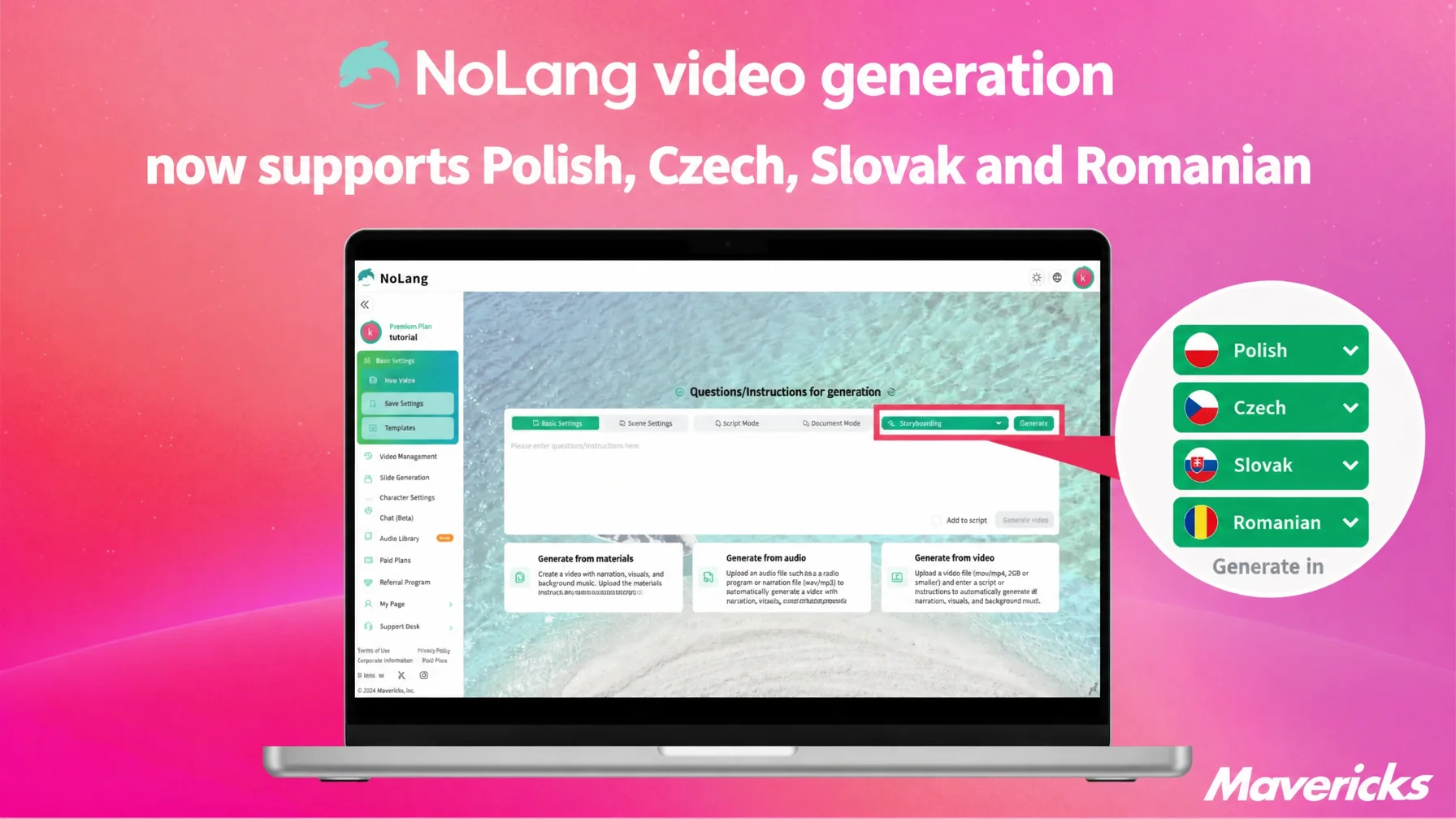
Mavericks, Inc., the company behind the AI video generation service NoLang, has added four Central European languages to NoLang’s video generation: Polish, Czech, Slovak and Romanian. Selecting one of them from the language menu produces a video with local-language narration and subtitles directly from Japanese source material, and the running time is adjusted automatically to match the speaking pace of the language. For companies that want to strengthen IR, training and marketing communication in Central Europe, this removes the need to route every video through a translation agency or a narration recording session.
Try NoLangGrowing demand for local-language content in an expanding Central and Eastern European market
Language is a well-known barrier to reaching and being understood in overseas markets. In a CSA Research (Common Sense Advisory) survey of 8,709 consumers across 29 countries, 76% said they want to buy products with information provided in their own language, and 40% said they will not buy from sites available only in other languages1. Polish, Czech, Slovak and Romanian each have a language system distinct from English, so publishing content in the local language has a direct effect on how well information lands.
The Japan External Trade Organization (JETRO) survey “FY2025 Survey on Business Conditions of Japanese Companies Operating Overseas (Europe)” (conducted August 20 to September 19, 2025, covering 1,449 Japanese companies operating in Europe, with 778 valid responses for a 53.7% response rate) points in the same direction: among companies operating in Central and Eastern Europe, the median base pay increase is 4% or higher, and in manufacturing the share of companies expecting improved operating profit rose 10.6 points year on year to 44.7%2. Local business activity is steadily picking up.
Video is drawing attention in these markets as a way to convey content intuitively across the language barrier. In practice, however, localizing a video or a set of slides through a translation agency and a narration recording every time is costly in both time and money. Against that background, Mavericks worked to expand the range of languages NoLang supports.
NoLang video generation now covers four Central European languages, generated with one button
With this update, NoLang video generation supports four new languages: Polski (Polish), Čeština (Czech), Slovenčina (Slovak) and Română (Romanian).
Generating a video is simple. In the language settings menu on the video generation screen, choose one of the four newly added Central European languages as the output language, and NoLang produces an avatar video in that language. This language menu is shared across every generation mode NoLang supports, including text input, PDF documents and audio files, so teams can start producing videos for Central Europe without changing how they already work.
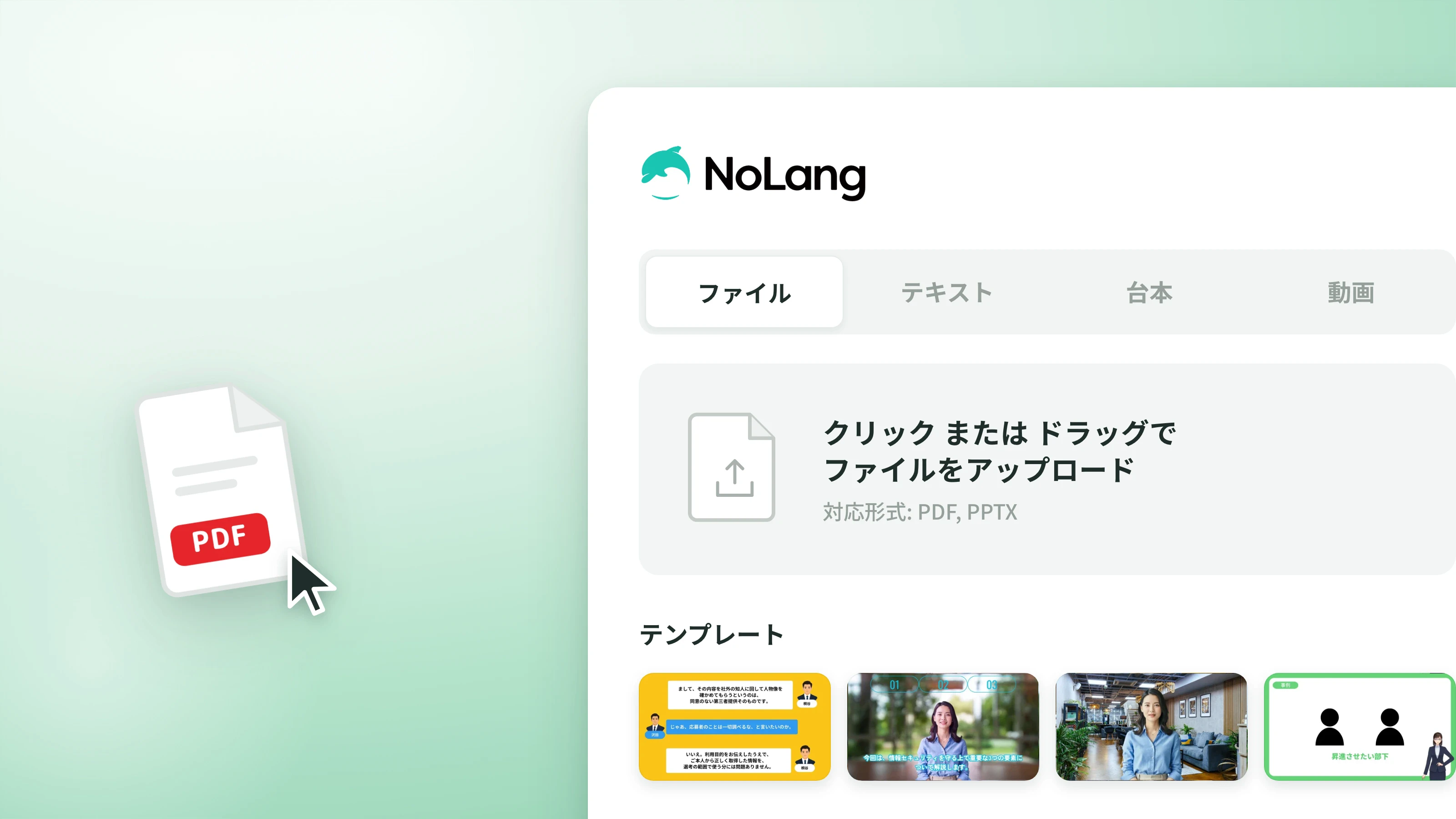
Upload Japanese documents and get a Central European language video
NoLang generates videos in which an avatar explains the content, from a range of inputs: typed text, questions or instructions, documents such as PDFs, and audio or video files with sound. Choose Polish, Czech, Slovak or Romanian as the output language, and NoLang produces a video with a local-language script, narration and subtitles from Japanese manuscripts and documents.
The four new languages also work in the PDF-based generation modes: Present documents, Summarize documents and Analyze materials. Existing Japanese documents such as financial results decks and product materials can be uploaded as they are and turned into explanatory, summary or analysis videos ready for a Central European audience.
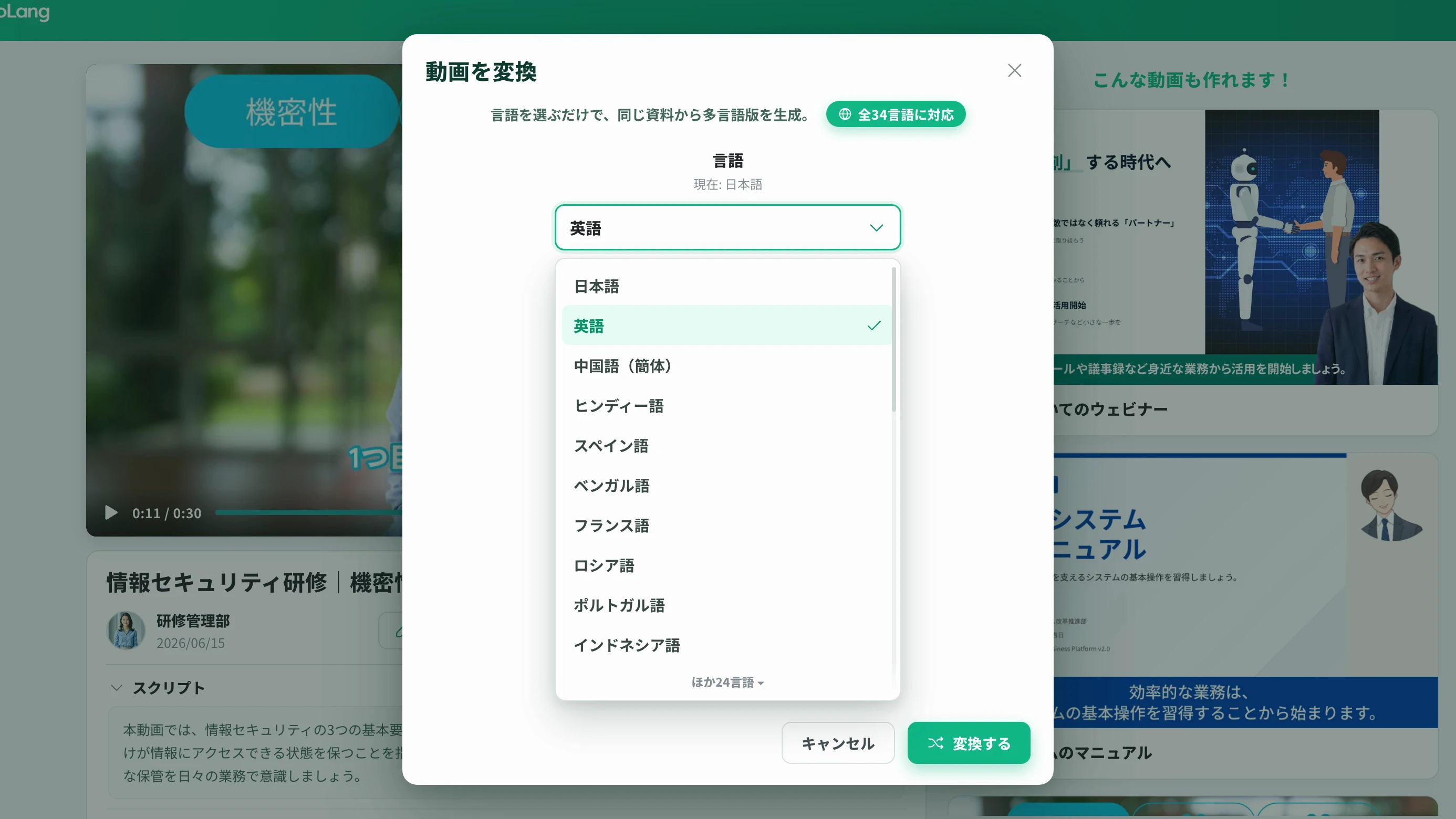
Videos that have already been generated can also be converted. The Convert button on the viewing screen turns a finished video into Polish, Czech, Slovak or Romanian in one click. The operation ends with “Select target language,” so there is no need to rebuild a Japanese video from scratch: a video already made in NoLang can be converted straight into a Central European version.
Subtitles that render correctly, and running time adjusted to each language
The subtitles shown in the video use fonts that cover the Latin script used by Polish, Czech, Slovak and Romanian. Characters specific to each language — ł and ż in Polish, č, š and ř in Czech and Slovak, ă and ț in Romanian — render correctly without breaking.
NoLang also calculates narration playback time and the expected length of the video from the standard speaking pace of each language (characters per minute) at generation time, and that mechanism now covers Polish, Czech, Slovak and Romanian as well. Because playback time is adjusted for the differences in character volume and word grouping between languages, the result avoids unnatural dragging or rushed delivery, and narration and subtitles flow at a natural tempo.
From manufacturing training to cross-border e-commerce: where Central European videos fit
Support for these four languages widens the range of videos that can be produced directly in NoLang. Reducing the time and cost of translation agencies and narration recordings makes it easier to communicate with local employees and business partners based in Central Europe, which is one answer to the twin challenge of securing talent and controlling cost. For the Polish, Czech, Slovak and Romanian markets, NoLang can be used in situations like the following.
The first is IR disclosure for overseas investors. Upload a PDF of an existing Japanese financial results deck or integrated report, choose Polish, Czech, Slovak or Romanian as the output language, and NoLang produces an explanatory video for local investors. Disclosure in the local language can be timed to events such as earnings announcements, without a translation agency or a narration recording in between.
The second is education and training video for employees of manufacturers and automotive-related companies with sites in Central Europe. Feed in existing work manuals and training materials as they are, and NoLang produces a training video with local-language narration and subtitles that local employees can follow, so training content does not have to be rebuilt from scratch for each site.
Learn more about making training videosA third use is product introduction video for local partners and business contacts. Feed in an existing product catalog or service overview and NoLang generates a product video with local-language narration and subtitles, ready for meetings with local partners and explanations to business contacts.
A fourth is product video for cross-border e-commerce. Feed in text or documents covering product specifications and usage, and NoLang generates a product video with local-language narration and subtitles that can be published straight to a product page on an e-commerce site.
What comes next
Mavericks will continue to add languages in step with user demand, including the native languages of foreign communities whose presence in Japan is growing quickly. As multilingual video production infrastructure centered on Japan and Asia, NoLang will keep supporting communication across the language barrier.
Footnotes
-
CSA Research, “Can’t Read, Won’t Buy” (survey of 8,709 consumers across 29 countries; 76% said they want to buy products with information provided in their own language, and 40% said they will not buy from sites available only in other languages) ↩
-
Japan External Trade Organization (JETRO), “FY2025 Survey on Business Conditions of Japanese Companies Operating Overseas (Europe)” (in Japanese) (conducted August 20 to September 19, 2025, covering 1,449 Japanese companies operating in Europe, 778 valid responses, 53.7% response rate; median base pay increase of 4% or higher among Japanese companies in Central and Eastern Europe, and in manufacturing the share of companies expecting improved operating profit rose 10.6 points year on year to 44.7%) ↩