Enter a topic, and everything from video generation to posting on social media runs on its own.
Tamai started his own company in 1994 and spent 25 years helping small and midsize businesses attract customers through landing pages.
After selling that business he encountered AI, and today he builds and sells a course on automating video marketing with NoLang and Make.
“You don’t have to appear on camera, you don’t have to speak. Put in a script and you get a video.”
That ease of use was his way in. Now he places NoLang at the front of his entire marketing process and connects it all the way through to AI agents.
What happens when 25 years of customer-acquisition know-how meets AI? We asked Tamai about his practice.
Building and selling a system that mass-produces videos with NoLang
― What kind of work do you do?
I started my company in 1994, and from ‘96 I was building websites.
I spent all those years helping small and midsize businesses attract customers with landing-page-style sites, and around 2019, in my 25th year, a large company got in touch and said they wanted the business, so I thought “why not” and sold it.
After that I worked as a freelancer. And right around then the AI boom arrived.
That’s when I found NoLang, and while I was playing with it thinking how interesting it was, it hit me — this could be used for video marketing.
― So you sold the business and then rode the AI boom. How did you end up at NoLang?
I’d been telling people “use video to attract customers” for years, but the average company president just can’t do it.
Shooting it yourself, speaking, editing, uploading one a week — the bar is far too high.
But with NoLang you don’t have to appear, you don’t have to speak; as long as you write a script, you get a video.
I thought, this solves in one go all the inconvenience I’d been feeling back when I was talking about marketing.

▼Tamai’s YouTube channel is here (in Japanese)


― Not having to appear or speak really is a big advantage. How are you using NoLang now?
At the end of last year I put together a course that combined how to use NoLang with automated posting, and sold it to my own mailing list.
More than ten people bought it.
I provide them with a system for mass-producing videos in NoLang and posting them to social media automatically.
One of the students keeps using it and keeps telling me “this is easy,” and that has become the center of what I do now.
Why NoLang works as a marketing tool
― What made you decide on NoLang?
First, the Japanese UI and the fact that it’s a tool developed in Japan.
That matters quite a lot — with an English tool it’s hard even to find the documentation, and you end up having to write your input in English too.
The other thing is the simplicity: put in one line and you get a video. I was genuinely impressed that a single line really does produce a video (laughs).
At first it was purely play, but as I used it the purpose gradually came into view.
― So it started as something you tried for fun. Is there a feature you’ve been especially grateful for as you’ve gotten deeper into it?
The addition of script mode was a real help.
Before that, I wanted to lead viewers to a CTA, but the endings would scatter and it wouldn’t come out the way I intended.
Now I can make the video follow the script, so I can create videos that properly include a prompt like “please sign up for this service.”
That’s the crux when you’re using it for marketing, so that update was huge.
― So script mode is especially important for marketing use.
Yes. My basic video-creation flow now is to write the script in ChatGPT or Gemini and then pour it into NoLang.
For long videos I used to have a separate process — generate the audio in Fish Audio, record with OBS — but recently I had NoLang learn my own voice and it reproduced it with quite a lot of accuracy, so I’ve started thinking, ah, I can do this in NoLang too.
How to build a fully automated video posting system
― What does your workflow look like, from producing a video to posting it?
When the API became available, I tried automating things.
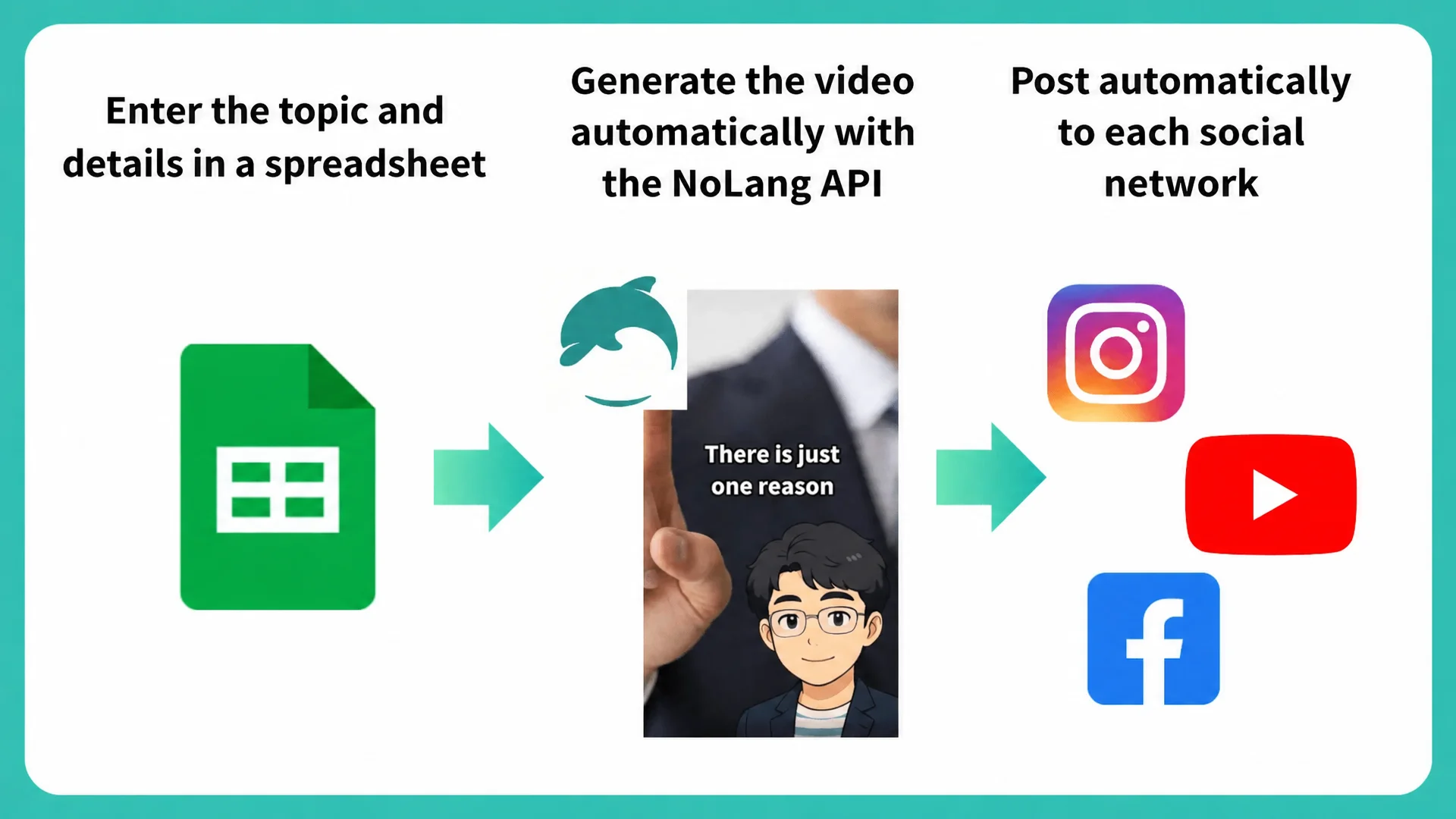
Using Make, I enter the topic and a video ID into a Google spreadsheet, and the video is generated automatically; then it copies the generated URL, downloads the video and posts it — that whole flow now runs.
If you stagger the timers by ten minutes and run it three times, a single video goes from generation to posting on its own.
Facebook, Instagram and YouTube are all posting automatically, so once I put in the topic, everything after that is automatic.
― Putting in a topic and having everything else be automatic is quite a system. Do you provide that system to your course students as well?
Yes. I’ve built it as steps: they start with the manual route of creating a video and scheduling the post, and once they’re used to it they move on to the fully automated system.
One student has kept posting one short video a day with NoLang, and it has added up to about 70,000 views.
When I asked, that person said “inquiries have gone up,” and I became convinced this definitely works as marketing.
― Leading all the way to inquiries really does prove the marketing effect. Once short videos build awareness, how do you picture connecting that to the next step?
First people get to know you through a short video, then a slightly longer video adds more explanation, and then you lead them to a landing page and invite them to register their email address.
At that point NoLang’s videos become the front door to the whole marketing process, and you can realize a setup where an AI agent sells to the prospects it brings in.
I think it’s the single most important service at the heart of that flow.
Thirty videos made in just thirty minutes
― How long are the videos you actually make?
Short videos of 60 to 90 seconds are easy to make, but with the YouTube algorithm you also need long videos of 10 or 15 minutes.
The thing is, if you make a full 10 minutes in NoLang in one shot, the AI voice is monotonous and it gets a bit tiring to listen to.
So what I’m thinking about now is making several 60-to-90-second videos and combining them into one long one.
Being able to take it section by section and join them later would be very welcome.
― Making it section by section and joining it later does sound like it would make video creation easier. Where do you feel NoLang’s strength lies compared with other tools?
There are people running courses that say make 30 days’ worth of short videos in Canva and upload one every day, but all that inserting work is a pain.
With NoLang you write a 30-line script, have every line turned into a video, set up scheduled posting, and you’re done in 30 minutes.
That’s the real strength — being able to step straight into mass-producing short videos with just one tool is something few other services offer.
― Thirty short videos in thirty minutes really is overwhelming.
There are various other tools that can make videos, like Genspark and NotebookLM, but each of them takes a bit of work.
Each one falls a little short — they haven’t quite become the final tool.
When the output becomes even slightly troublesome, you inevitably stop.
NoLang clears that hurdle, though, so that strength of anyone being able to make a video easily is something I really hope you never let go of.
What kind of automation is Tamai aiming for next?
― Could you tell us what you want to spread through your course going forward?
With social media marketing, there’s this image that you have to learn all sorts of know-how about how the Instagram algorithm works and so on.
But if you use NoLang’s automation setup, you can expand awareness without mastering that fine-grained know-how.
That message hasn’t gotten out yet, so only some people know about it.
― The fact that many people don’t know about it yet also means there’s a lot of potential. What kind of people tend to take your course?
Mostly company presidents in their 40s and 50s. People who know they have to do marketing but aren’t confident about producing video.
For them, “you can make videos easily” is the biggest differentiator no other tool can offer.
They’re a group that cares about real quality more than playfulness, so “fast to make, and effective” lands directly with them.
― It sounds like exactly the right fit for those presidents. What are you planning next?
The automated video generation flow is finished, so right now I’m at the stage of working out how to sell that system,
and on top of that, I’ve combined it with AI agents to build a flow that connects everything from short videos to the landing page, the sales conversation there, and payment.
I call this the AI sales engine.
My whole concept works because NoLang functions as the front door to that flow.
That strength of being able to step into mass-producing short videos with a single tool is something I really hope you keep valuing.
― Thank you very much for sharing such valuable stories with us today! We’ll keep developing NoLang so that it holds on to the “make videos easily” concept while letting you create videos that deliver even better results. We look forward to continuing to work with you!
[Editor’s note]
What stayed with me most from this interview was the story of a student who kept posting one video a day and ended up with 70,000 cumulative views and more inquiries. Rather than using NoLang only for himself, Tamai turns it into a system and delivers it to others. That perspective feels like something only someone who has faced marketing for so many years could have.
Just as he said — never let go of the strength of “you can make videos easily” — we came away determined to keep polishing the value of anyone being able to create videos with ease.
Profile: Noboru Tamai
■Website (in Japanese)

■YouTube channel (in Japanese) HDN.jp | Digital Asset Base
Unauthorized use, reproduction or duplication of the text and specific content published in this article is strictly prohibited.