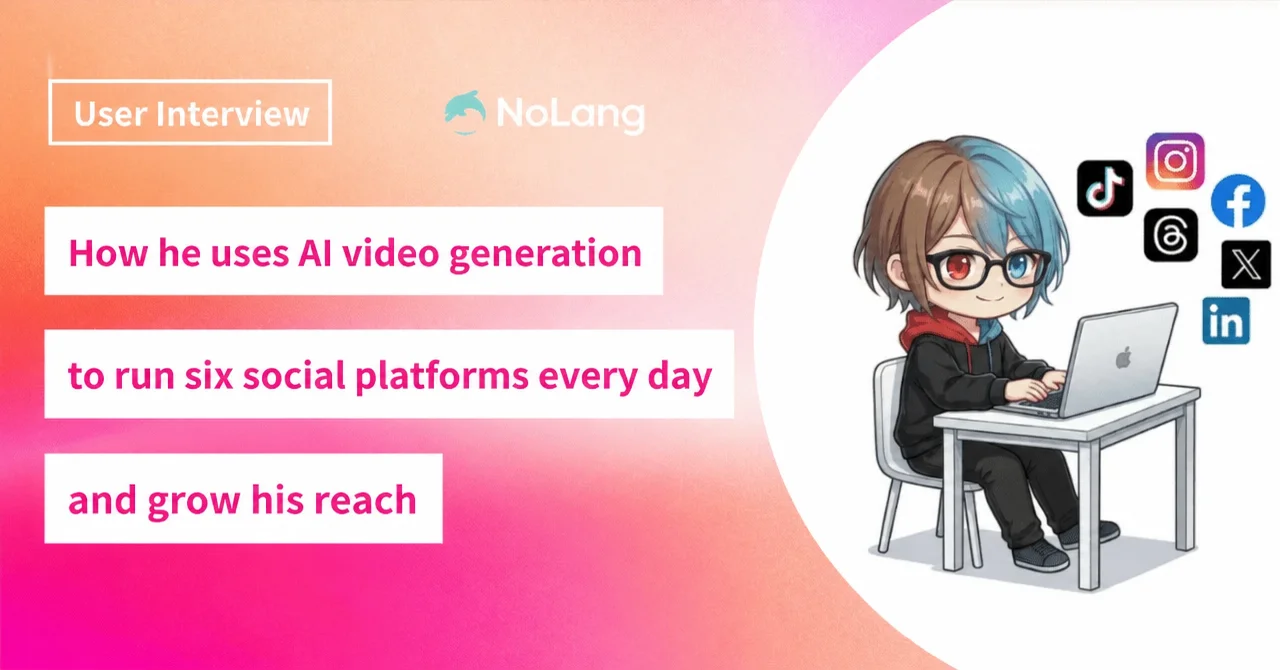
Takashima works as a time management consultant.
To get his name known in a highly specialized field, he started posting videos — mainly YouTube Shorts — and today he updates several channels and six social platforms every single day.
He has trained ChatGPT relentlessly, and by combining it with NoLang he keeps that daily posting across six platforms down to under an hour a day.
We asked Takashima how he uses NoLang and how he thinks about producing content at volume in the age of AI.
Posting videos to get better known
― What kind of work do you do?
I work as a time management consultant.
I specialize in managing time, and there really aren’t that many people working in the same field.
So the first thing that matters is getting people to know I exist, and I started posting videos on social media to raise my profile.
― So the posting is about getting better known. How exactly do you go about it?
I run three channels now, mainly with YouTube Shorts.
▼ Takashima’s YouTube channel (in Japanese)

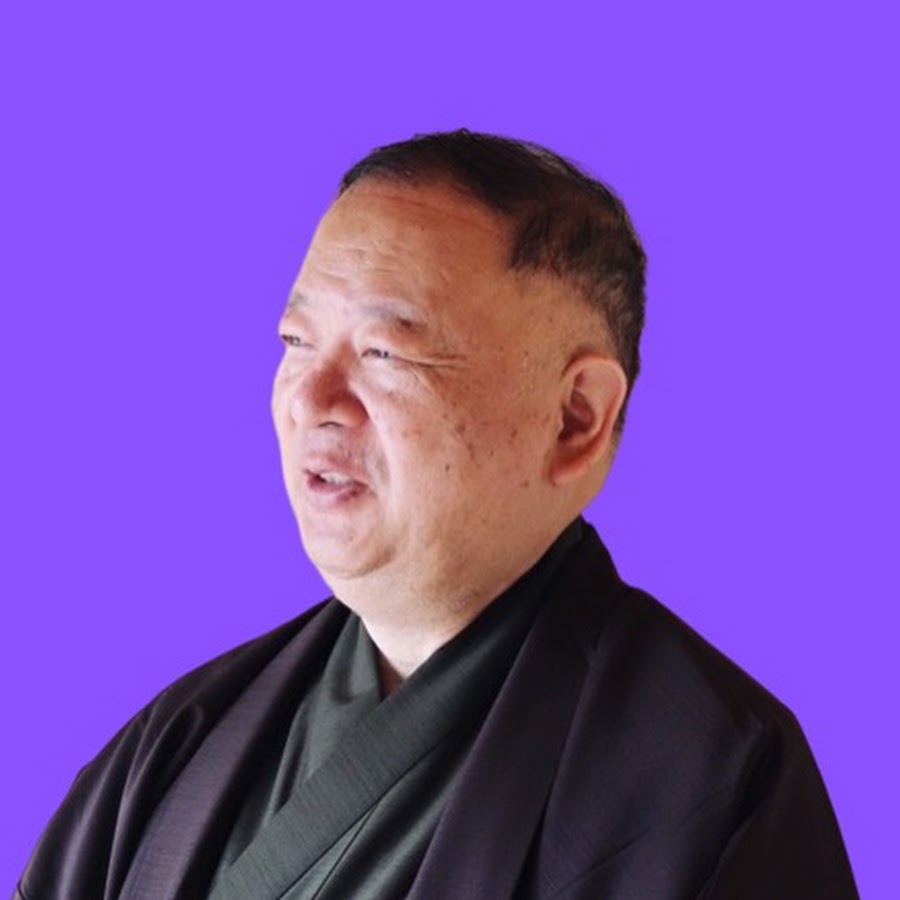
Each one gets around 1,000 views or so.
For themes, I make three patterns: videos about how famous people manage their time, videos where I talk about my own views on one time management topic a day, and then other topics.
▼ One of the short videos Takashima actually posts (in Japanese)
I also post the same video to all three channels, just shifting the time slot a little.
Something like starting at 6:00, then 6:30, then 7:00 — spreading them out.
It’s not just YouTube. I also post on Facebook, Instagram, three X accounts, LinkedIn and Threads.
That adds up to a huge number of posts, and the only reason I can keep it going is the system behind it.
― You post to that many platforms every day. What made you first hear about NoLang?
Someone introduced me to it in April last year.
I’ve been using it ever since.
At first, what I appreciated was that I could type in a single line and it would write the text automatically and then build a video from it.
That alone was plenty useful, but lately my flow has changed further.
These days I write a solid script in ChatGPT first, then put it into NoLang to make the video.
I have ChatGPT write differently for each social platform, so it produces the text first, and then I paste that into NoLang’s Generate from Script mode to turn it into a video. That flow has really settled in.
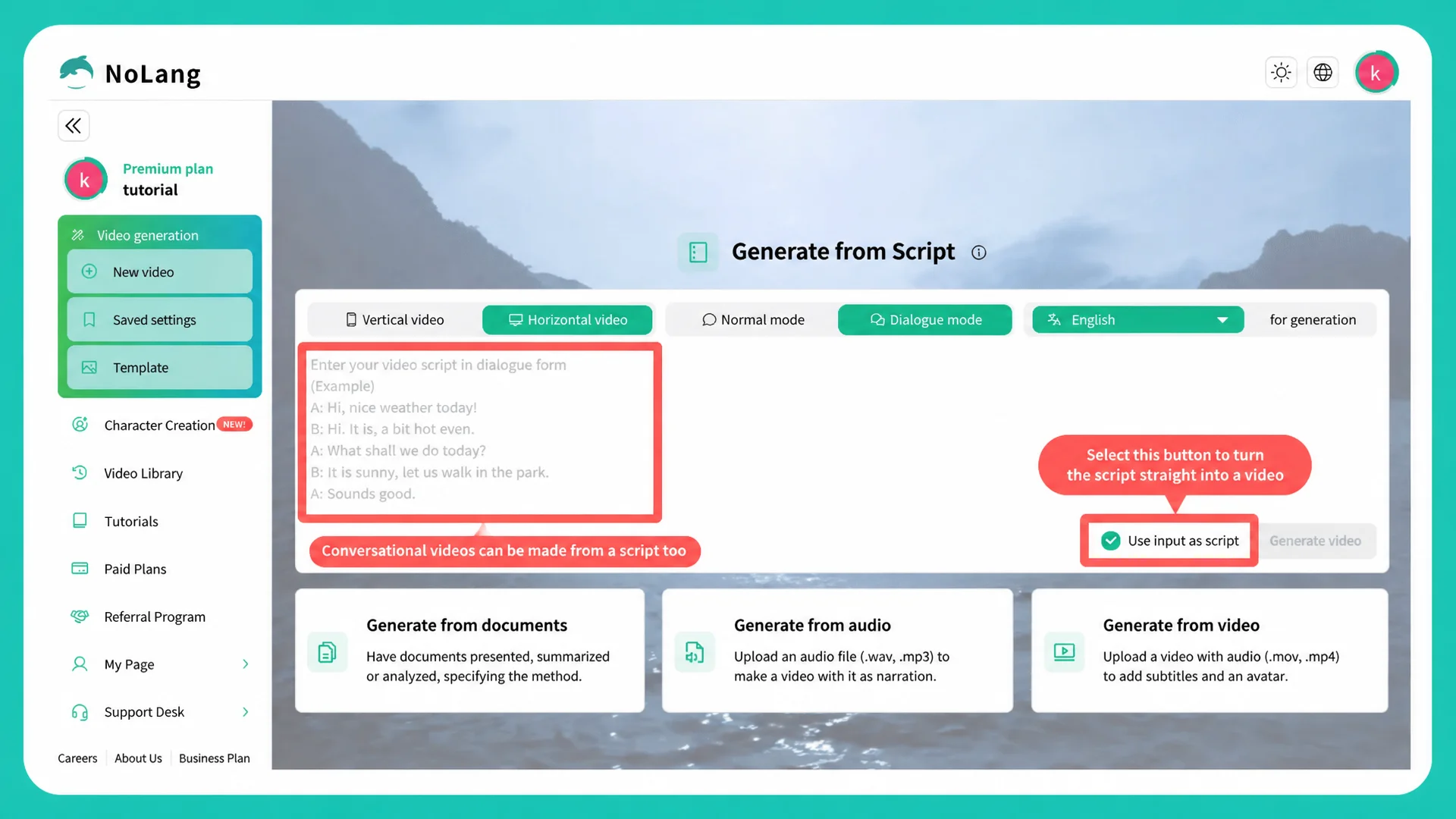
Making videos with a well-trained ChatGPT and NoLang
― So you combine ChatGPT and NoLang. How do you use ChatGPT?
I’ve trained ChatGPT incredibly hard.
I had it learn my way of thinking and about 3,000 of my slides, so it’s trained to write text that stays close to what I want to say.
― You’ve spent a lot of time raising it, then.
That’s right. Unless you train it, you can’t use it for the content of my consulting.
At the level of just pulling together something roughly on topic, it’s no use for consulting work.
But now it churns out pretty much what I would have said, and I hardly ever have to fix anything.
Because that works, the flow of having ChatGPT write the text and feeding it into NoLang holds up.
― That sounds great. What do you use for the audio in the videos?
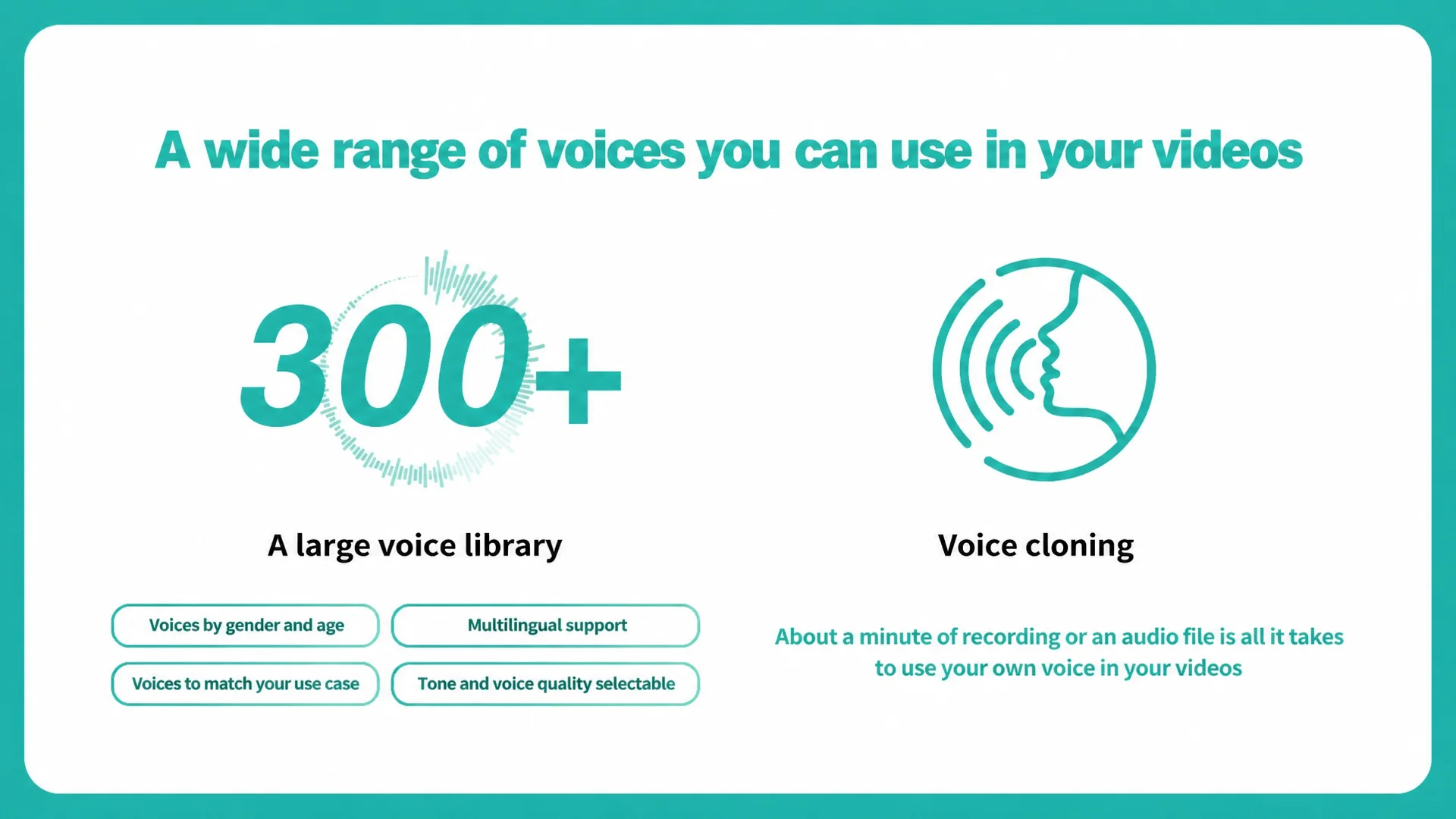
For the videos where I talk about time management every day, I use my own voice.
But for the ones that quote famous people, if I say it out loud people would think “whose words are those?”, so for those I use a synthetic voice (laughs).
I use different audio depending on what the video is about.
Running six social platforms in “one hour a day”
― From generating the script to making the video, how much time does it take in a day?
The way I do it now, it doesn’t even take an hour.
And that keeps my daily posting going.
If I tried to do all of this myself without NoLang, there is no way it would work.
I’m genuinely grateful that I can produce this much.
― Keeping daily posting going in under an hour is impressive.
It is. And on top of that, when I put one piece of text into ChatGPT, I have it produce a set of six all at once: the Facebook post, the X post, the Threads post, the note post, the YouTube description and the script for the YouTube Short.
The Facebook post has the links in it properly, and it gives me three options for the YouTube title.
After that I just copy and paste, and making the video is easy.
― That’s very efficient.
I make the video in NoLang, download it, and when I upload it to YouTube I just paste in the description that ChatGPT prepared earlier.
It’s the same for the other platforms — I just paste in the text written for that platform.
That’s why I can come in under an hour.
And with a YouTube description, whether the links and the guidance text are properly written there matters quite a lot.
The goal isn’t for people to watch the video; it’s for them to click the link and get in touch, so I pay a lot of attention to whether that text connects them through.
Building on Shorts and expanding to long-form video
― How do you think about the position of these short videos you produce in such volume?
I think short videos are ultimately disposable — people glance at them and they’re gone.
That’s exactly why you absolutely need a system that lets you produce them at volume.
I’ve accepted that shorts can be disposable and that I shouldn’t obsess over quality, and that’s what lets me produce them at volume with the combination of ChatGPT and NoLang.
If something in it is really off, I scrap it, but otherwise I just let it go out.
― It’s because you accept they’re disposable that you can produce them at volume. Are you thinking about expanding beyond shorts into longer videos?
Yes. Since shorts are disposable, I want to make longer videos separately that can serve as a foundation.
I’d like people who saw a short to land on a longer video and build up views there.
Eventually I want to turn those longer videos into Udemy course videos.
▼ A horizontal long-form video Takashima actually posts (in Japanese)
Once I can make something at least 20 minutes long, ideally around 30, that plan gets a lot closer to reality.
― So you have a concrete plan for Udemy course videos. In terms of combining AI tools, is there anything else you use?
I use manga generation AI as well.
I create characters to match time management themes and post manga to Facebook. Once I’ve written the copy in ChatGPT, the manga is done in about a minute, so that suits producing at volume too.
That said, there’s a limit to how much you can leave everything to ChatGPT.
ChatGPT isn’t very good with long text, image generation AI is better for images, NoLang is better for video — the strengths and weaknesses are clear.
I make the content in ChatGPT, turn it into video with NoLang, and create the visuals with manga AI.
Each one has its own strengths, so I keep trying different combinations and producing content every day.
― Thank you very much for sharing such valuable insights today. We’ll keep developing NoLang so you can keep posting videos on social media more easily and with less effort. We look forward to continuing to work with you.
[Editor’s note]
Until now, just posting a video every day and keeping a single social account running took a considerable amount of effort.
Today, by using AI to work more efficiently, it has become possible to run six social platforms at once — and in under an hour.
Takashima’s example shows that possibility in very concrete terms.
For people with specialized expertise like Takashima, spreading that first layer of awareness is extremely important.
At NoLang, we want to keep supporting those people so they can expand their reach through video on social media more easily and more efficiently.
Profile: Toru Takashima
▼ Facebook (in Japanese)

▼ X (in Japanese)

▼ YouTube (in Japanese)
◆ Free assessments: Heartgram, decisiveness, career fit and more (in Japanese)
https://www.reservestock.jp/page/step_mails/4179
◆Publishing business (in Japanese)
https://decision.ne.jp/services/publication/
New book: The Easiest Guide in Japan to the Rules of New Business Success
◆ E-learning courses (in Japanese)
https://decision.ne.jp/e-learning/
Unauthorized use, reproduction or reprinting of the text and specific content in this article is strictly prohibited.