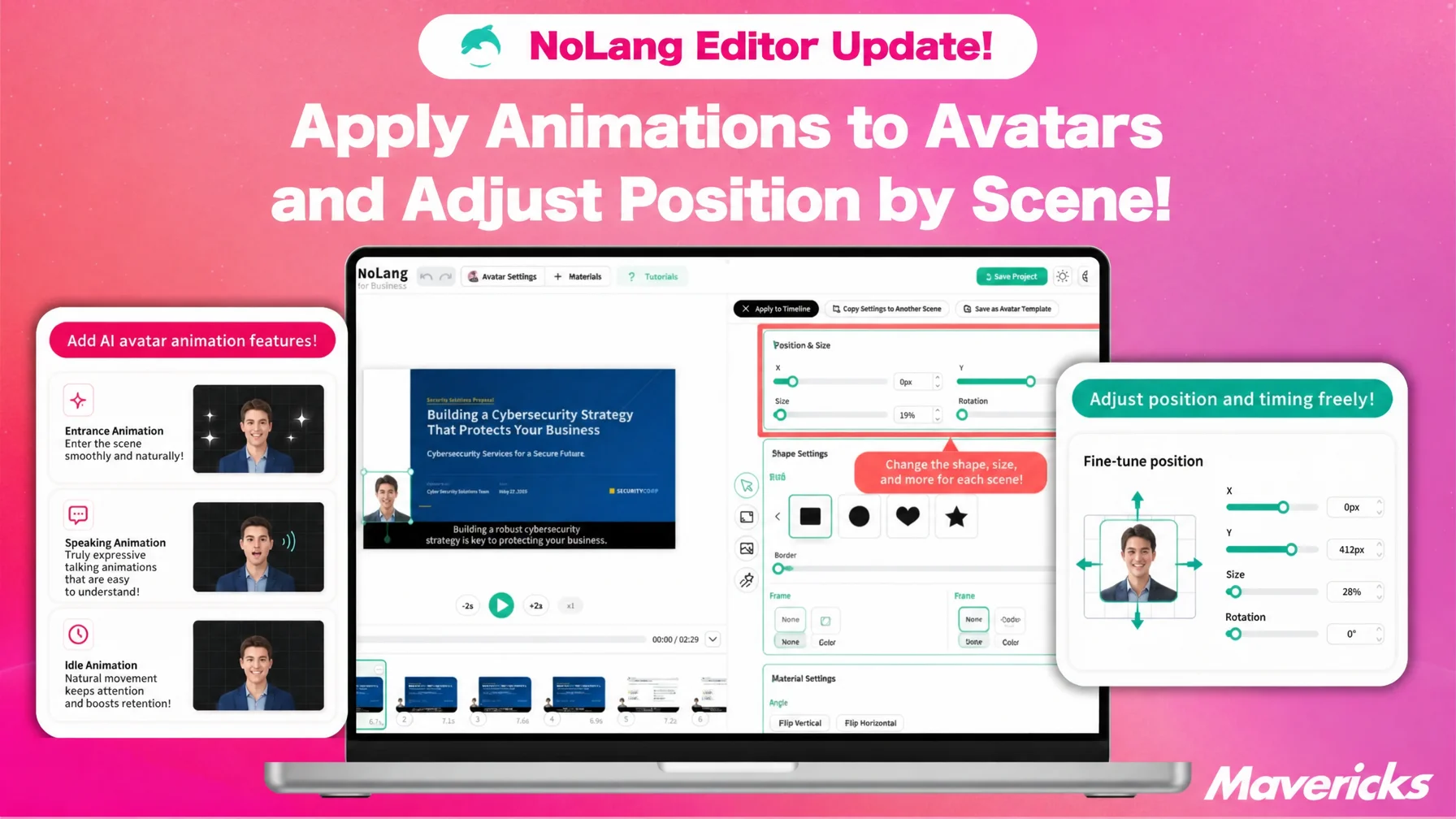
Mavericks, Inc., the company behind the AI video generation service NoLang, has added two features to the NoLang video editor: free control over where and when an AI avatar appears, and an animation feature that gives the avatar movement through five animation options. Avatars that used to stand fixed in the center of the frame can now carry the presence and motion of a live presenter, which greatly widens the range of expression available in avatar videos.
Contact us about NoLangAvatar videos face a new problem: monotonous presentation
More and more companies are producing video in-house. In a survey run by Hikaku Biz and Mteam from April 7 to 14, 2025, covering 111 people working in marketing, public relations and brand strategy, 34% of companies produced video entirely in-house and 56% combined in-house work with outsourcing, meaning a combined 90% of companies produce video in-house in some form. The same survey also identified shortages of staff and resources, and the difficulty of maintaining quality, as problems on the in-house side, so the shift comes with a real burden on the teams doing the work1.
Outsourcing a single video is reported to cost from several hundred thousand to several million yen and to take one to two months2. Against that background, producing video in-house with AI avatars has spread quickly as a way to solve those cost and schedule problems.
At the same time, AI avatar videos have well-known limits in how they look: the avatar stands fixed in the center of the screen and keeps talking, with little variation in expression or movement. This uniform presentation makes viewers more likely to drop off and weakens the message. The effect is strongest in long or varied formats such as training videos, product introductions and news commentary, where the same framing and the same motion repeat until the viewing experience turns flat. Production teams have been asking for the freedom to direct how the avatar itself is presented.
In response, NoLang has strengthened the editor so that both the position and timing of the avatar and its movement, through animation, can be controlled freely.
Set the avatar’s position and timing freely
With this update, the NoLang video editor lets users adjust the avatar’s position and size anywhere on the canvas. Users can also show or hide the avatar at any point in the video.
This makes time-based control possible: keep the avatar large and centered at the opening, then shrink it to the edge of the frame once the main topic begins so the slides take the lead; or remove the avatar for specific scenes so footage or images fill the screen. Because the way the avatar is presented can change as the video develops, avatar videos that used to sit fixed in the center now have contrast and pacing.
A new feature that applies animation to the avatar
Alongside position and timing, the Animation panel in the editor lets users direct the avatar’s movement by choosing from five animations.
Applying an animation is a matter of picking one of the prepared animations, and the relevant section plays back automatically in the preview right after the selection, so the result can be checked on the spot. The presets include several variations such as Standard, Return, Bounce and Spring, and sliders adjust the speed and strength of the animation, so the effect can be tuned in detail to match the tone of the video.
Combining position control and animation greatly widens creative freedom
Combining free control of position and timing with applied animation gives an avatar that used to stand fixed in the center of the screen the movement and presence of a live presenter.
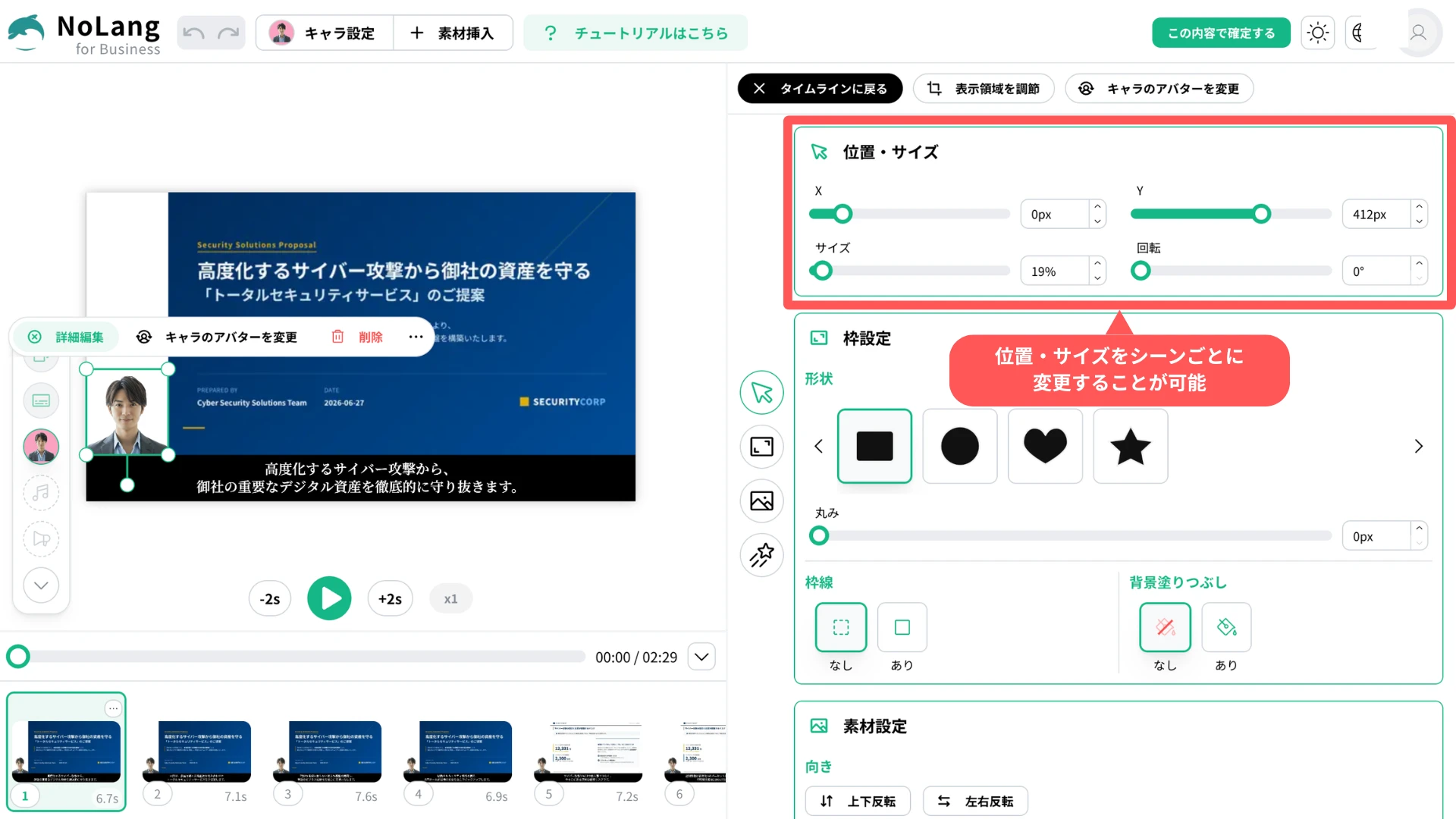
For example, a sequence can be built in which the avatar slides in from the edge of the frame as it starts to speak, bounces gently while speaking, and zooms out and off screen once it finishes. Handling not only text entry and script writing but also this kind of motion direction entirely inside the editor is a defining strength of the AI video generation service NoLang.
Contact usWhat comes next
Mavericks plans to expand the range of animation presets further and to strengthen the link between animation and the avatar’s facial expressions and emotional range. Development will continue toward an environment in which anyone can produce video with the expressive power of live-action footage, while raising the creative freedom that comes from combining position, timing and movement at will.
Footnotes
-
Hikaku Biz and Mteam, “Survey on in-house versus outsourced video production and its challenges” (in Japanese), conducted April 7-14, 2025 with 111 people working in marketing, public relations and brand strategy: 34% in-house only, 56% in-house plus outsourcing, 10% outsourcing only. ↩
-
LIG Inc., “Complete guide to bringing video production in-house” (in Japanese), citing market figures of several hundred thousand to several million yen per outsourced video and a production period of one to two months. ↩