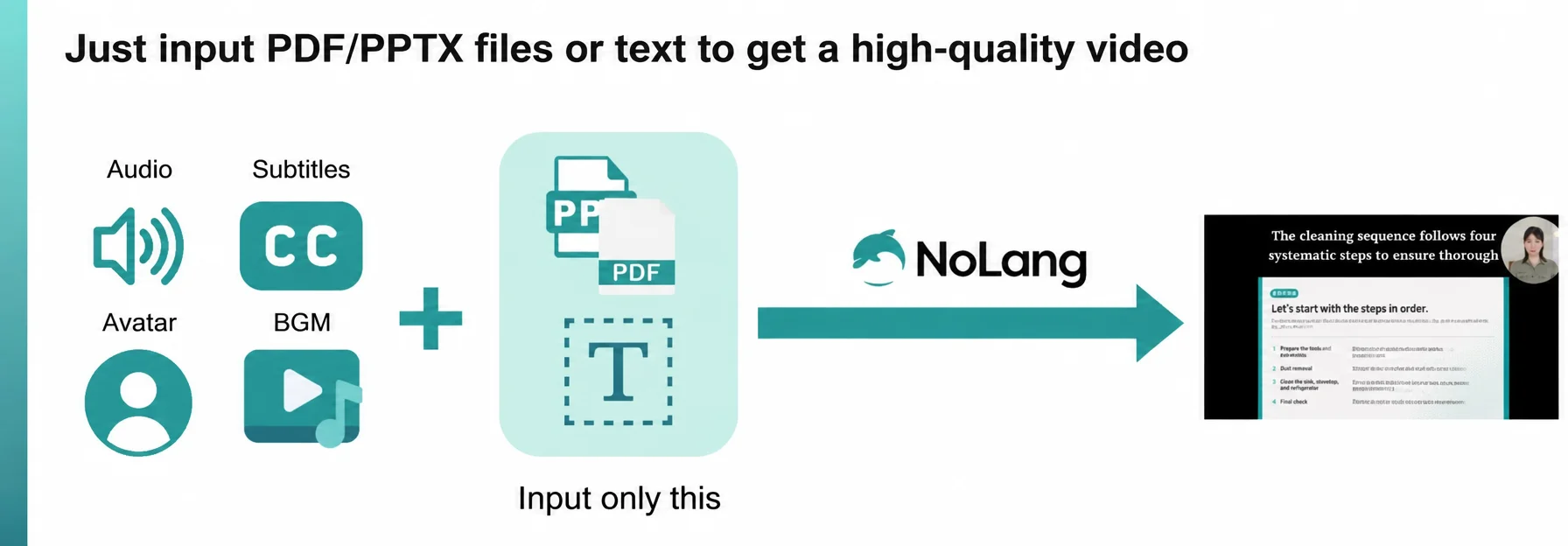
Mavericks, Inc., a developer of advanced AI products, has expanded the English video templates in its AI video generation service NoLang. A company can feed in the Japanese documents it already has — operating manuals for production equipment and internal systems, training materials on occupational and food safety, work rules and compliance decks, or step-by-step procedures for customer service and picking work — and NoLang produces a high-quality training video with English narration and subtitles in a few minutes. The feature helps companies avoid the rising personnel costs of securing English-capable staff, and supports the productivity of organizations that employ foreign workers.
Growing need for training in English as the foreign workforce expands
Japanese companies are hiring more foreign workers every year, against a backdrop of severe labor shortages and rising recruitment and personnel costs. The number of foreign residents in Japan reached 3,956,619 at the end of June 20251, the highest figure on record, and employing foreign workers is becoming standard practice. With that shift, the language barrier in internal training has turned into a significant management issue. In fact, the most frequently cited challenge in employing foreign workers is “communication is difficult because of Japanese language ability,” at 43.9 percent.2
Multilingual internal manuals should be the answer to that communication gap, but workplaces have not kept up. A survey of food service establishments3 asked sites with foreign workers on staff whether manuals in five key areas were available in a foreign language. “Store operations” scored highest at 30.6 percent, followed by “general business” at 25.1 percent, “food safety” at 22.5 percent, “occupational safety and health” at 20.0 percent, and “crisis management” at 16.8 percent — every area except store operations came in below 30 percent. The fact that even “occupational safety and health” and “crisis management,” which bear directly on employee safety and corporate compliance, sit at around 20 percent points to a serious gap. Those figures cover text-based manuals only. Video manuals require far more cost and specialist skill to produce than translating and distributing text, because of narration recording and editing, so their coverage is very likely to lag even further behind.
Strengthening internal training in English with NoLang templates
Against that background, Mavericks, Inc. has expanded the English video template feature in its AI video generation service NoLang. Earlier versions of NoLang could already generate a training video with English narration and subtitles in a few minutes from existing internal documents in text, PowerPoint or PDF form — equipment manuals, occupational safety training materials, detailed work procedures, compliance documents — with the AI understanding and translating the content. The expanded template feature now places subtitles, slides and other elements in the best position, so a person with no specialist knowledge can easily create a training video of higher quality. This lowers the barrier to adopting NoLang considerably and extends support to more companies facing training problems caused by the language barrier.
See the training video automation solution Read the guide to making training videosBecause the feature removes the need to hire additional English-capable staff, it helps replace recruitment and personnel costs of several hundred thousand to several million yen a month with a NoLang subscription costing tens of thousands of yen a month. Consistent training quality is another strength. The AI always generates videos that meet a set standard, so training is standardized rather than dependent on the skill of the individual trainer.
Video is also said to be nine times more effective than text alone for memory retention. Delivering complex work procedures and safety rules in a video format that engages both sight and hearing markedly improves how well foreign workers understand them, and contributes to productivity across the organization.
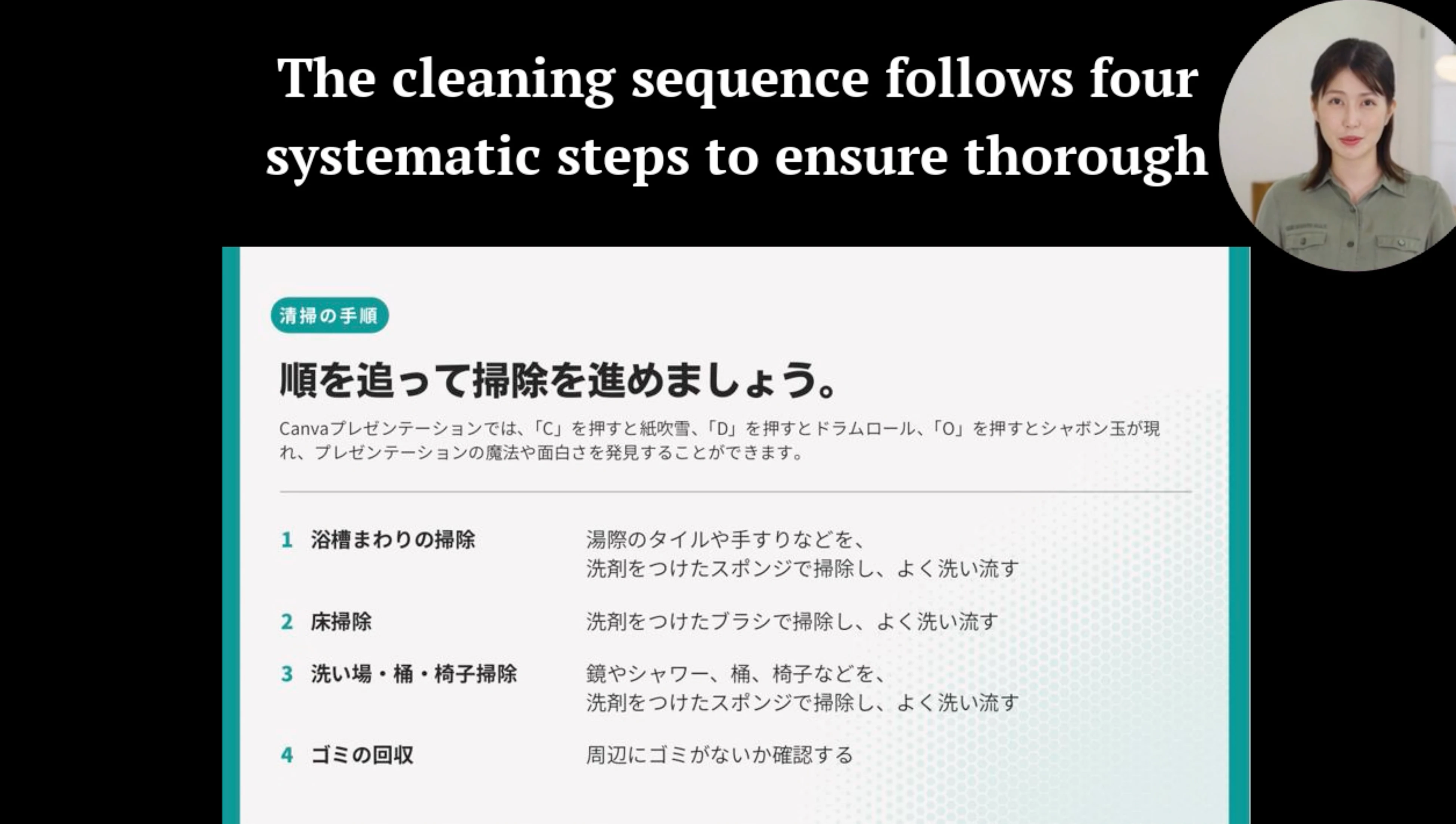 Watch the sample video
Specific use cases
Operating manuals and work procedures for new products
An English explainer video can be generated immediately from the Japanese version of a manual. Foreign workers in Japan, and employees at overseas sites of globally active companies, can pick up new operational knowledge with no time lag. Complex operations and subtle nuances that text-based manuals struggle to convey are grasped intuitively through video that engages both sight and hearing, which prevents uneven levels of proficiency.
Occupational safety and compliance training
Important rules that every employee must understand correctly can be rolled out as uniform video content, without variation in translation or differences in trainer skill. When laws or internal rules change, updating the original Japanese document is enough to create and distribute the latest English training video right away. That establishes a structure in which employees at every site always have an accurate view of the current rules, and it reduces compliance risk for the company.
Onboarding training on employment contracts and labor matters
When a company hires foreign workers, there are many important points they must understand accurately regardless of employment type: the terms of the employment contract, work rules, Japanese labor law, and the rules attached to residency status. These explanations are full of technical terms, and misunderstandings caused by the language barrier carry a real risk of turning into labor disputes later. With NoLang, an English video that explains difficult legal terms and contract conditions in plain language can be generated immediately from these complex briefing materials and contract documents. Foreign workers can then start work with an accurate understanding of their own rights and obligations, which cuts the cost of onboarding explanations while strengthening the compliance framework.
Looking ahead
Mavericks, Inc. plans to strengthen the multilingual support in NoLang further, extending coverage beyond English to other major languages in stages. Through the development of advanced AI products, including the real-time AI video generation service NoLang, the company aims to remove language barriers worldwide and to contribute to global communication and higher productivity at companies of every kind.
Contact usFootnotes
-
Source: Immigration Services Agency of Japan, “Number of foreign residents as of the end of June 2025” (in Japanese) ↩
-
Source: Ministry of Health, Labour and Welfare, “2024 Survey on the Employment of Foreign Workers” (in Japanese) ↩
-
Source: UA Zensen, “Survey report on the employment and living conditions of foreign workers” (in Japanese) ↩