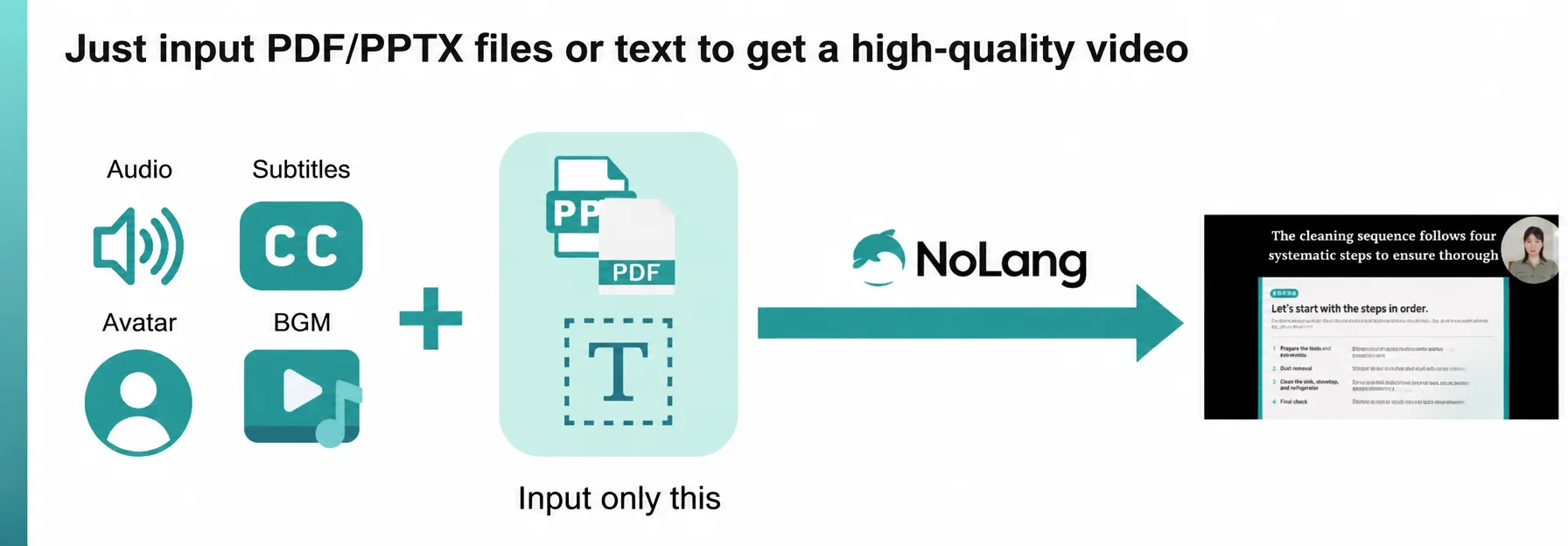
Mavericks, Inc., the Japanese company behind the AI video generation service NoLang, has significantly expanded the multilingual capabilities of NoLang to help companies strengthen training for foreign workers. Upload a Japanese manual or document, and NoLang automatically generates a training video with narration and subtitles in any of 18 languages, including Chinese and Vietnamese, in a single click. It can also convert a video from one language into another. Companies can now deliver intuitive video instruction in a worker’s native language, something plain text manuals could not do, helping foreign workers become productive sooner while reducing the workload on training staff.
Try NoLang for yourselfWhy multilingual training videos personalized by nationality are needed as the foreign workforce grows
Japanese companies are hiring more foreign workers every year as labor shortages deepen and recruiting and personnel costs rise. At the end of June 2025, the number of foreign residents in Japan reached a record 3,956,6191, and employing foreign workers is becoming standard practice. That shift has made the language barrier in internal training a serious management issue. In fact, the most common problem companies report when employing foreign workers is “difficulty communicating due to Japanese language ability,” cited by 43.9%.2
Multilingual manuals should be the answer to this communication gap, but on the ground they have not kept pace. A survey of food-service establishments3 asked workplaces that employ foreign workers whether their manuals were available in foreign languages across five major areas. “Store operations” ranked highest at 30.6%, followed by “general business” (25.1%), “food hygiene” (22.5%), “occupational safety and health” (20.0%) and “crisis management” (16.8%). Every area except store operations stayed below 30%. The fact that even “occupational safety and health” and “crisis management,” which bear directly on employee safety and corporate compliance, sit at around 20% points to a serious problem. These figures also cover text-based manuals only. Video manuals require narration recording, editing and other specialized work that costs far more than translating and distributing text, so their coverage is very likely even further behind.
Turning Japanese training and operating manuals into multilingual training videos automatically with NoLang
Against this backdrop, Mavericks, Inc. has substantially expanded the multilingual features of NoLang. NoLang already generated videos with English narration and subtitles from existing internal materials such as text, PowerPoint files and PDFs. With this update, that coverage grows to 18 languages in total, adding Chinese, Filipino, Vietnamese and others alongside English. A new feature also converts a finished video into another language instantly at the press of a button.
As a result, even people with no video editing skills can follow a simple flow: create the training video in Japanese first, then localize it for foreign staff in one click. Producing high-quality multilingual videos is now within reach for anyone.
See the training video automation solution Read the guide on making training videos[Steps]
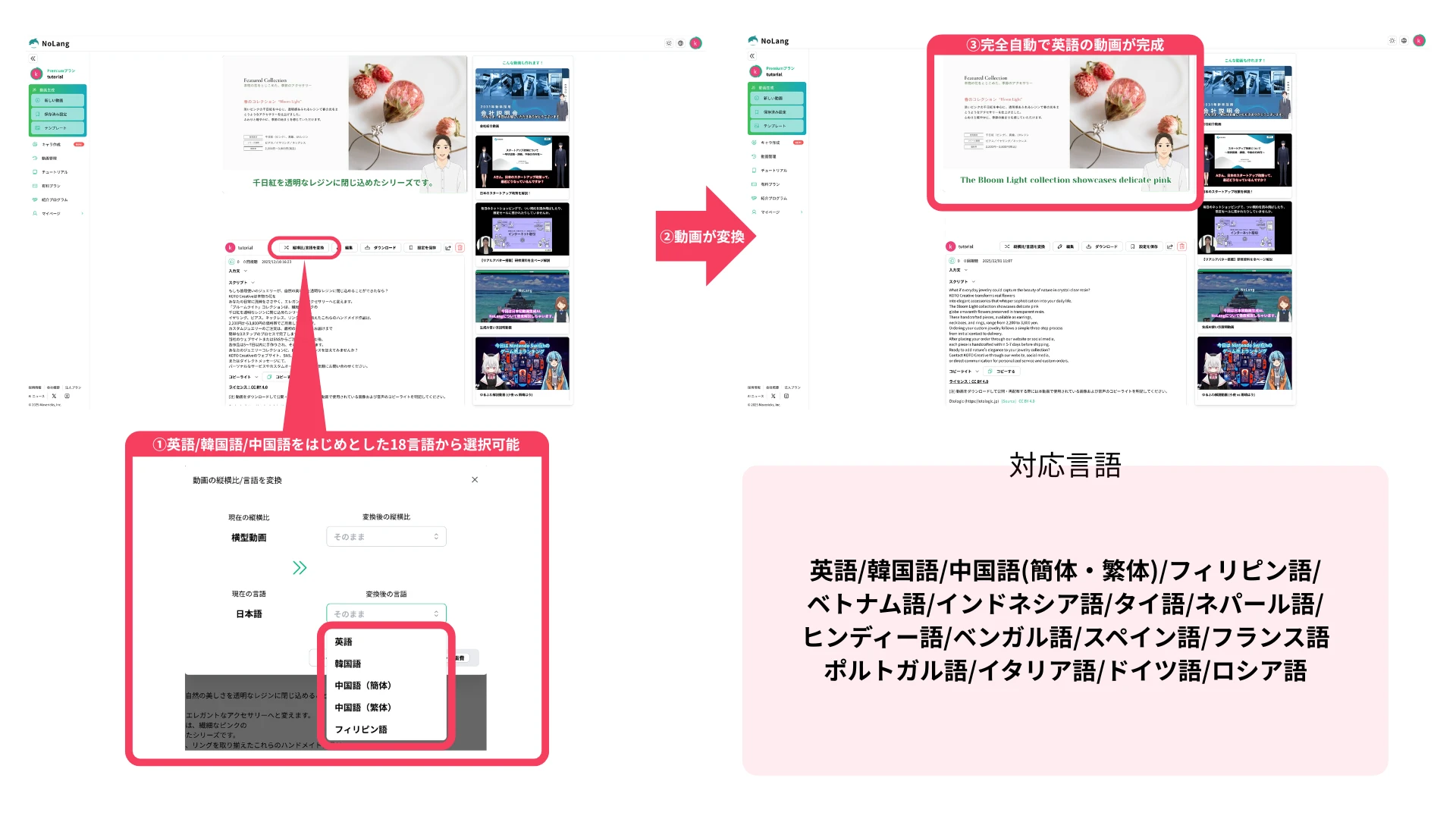
A video created in Japanese can be converted into another language in three steps.
① Open the viewing screen of the Japanese video created in NoLang and select the “Change aspect ratio / Convert language” button
② In the settings dialog, choose the language to convert to (all 18 languages4 are available)
③ Press “Generate” and wait for it to finish (the video in the selected language is produced automatically)
With this update, workers from Vietnam, China, the Philippines and elsewhere who staff the food-service, construction and nursing-care industries can be trained with videos in their native language rather than in English, so the content lands intuitively. Video training is said to produce roughly nine times higher retention than text alone.5 Delivering complex work procedures and safety rules through native-language video that engages both sight and hearing sharply improves how well foreign workers understand them. Because the videos are AI-generated, the quality of training no longer depends on the skill of the individual trainer, which standardizes training quality and lifts productivity across the organization.
How companies can use NoLang
Operating manuals and work procedures for new products
Starting from the Japanese manual, NoLang instantly produces videos in other languages. Since a Japanese video can be converted at the press of a button, a company introducing new machinery or launching a new product can have videos ready the same day in every language its foreign workers need. Complex operations and fine distinctions that text manuals struggle to convey come across intuitively through video that engages both sight and hearing, which prevents uneven levels of proficiency.
Occupational safety, health and compliance training
Rules that every employee must understand precisely can be rolled out as uniform video content, free of translation inconsistencies and differences in trainer skill. When laws or internal regulations change, updating the original Japanese document is enough to create and distribute an up-to-date multilingual training video immediately. That keeps employees at every site accurately informed of the latest rules and reduces compliance risk.
Onboarding training on employment contracts and labor matters
When a company hires foreign workers, there are many critical points they must understand accurately regardless of employment type: the terms of the employment contract, work rules, Japanese labor law and the rules attached to their residence status. These explanations are full of technical terms, and a misunderstanding caused by the language barrier can grow into a labor dispute later. With NoLang, companies can take these complex explanatory documents and contracts and instantly generate multilingual videos that explain difficult legal terms and contract conditions in plain language. Foreign workers start work with an accurate grasp of their own rights and obligations, which cuts the cost of onboarding explanations and strengthens compliance at the same time.
What comes next
Mavericks, Inc. plans to strengthen the multilingual support in NoLang further and to add other major languages in stages. Through the real-time AI video generation service NoLang and other advanced AI products, the company aims to remove language barriers worldwide and contribute to global communication and productivity at companies everywhere.
Try NoLang for yourselfFootnotes
-
Source: Immigration Services Agency of Japan, “Number of foreign residents as of the end of June 2025” (in Japanese) ↩
-
Source: Ministry of Health, Labour and Welfare, “2024 Survey on Employment Conditions of Foreign Workers” (in Japanese) ↩
-
Source: UA Zensen, “Survey report on the employment and living conditions of foreign workers” (in Japanese) ↩
-
Supported languages: English / Korean / Chinese (Simplified and Traditional) / Filipino / Vietnamese / Indonesian / Thai / Nepali / Hindi / Bengali / Spanish / French / Portuguese / Italian / German / Russian ↩
-
inisvia, “Most Important Marketing Stats in the Software & SaaS Industry” https://arc.net/l/quote/fckpvupd ↩