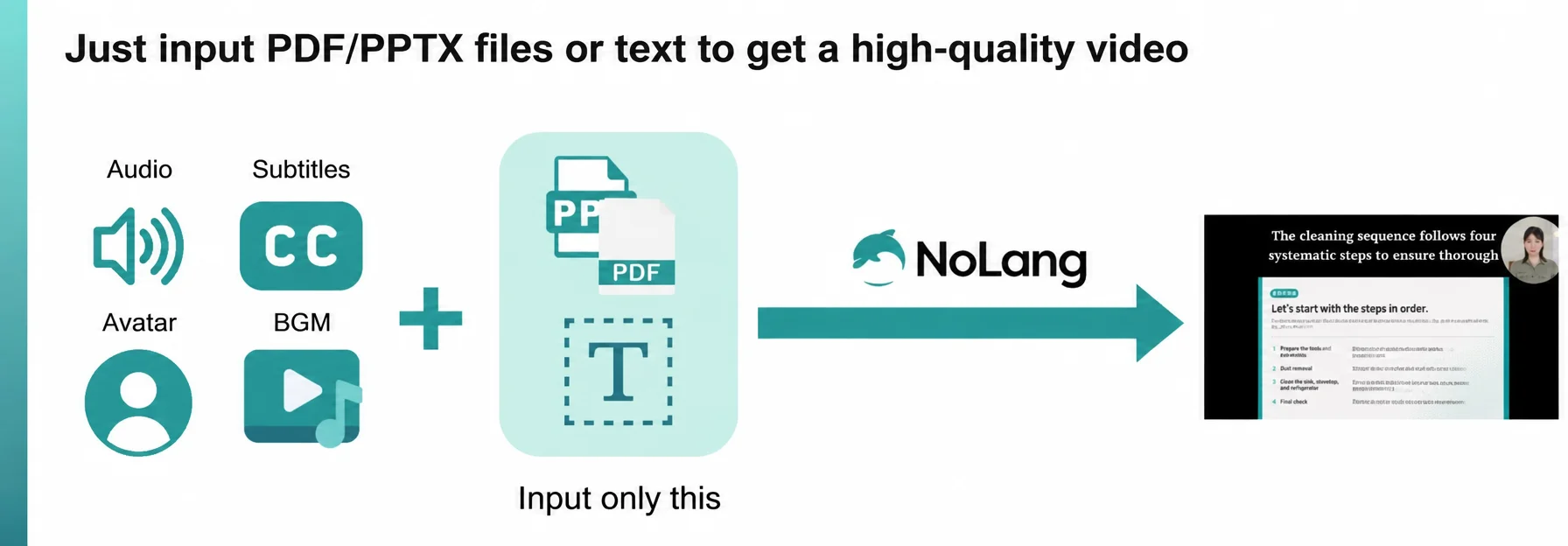
Mavericks, Inc., the Japanese company behind the AI video generation service NoLang, has expanded the multilingual capabilities of NoLang to a total of 18 languages, in order to support inbound-facing operations at restaurants, hotels, local governments, and tourism facilities. The update adds a new function that instantly converts a video created in Japanese into another language at the press of a button. Tourism, restaurant, and accommodation businesses can now take their existing materials and immediately produce multilingual versions of service guidance for foreign visitors or social media videos aimed at travelers still in the planning stage, without translation work or specialized video editing skills. The goal is to make video production more efficient at sites struggling with staff shortages, and to help them capture as much inbound demand as possible.
Try NoLang for YourselfInbound demand is at a record high, but language barriers and video and social media outreach for visitors remain serious problems
Inbound demand in Japan has recovered and expanded rapidly in recent years, and the number of foreign visitors reached a record 36.87 million in 20241. Against the backdrop of this business opportunity, the tourism, restaurant, and accommodation industries face two main problems.
The first is the slow progress of multilingual support on site. In a survey by the Japan Tourism Agency, foreign visitors ranked “unable to communicate with facility staff” (26.1%) and “too little or unclear multilingual signage” (21.8%) among their most common problems during a trip, and named “restaurants” (28.5%) as the place where they had the most trouble2. The data shows that smooth communication on site and easy-to-understand multilingual guidance are still in short supply. Many facilities and stores, however, cannot hire enough staff who can handle the work, and the growing cost of recruiting and training them is a heavy burden.
The second is the challenge of publicity and PR before a trip begins. According to a recent survey, “social media” (40.6%) and “video sites” (37.9%) ranked at the top of the information sources that visitors found useful before traveling to Japan, and “English” (48.8%) was the most common language used3. This shows that information gathering has shifted from text to video and social media, and how important it is to publish information in English. Producing English video content, however, takes considerable time and money for translation, narration arrangements, and more. For businesses with limited resources, that is difficult to take on, and it has become a major barrier.
Multilingual support and language conversion in NoLang give strong support to inbound video production
In response to these problems, Mavericks, Inc. has significantly expanded the multilingual capabilities of NoLang. Until now, NoLang could automatically generate videos with English narration and subtitles from existing internal materials such as text, PowerPoint files, and PDFs. With this update, coverage expands beyond English to a total of 18 languages, including Chinese, Filipino, and Vietnamese. In addition, a new function instantly converts a finished video into another language at the press of a button.
As a result, even people with no video production skills can first create a video in Japanese for foreign visitors and then localize it for a foreign audience with a single click, so that anyone can easily produce high-quality multilingual videos.
How to use it
A video created in Japanese can be converted into another language in three simple steps.
- Open the viewing screen of the Japanese video created in NoLang and select the “Change aspect ratio / Convert language” button
- On the settings screen, choose the language you want to convert to (all 18 languages4 are available)
- Press the “Generate” button to finish (a video in the selected language is generated automatically)
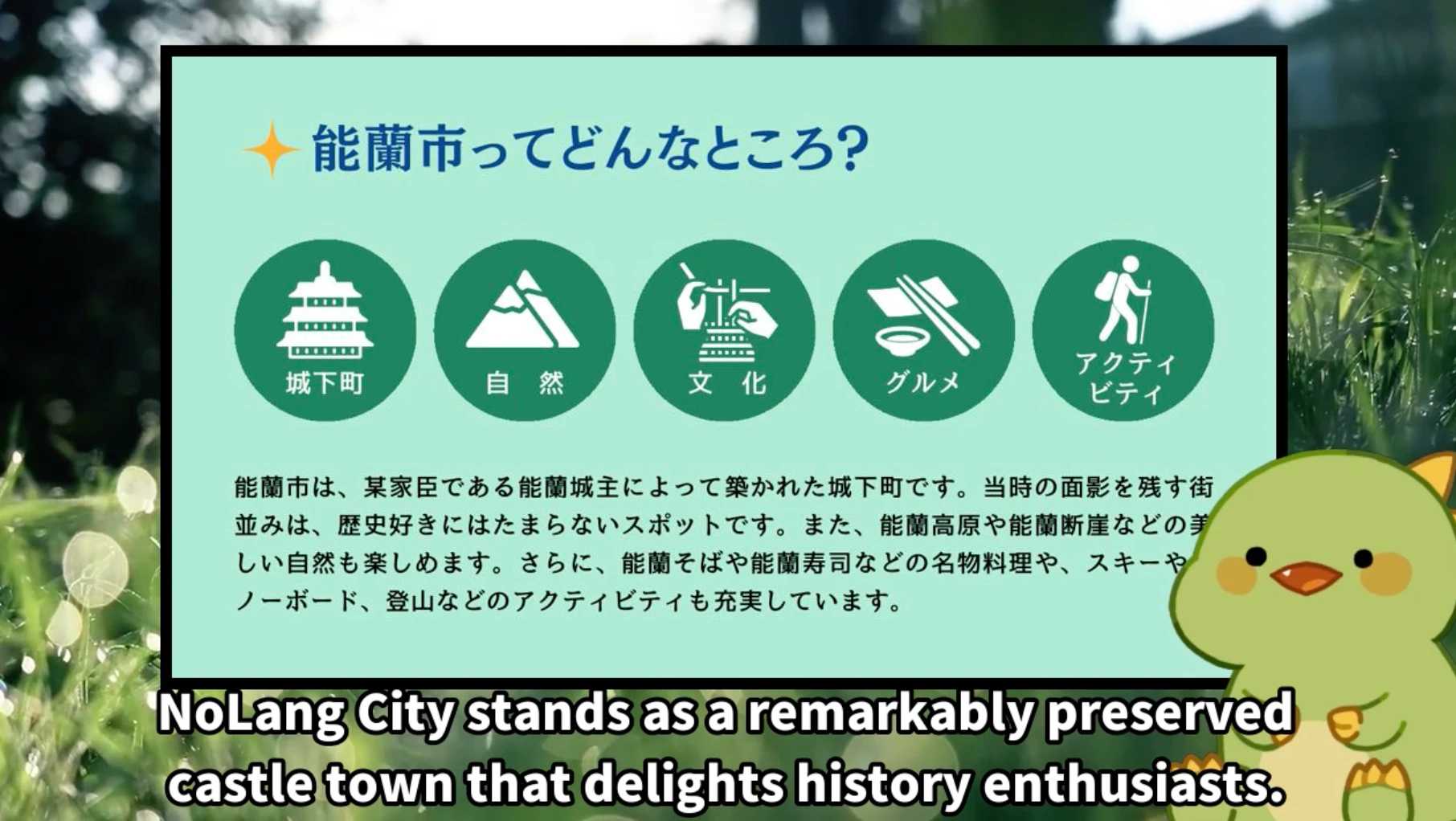 See a Sample Video
Original characters unify and strengthen branding
NoLang also makes it easy to create videos featuring Japanese anime-style avatars, which are popular overseas as well. Simply upload an image of a character and a business gets its own original character avatar right away. Beyond human avatars, animals, a company mascot, and other intellectual property can all be used as a “moving avatar.” Companies can therefore use their own assets to easily produce videos with an originality that sets them apart, strengthening and unifying their brand image.
How NoLang is used in practice
Restaurants and accommodation facilities
At restaurants and accommodation facilities, videos can be generated immediately from existing Japanese menus and service brochures. Playing those videos on digital signage in the entrance area or on in-room tablets makes recommended menu items more appealing and communicates facility rules smoothly.
Templates such as “facility guidance” for hotels and traditional inns or “menu introductions” for restaurants also let an AI avatar take over the detailed explanations that staff previously had to give in person. Practical guidance on how to order at a touch panel or ticket machine, or how to operate the equipment in a guest room, can be delivered automatically through an avatar 24 hours a day. That addresses the difficulty of hiring and assigning English-speaking staff while keeping the quality of hospitality for foreign travelers consistent.
Transportation and tourism facilities and local governments
Local governments and tourism facilities can load a tourist brochure (a PDF or PPTX file) and convert it into a compelling English PR video. NoLang offers more than 100 AI avatars, so an organization can pick a character that matches its regional brand image and create a distinctive video. Publishing those videos on social media and websites contributes greatly to awareness among foreign travelers who are still planning their trip.
The same approach works well for improving the on-site experience once travelers arrive. Complicated station transfers, how to use a ticket machine, or how to worship at a temple or shrine are all hard to convey in text alone, and video explains them clearly and visually. FAQ videos, in which an avatar answers questions travelers have, such as “When is the best time to see the cherry blossoms?” or “What local food do you recommend?” can also be generated automatically from text, so information can be delivered that answers the needs of overseas audiences precisely.
Outlook
Mavericks, Inc. plans to strengthen multilingual support in NoLang further and to add other major languages in stages. Through the development of advanced AI products, including the real-time AI video generation service NoLang, the company aims to remove language barriers around the world, energize Japan’s inbound market, and contribute to global communication at companies of every kind.
Try NoLang for YourselfFootnotes
-
Source: Japan National Tourism Organization (JNTO), “Foreign Visitors to Japan” (in Japanese) ↩
-
Source: Japan Tourism Agency, “Survey on Multilingual Support and Other Aspects of the Reception Environment for Foreign Visitors to Japan” (in Japanese) ↩
-
Source: Japan Tourism Agency, “Consumption Trend Survey for Foreigners Visiting Japan, July-September 2024 Report” (in Japanese) ↩
-
Supported languages: English / Korean / Chinese (Simplified and Traditional) / Filipino / Vietnamese / Indonesian / Thai / Nepali / Hindi / Bengali / Spanish / French / Portuguese / Italian / German / Russian ↩