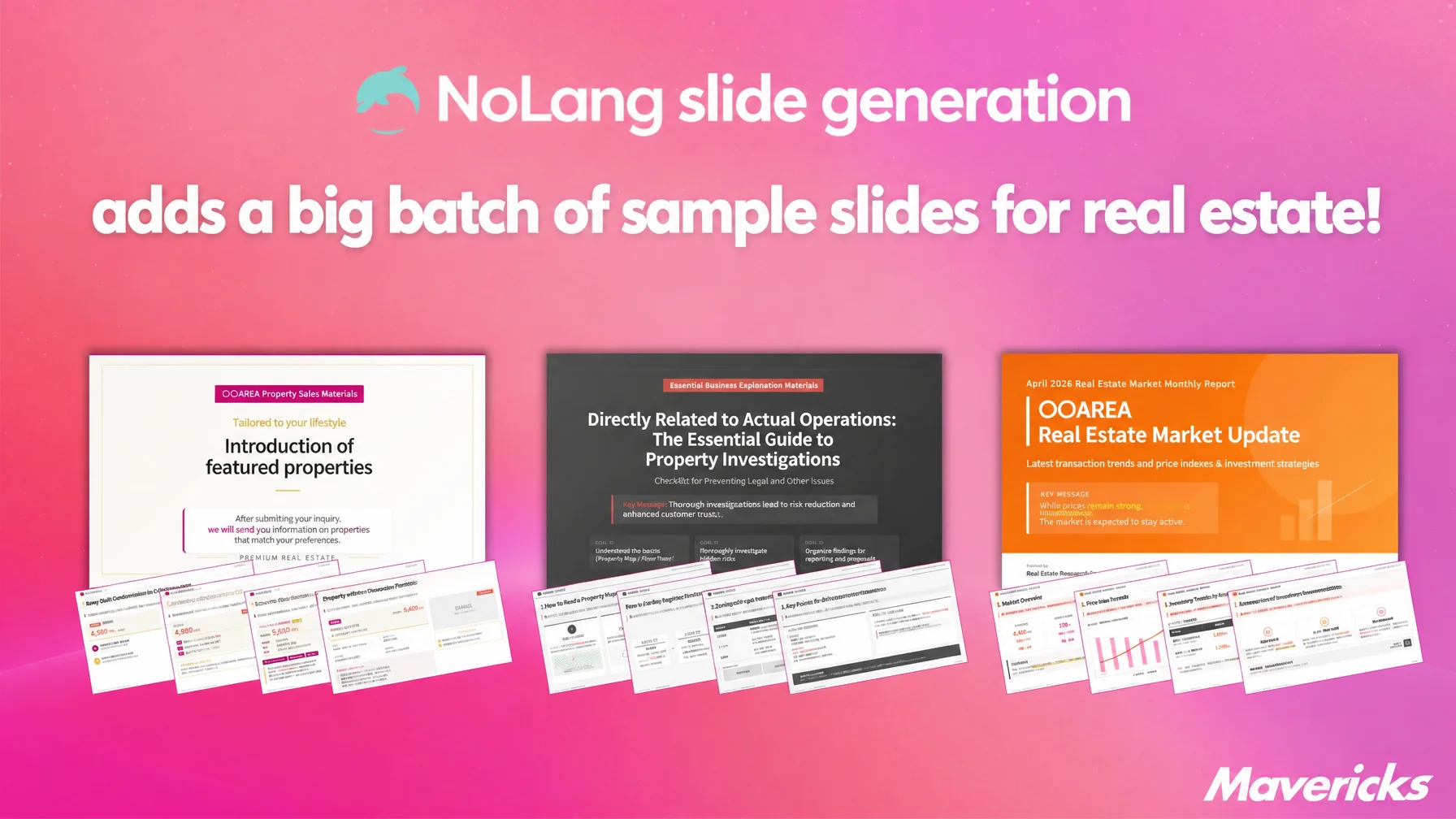

Mavericks, Inc. (headquarters: Bunkyo City, Tokyo; President and CEO: Shota Okuno), the Japanese company behind the AI video generation service NoLang, has added a new set of sample slides for the real estate industry to the Slide Generation feature. Teams can drop in the documents they already have — property information PDFs, floor plans, operating data from property management systems, income simulation spreadsheets, legal documents — and generate both slides and videos in a single pass for property introductions, client proposals, operating reports to owners, investment proposals, and real estate compliance training. The goal is to cut the time spent on document production so staff can spend it on clients and proposals instead.
Property introductions, proposals, and operating reports pile up while the workforce ages and shrinks
Real estate brokerage, sales, property management, and investment teams produce customized documents every day: property introduction decks, client-specific proposals, operating reports for owners, market reports, investment proposals, and training materials on the Real Estate Brokerage Act. Japan’s real estate tech market reached 940.2 billion yen in fiscal 2022, up 21.1% year on year, and is projected to grow to 2.378 trillion yen by fiscal 2030 — roughly 2.5 times the fiscal 2022 level1. Meanwhile, 99.0% of companies surveyed said digital transformation is something the industry should pursue2. Staffing on the ground, however, keeps shrinking, and the capacity to produce these documents is no longer keeping up.
The burden is not unique to real estate. A 2021 survey of 400 sales and sales planning professionals found that document preparation was the single most time-consuming task, cited by 30.5% of respondents, and that each person spends roughly 619 hours a year on it — about 1.67 million yen per person when converted to labor cost3. Real estate adds another layer: introduction materials have to be rebuilt around each property’s information sheet, floor plan, and photos; proposed properties have to be swapped out to match what each client said in an interview; and monthly reports have to be assembled for every managed property. Customization per property and per client is the norm, and it takes a large share of an agent’s time. On top of that, the Real Estate Brokerage Act is amended frequently — revisions to its enforcement regulations took effect in January and April 20254 — so training materials and the documents used for explanations of important matters have to be updated on an ongoing basis.
The workforce that would absorb this work is getting older. According to reference materials for the Ministry of Land, Infrastructure, Transport and Tourism’s Real Estate Industry Vision 2030, about half of the people working in the industry are 60 or older, an average age higher than that of Japanese industry as a whole5. The Information-technology Promotion Agency’s DX Trends 2024 report adds that 62.1% of companies say they are severely short of the people needed to drive digital transformation — the first time the figure has passed half since the survey began6. Interest in digitization and efficiency is high in real estate, but with production capacity stretched thin, property introduction materials, owner reports, and training decks are the first things to be postponed.
NoLang has added sample slides for the real estate industry to its Slide Generation feature to address exactly this gap.
Turn property documents and operating data into slides and videos in one pass
The Slide Generation feature in NoLang takes text, PDFs, and other source material and automatically builds slides complete with headings, charts, and diagrams, then exports them as a narrated video. Doing both in one service is the point: the work that used to require a document tool and a separate video tool, each with its own learning curve, now runs end to end in one place. Real estate teams can feed in the material they already accumulate day to day — property information PDFs, floor plans, property photos, operating data from management systems, income and expense reports, market data, REINS transaction records from Japan’s property listing network, income simulation spreadsheets, and legal document PDFs — and turn those dormant information assets into introduction, proposal, reporting, and training materials.
The new addition is a set of sample slides built specifically for the real estate industry. Selecting a sample slide as a template gives you a design and structure that already fits the use case, so you can start immediately. To build a property introduction deck, for example, you pick the matching sample slide, upload the property information PDF, floor plan, and photos, and the introduction slides are generated for you — ready to use as pre-viewing material for clients, as listing content for property portals, or as a property introduction video.
The samples cover a range of situations across brokerage, sales, management, and investment work, so staff without design training can still produce polished introduction, proposal, and reporting materials.
Five real estate sample slides, from property introductions to reports, investment proposals, and legal training
Here are five representative examples from the new set of real estate sample slides. All five address document and training needs that come up constantly in brokerage, sales, management, and investment work.
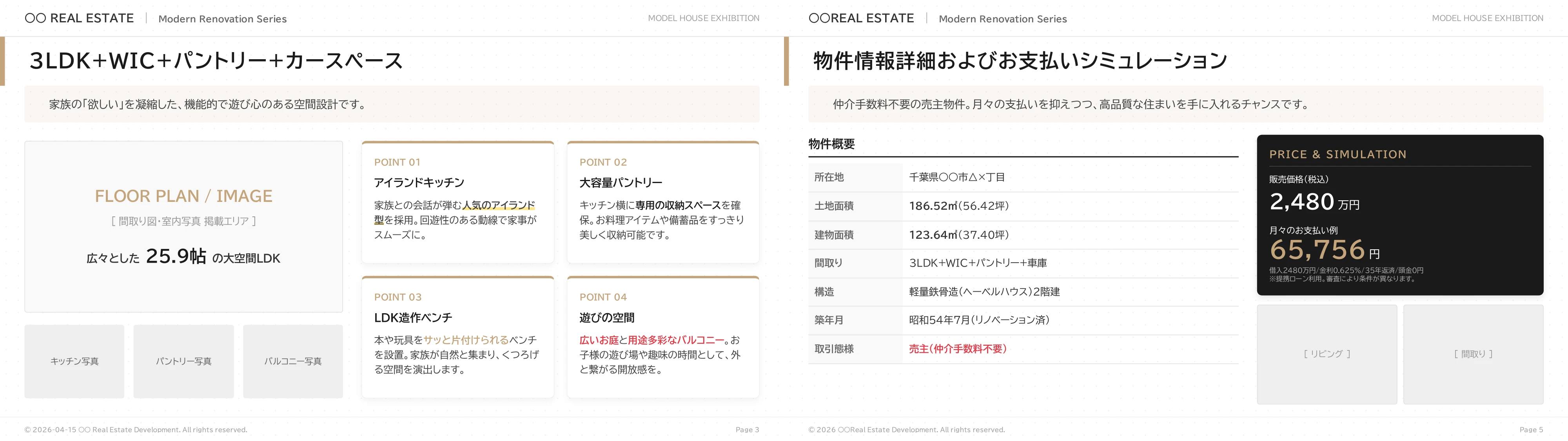
The first is the property introduction slide. Aimed at prospective buyers and renters, it generates an introduction deck covering the property overview, floor plan, surrounding area, facilities, and access. Feed in the property information PDF, floor plan, and photos as they are, and a presentable introduction deck comes together in a short time. It makes pre-viewing material, sales meetings, and portal listings faster to prepare, with consistent quality from property to property.
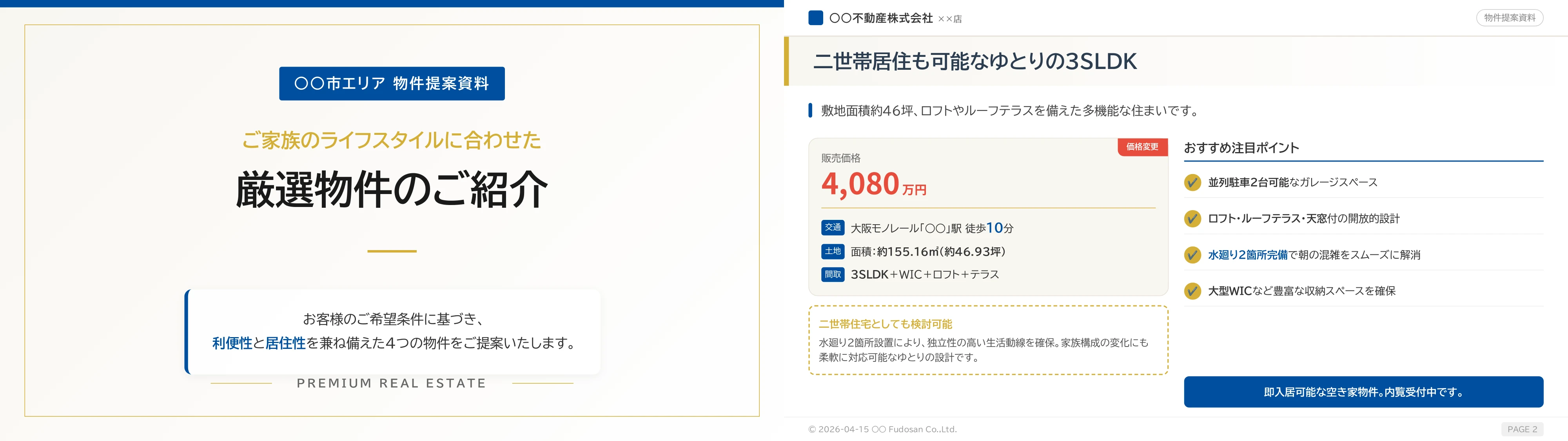
The second is the client-specific property proposal slide. Aimed at buyers and renters in the decision phase, it generates a deck that compares and proposes multiple properties against the conditions gathered in the client interview. Feed in the property information PDFs, interview notes, and area information, and a proposal tailored to each client meeting takes only a short time to build. Agents get more time back for client-facing work while keeping both proposal quality and response speed.
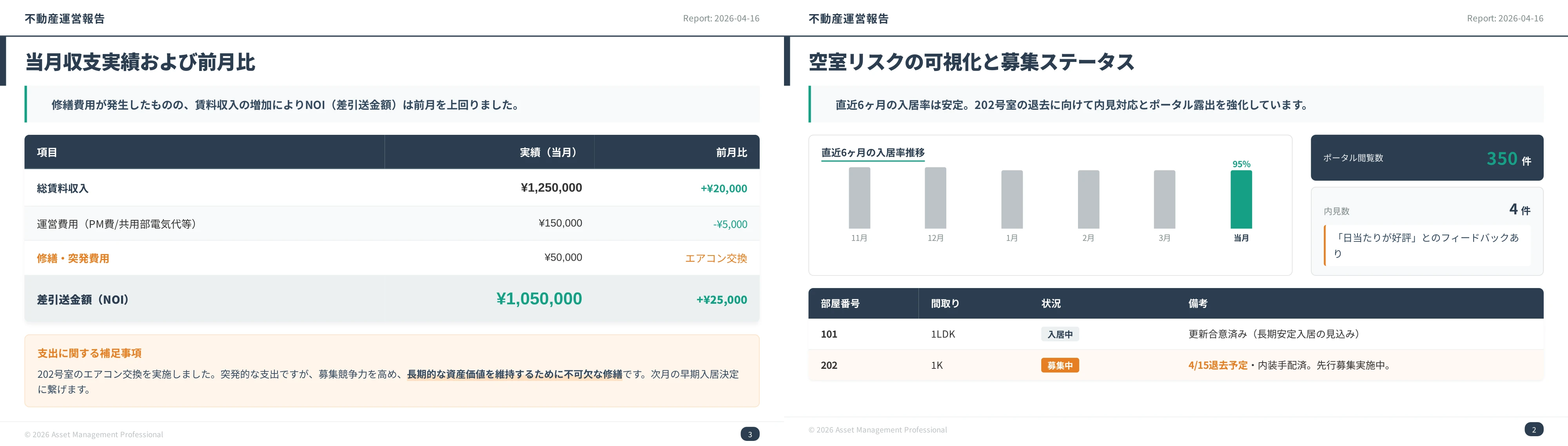
The third is the property operating report slide for owners. Aimed at individual and corporate property owners, it generates an operating report that pulls occupancy, income and expenses, leasing status, and repair plans into charts and tables. Feed in operating data from the management system, income and expense reports, and repair history, and periodic reports for each managed property come together efficiently. Management companies keep the quality of their ongoing communication with owners while spending less time producing it.
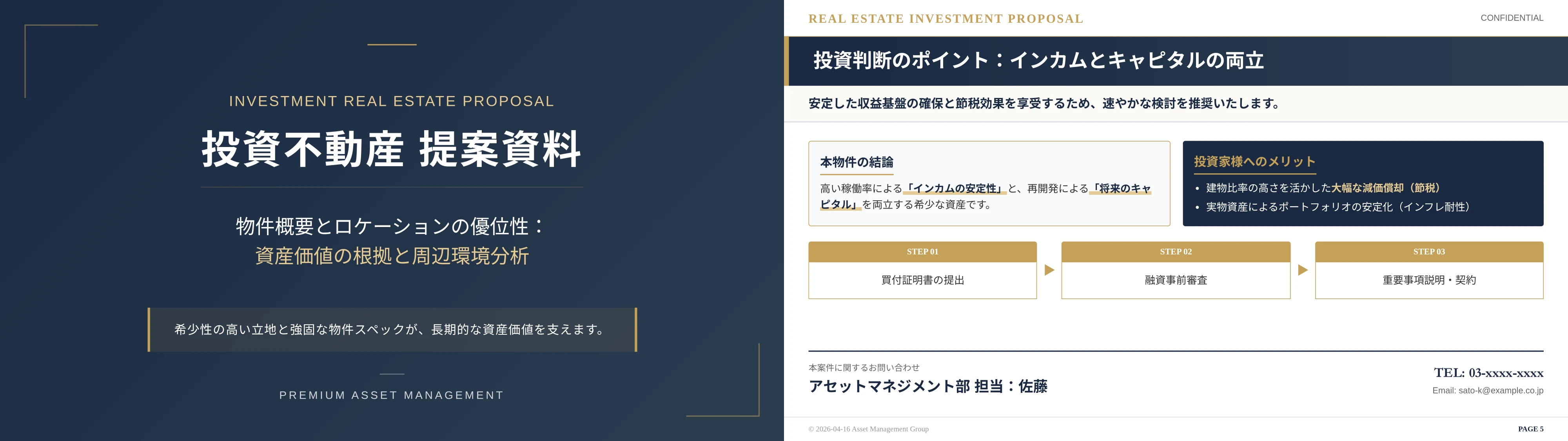
The fourth is the investment property return slide. Aimed at investors and high-net-worth clients, it generates an investment proposal covering the property overview, return analysis, cash flow simulation, and risk analysis. Feed in the property data, income simulation spreadsheet, and area analysis, and a proposal reflecting that property’s return simulation is ready in a short time — supporting both the quality of the explanation and the speed of the proposal in investor meetings.
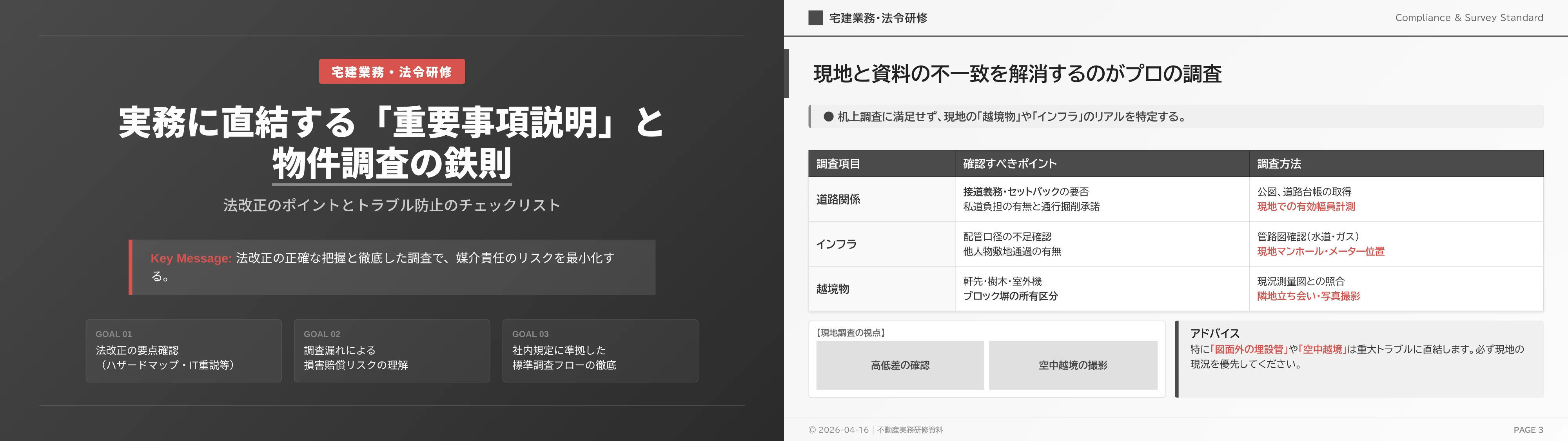
The fifth is the real estate compliance and legal training slide. Aimed at licensed real estate transaction specialists, sales staff, and new hires, it generates training decks on the Real Estate Brokerage Act, contract law, explanations of important matters, property surveys, and other practical knowledge. Feed in legal document PDFs, internal manuals, and case collections, and training decks can be refreshed quickly. Annual and new-hire training materials stay current without adding to the training team’s production load.
What comes next
NoLang will continue to strengthen the product so that it reduces the load of producing documents and running training in the real estate industry, and makes property introductions, client proposals, owner reports, and investment proposals more efficient.
Footnotes
-
Yano Research Institute, Survey on the Real Estate Tech Market (2024) (in Japanese) — size of Japan’s real estate tech market in 2023 and the fiscal 2030 forecast ↩
-
Itandi, Inc. and six other real estate tech companies, Survey on DX Progress in the Real Estate Industry 2024 (in Japanese) — intent to pursue digital transformation in the real estate industry ↩
-
Smart Slide, Survey on Working Practices in Sales 2021 (in Japanese) — 400 sales and sales planning professionals, conducted October 2021 ↩
-
Keiyaku Watch, Key Points of the 2025 Amendments to the Enforcement Regulations of the Real Estate Brokerage Act (effective January and April 2025) (in Japanese) — amendments on preventing listing lock-ups, required items on broker registration plates, and more ↩
-
Ministry of Land, Infrastructure, Transport and Tourism, Real Estate Industry Vision 2030: Reference Materials (in Japanese) — age composition of the real estate workforce ↩
-
Information-technology Promotion Agency (IPA), DX Trends 2024: The Deepening Shortage of DX Talent and Its Challenges (in Japanese) — published 2024 ↩