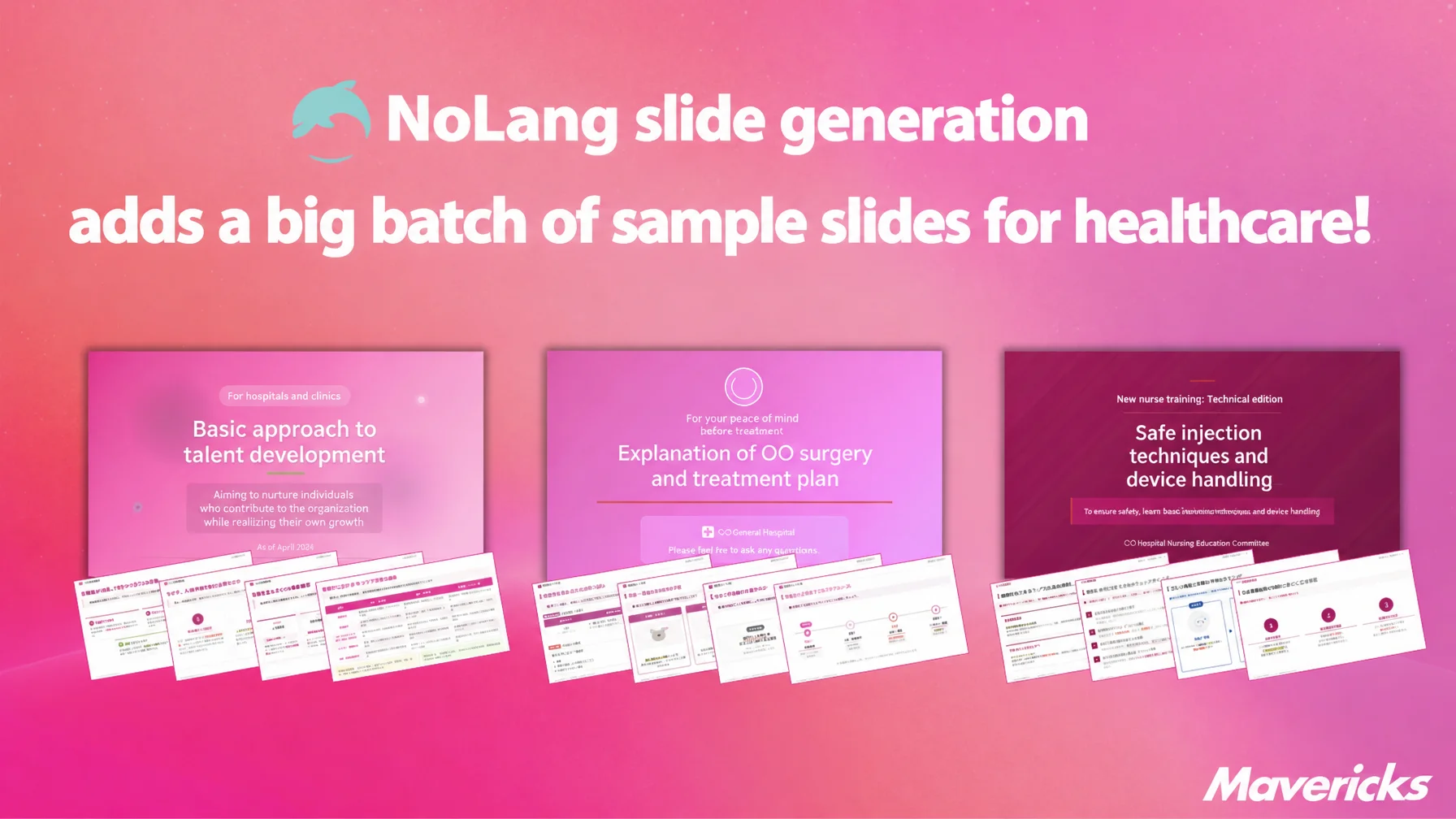
Mavericks, Inc., the Japanese company behind the AI video generation service NoLang, has added a new set of sample slides for the healthcare industry to the slide generation feature. Staff upload existing materials such as clinical guideline PDFs, clinical pathways, or procedure manuals, and NoLang automatically produces illustrated explanatory slides and narrated videos. The samples cover five situations, from patient briefings and test guidance to training for newly hired nurses, webinar presentations, and waiting-room signage. As long working hours for doctors and the shortage of nurses grow more serious, the feature is meant to reduce the workload of preparing materials while maintaining the quality of informed consent.
Long working hours for doctors and a nursing shortage put material preparation under pressure
Hospitals and clinics constantly produce materials whose purpose is to explain and be understood: descriptions of tests, surgery and treatment plans for patients, training programs for new nurses, and slide decks for webinars. Informed consent matters more than ever, but the time of doctors and nurses is largely consumed by clinical work, and keeping explanatory materials at a high standard within those limits has become a real problem on the ground.
The heavier this workload grows, the more it is shifted to other roles. In a survey by Japan’s Ministry of Health, Labour and Welfare, 87.9% of outpatient departments had assigned a medical clerical assistant whose duties include drafting explanatory documents for patients and their families on the doctor’s behalf1, which suggests that preparing such materials is widely seen as work that should leave the doctor’s hands. Because the content has to be customized for each department and each patient, the workload rises further.
The staff who would absorb that work are stretched thinner every year. According to the same ministry, hospital doctors work an average of 61.3 hours per week2. Japan’s work-style reform for physicians, in force since April 2024, caps overtime at 960 hours per year in principle, yet roughly 40% of full-time hospital doctors still work beyond that limit3. Nursing is no easier: a survey by the Japanese Nursing Association put the turnover rate for full-time nursing staff at 11.8% in fiscal 2023, and Japan is projected to be short of up to about 270,000 nurses in 20254. With limited staff and limited hours, handling outpatient and ward duties while also building patient explanations and new-hire training materials is not realistic, and many sites are left wanting to explain things properly but unable to find the time to prepare.
To address this, NoLang has added sample slides for the healthcare industry to its slide generation feature.
One pass from guidelines and procedure manuals to slides and videos, now with healthcare samples
The slide generation feature in NoLang builds slides with charts, diagrams, and headings from source material such as text or PDFs, and then exports the same deck as a narrated video. Everything from writing the slides to producing the video happens in a single service. Previously this meant preparing a document tool and a video production tool separately and learning to operate both. Medical sites can feed in the materials they already have — clinical guideline PDFs, clinical pathways, test procedure documents, procedure manuals, existing PowerPoint decks — and turn them into patient explanation materials, training content, in-house presentations, and webinar decks.
See the training video automation solution Read the guide to making training videos
The sample slides added this time are specific to healthcare. Selecting a sample as a template gives an immediate starting point with a design and structure suited to the intended use. To prepare, for example, a patient explanation document for informed consent in outpatient care, staff pick the matching sample and upload a clinical guideline PDF or an existing PowerPoint file; NoLang produces an organized set of slides with illustrations and diagrams that can be used directly in the consultation room or shared as a video for patients and their families. No specialist design skills are needed to produce the quality of explanatory materials and training content that medical work demands.
Five sample slides, from patient briefings to new-hire training and webinars
Here are five representative uses among the healthcare sample slides added this time. All of them address needs that come up frequently in hospitals and clinics: patient explanations, training, and internal communication.
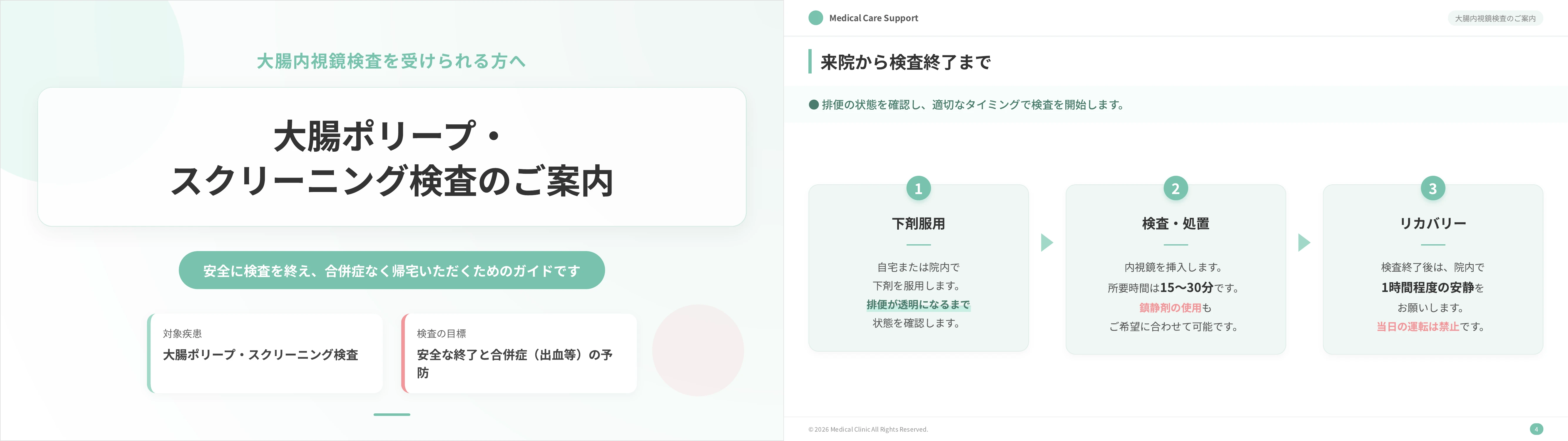
The first is admission, discharge, and test guidance by department. For inpatients and outpatients, this sample generates slides that lay out procedures for endoscopy, CT, and other tests, along with the admission and discharge process, organized department by department. It answers a common situation: the hospital wants explanatory materials for every department, but production capacity is limited and cannot keep up with department-by-department work. Feeding in existing PowerPoint files, clinical pathway PDFs, and test procedure documents makes it possible to produce department-specific decks efficiently and to cover all departments quickly.
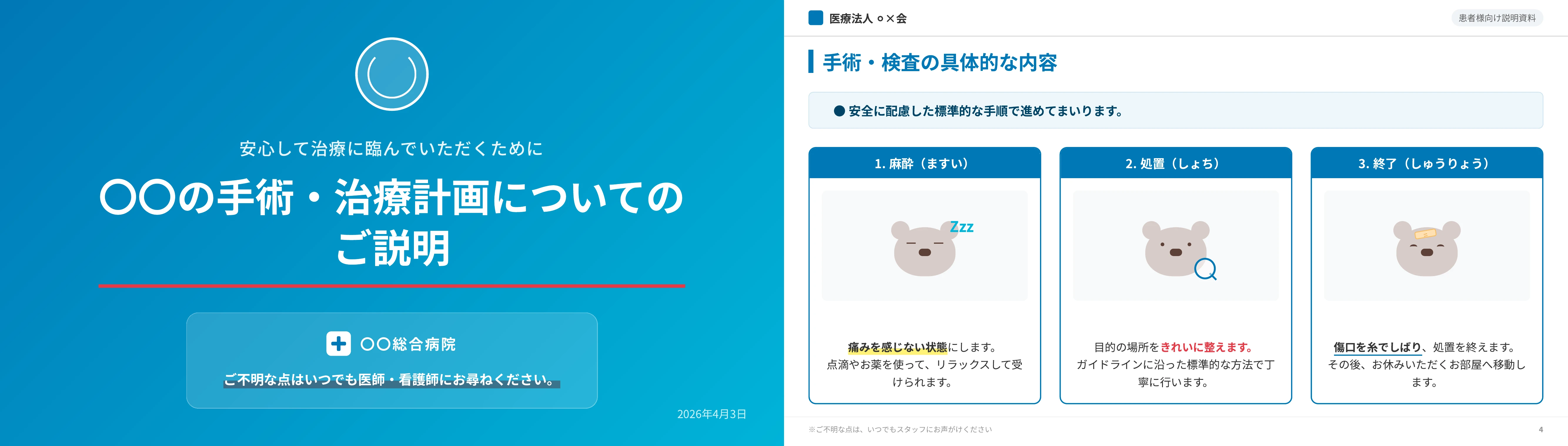
The second is patient explanation slides covering the flow of a test, surgery, or treatment. Aimed at patients and their families, this sample generates slides that explain test procedures, the course of surgery, and treatment plans through illustrations and diagrams. It answers the case where materials are needed for informed consent, but doctors cannot spare the time to build slides or videos and have to rely on verbal explanation. Uploading a clinical guideline PDF or a package insert PDF produces illustrated patient-facing slides in a short time, improving the quality of informed consent while limiting the load on doctors.
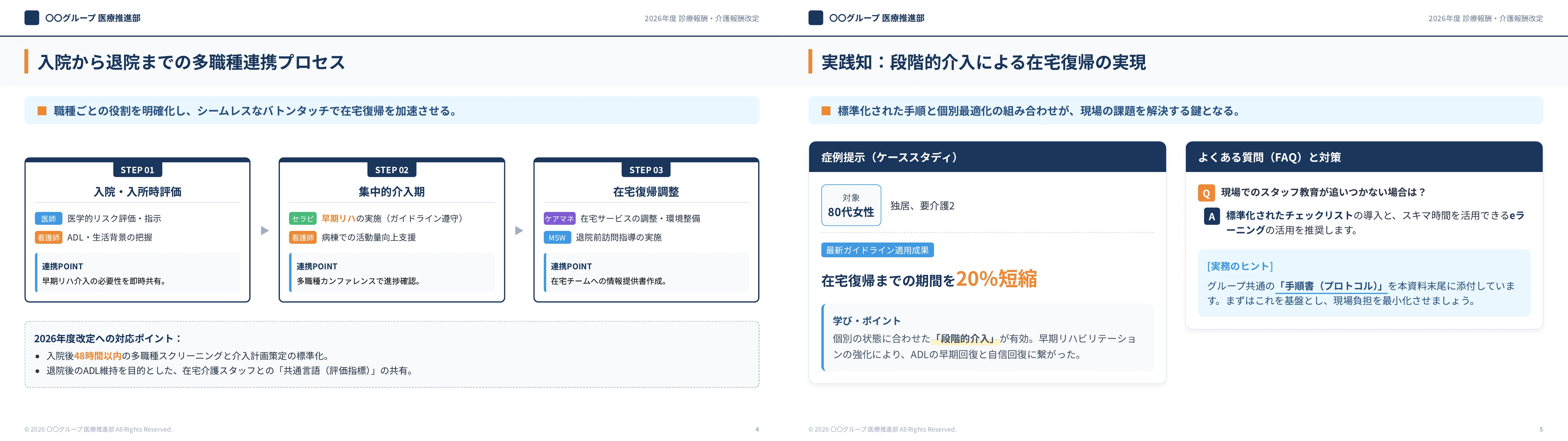
The third is webinar and seminar presentation slides. Aimed at seminar audiences of medical and nursing-care professionals, this sample generates slides that explain current topics in healthcare and nursing care. It answers the difficulty of continually producing presentation decks for academic conferences and regular webinars while also carrying a clinical workload. Feeding in public documents and guideline PDFs produces presentation-ready slides efficiently and substantially cuts the effort of preparing for recurring webinars and conference talks.
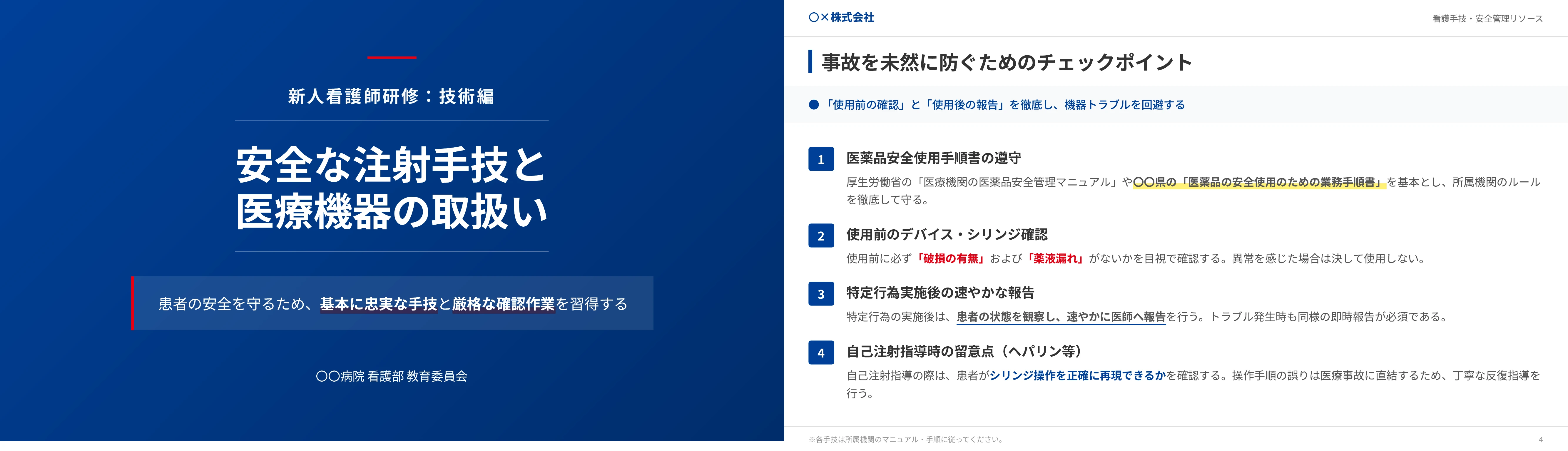
The fourth is training slides for new staff, covering injection technique and similar skills. Aimed at newly hired nurses and medical staff, this sample generates training slides that set out the steps for injection technique and the operation of medical devices. It answers the April training season, when large volumes of training material are needed and the nurse educators responsible for them cannot produce enough alongside their regular duties. Uploading training texts and procedure manual PDFs produces step-by-step illustrated training slides efficiently and greatly reduces the production burden during the new-hire training season.
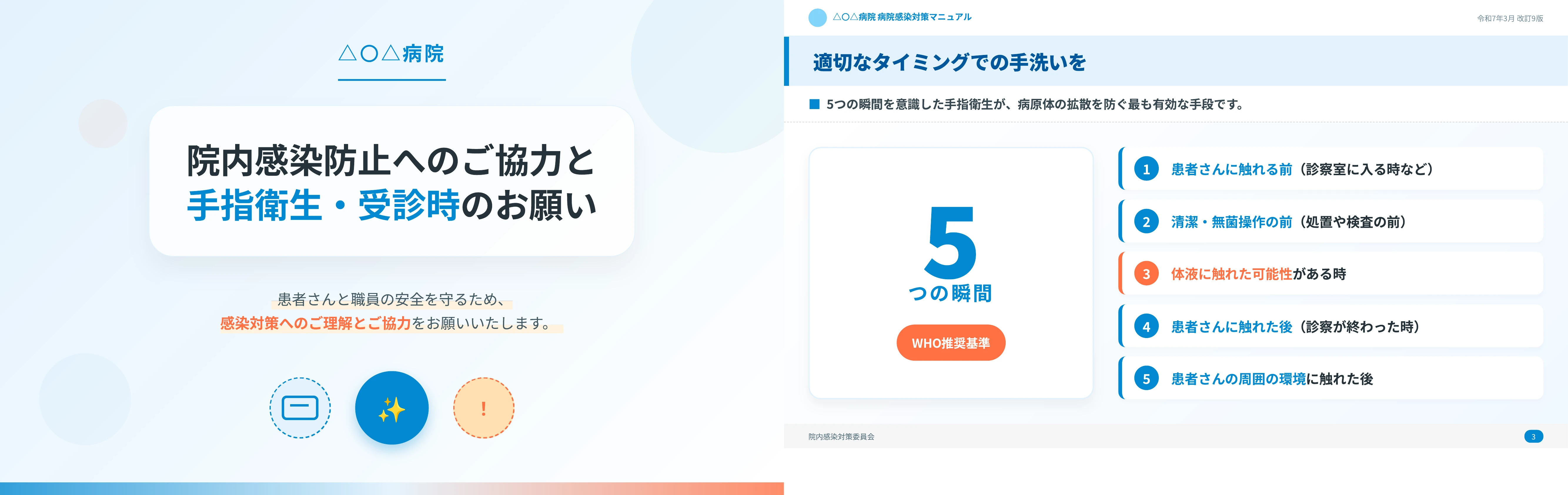
The fifth is slides for waiting-room signage. Aimed at visiting patients, this sample generates slides on the flow of a consultation and points to note, to be played during waiting time. It answers the case where a facility wants to keep waiting-room content up to date but has no dedicated designer on staff, so creation and updates stall. Feeding in internal manuals and test procedure documents makes it possible to keep signage slides current and to provide information reliably during patient waiting time, even without a dedicated owner.
Looking ahead
NoLang will continue to strengthen the product so that reducing the workload of preparing patient explanations, new-hire training, internal communication, and webinar decks gives doctors and nurses back their time and raises the quality of informed consent. Mavericks also plans to expand the sample slides by department and by task, reflecting feedback from medical sites.
Footnotes
-
Ministry of Health, Labour and Welfare, “Measures to reduce the workload of hospital doctors (survey of hospitals filing for the regional healthcare system security addition)” (in Japanese) (a survey on how medical clerical assistants are assigned) ↩
-
Ministry of Health, Labour and Welfare, “Survey on the working conditions and work-style preferences of physicians” (in Japanese) (covering hospital doctors nationwide) ↩
-
Ministry of Health, Labour and Welfare, “Work-style reform for physicians: the upper limit on overtime” (in Japanese) (in force since April 2024) ↩
-
Japanese Nursing Association, “2024 Survey on Hospital Nursing Report” (in Japanese) (covering hospital nursing departments nationwide) ↩