Most guides to video marketing stop at a list of steps. This one puts the whole strategy on a single page you can fill in, shows that page completed for a small local business, and then shows two videos made straight from it, one for each of two stages of the funnel.
If you run marketing for a small business, or you are the business, you should finish this article with the sheet filled in, your first two videos chosen, and a clear idea of the number that will tell you whether each one worked.
What is video marketing?
Video marketing means planning, making and distributing videos so that each one moves a specific group of people one step closer to buying from you, and measuring whether it did. It is wider than video advertising. An ad is one place a video can run; a how-to on your website, a short answer to a common question on Instagram and a thank-you video sent after a purchase are all video marketing too.
The simplest way to see the whole field is by the state of the person watching. Someone who has never heard of you needs something different from someone comparing you with a competitor, and both need something different from an existing customer.
| Stage | Where the viewer is | Where the video usually runs |
|---|---|---|
| Awareness | Does not know you yet, or does not yet see the problem you solve | Reels, TikTok, YouTube Shorts, paid social |
| Consideration | Knows the problem and is looking at options, including you | Your website, YouTube, email, Google search results |
| Decision | Close to choosing and checking the last doubts | Landing or booking pages, retargeting ads, sales emails |
| Retention | Already a customer | Email, text messages, a customer portal, the product itself |
The stages are the backbone of the strategy below. Each video you make should be written for one of them, which is what keeps it short and gives it an obvious next step.
Why video marketing works, and what it costs you
The case for video is easy to make with survey numbers, and the most useful numbers are the ones that also show its cost. The figures below come from Wyzowl’s 2026 State of Video Marketing survey, 266 marketers and consumers questioned in late 2025. Wyzowl makes explainer videos for a living, so read it as an industry survey rather than an independent study; it is useful because it has run the survey every year for twelve years, so you can see the trend.
- Almost everyone uses it. 91% of businesses use video as a marketing tool, up from 89% a year earlier.
- Marketers credit it with results across the funnel. 93% say video has increased viewers’ understanding of their product, 93% say it has increased brand awareness, 85% that it has generated leads and 83% that it has directly increased sales.
- Buyers ask for it. 63% of consumers say a short video is how they would most like to learn about a product or service, against 12% who prefer an article.
- Returns are no longer automatic. 82% of marketers say video gives them a good return on investment, down from 93% in 2025, an 11-point fall in one year.
- Cost and time keep people out. Among businesses that do not use video, 24% say it is too expensive, 24% that it is not needed and 19% that they lack the time.
Read together, the last two points are the argument for a strategy. Video is widely used and widely credited, but making it costs money and hours, and returns slip when the videos are made without a defined job. A plan that names one goal, one video per stage and one number per video is how a small team keeps the cost in proportion to the result.
The one-page video marketing strategy template
The template below is the strategy. The seven steps in the next section fill in its fields in order (steps 3 and 4 both feed the stage plan), so you can complete it as you read. Copy it into a document or a spreadsheet; a single page is enough, and a plan that grows past one page usually means the goal in field 1 is still too broad.
| Field | What to write | The question that decides it |
|---|---|---|
| 1. Goal | One business result, with a number and a date | What would change in the business if video worked? |
| 2. Viewer | Who you want to reach, and where they already watch | Who buys from us, and what do they ask before they do? |
| 3. Message | One sentence every video should leave behind | What should a viewer remember about us after any video? |
| 4. Stage plan | For each stage: their question, the video, where it goes, its format, the call to action and one KPI | Which question stops people at each stage? |
| 5. Budget and time | Hours a month, videos a month, money for promotion | What can we keep doing every month, not just once? |
| 6. How we make them | Who makes the videos, with what, and which versions each one gets | Which route fits each video, and what can we reuse? |
| 7. Review | When you look at the numbers, and what you change first | When do we check, and what is the one thing we try next? |
You will see the same sheet filled in for a dog grooming salon further down, with the two videos it produced.
How to build a video marketing strategy in 7 steps
Step 1: Choose one business goal and put a number on it
“Raise awareness” cannot be checked, so it cannot be managed. Start from a result the business already counts, such as new customers, booked calls, trial sign-ups or repeat orders, and write the number you want and the date by which you want it. Ninety days is a useful horizon: long enough to publish and adjust a handful of videos, short enough to be honest about whether they worked.
One goal keeps every later decision small. With “30 first-time bookings a month within 90 days”, you are no longer choosing among every video you could make, only among videos that bring in first-time bookings.
Step 2: Describe the viewer, their questions and your one message
Write two or three sentences about the people you want to reach: where they are, what situation they are in, and where they already watch video. Then collect the questions they actually ask, in their own words. Sales calls, reviews, direct messages, the questions your front desk answers every day and the search terms in your website analytics are all better sources than a persona invented in a meeting.
Sort those questions by stage. “Do I need this?” belongs to awareness, “How does it work, and will it work for me?” to consideration, “Why you, and why now?” to decision, and “How do I get more out of it?” to retention. Then write the one sentence you want every video to leave behind, in words a customer would use rather than a slogan. Fields 2 and 3 hold the viewer and the message; the questions go into the stage plan.
Step 3: Give each funnel stage one video with one job
For each stage, pick the question that stops the most people, and plan one video that answers it. That video gets one call to action and one KPI, chosen for what that stage is supposed to achieve.
| Stage | The viewer’s question | Videos that answer it | One KPI that shows it worked |
|---|---|---|---|
| Awareness | Is this for me? | Short tips, myths, before and after, behind the scenes | New followers or new viewers from the video |
| Consideration | How does it work, and will it work for me? | Explainers, demos, how-tos, a walk-through of the first visit, webinars | Clicks to the next page, or watch time on that page |
| Decision | Why you, and why now? | Customer stories, testimonials, comparisons, an offer with a deadline | Bookings, sign-ups or sales from the video’s page |
| Retention | How do I get more from it? | Onboarding, care and use tips, thank-you videos, what’s new | Repeat purchases, rebookings or renewals |
You do not need all four at once. Start with the stage where you lose the most people. A business with plenty of followers and few bookings has a consideration problem, not an awareness one, and a second short tip will not fix it. For the consideration stage specifically, how to make a service explainer video and how to make a product video go into the format in depth.
Step 4: Pick where each video runs, then match the format to the place
Decide the place before the video, because the place sets the shape, the length and how the first seconds have to work. A vertical Reel is watched on a phone, often with the sound off, by someone who did not ask to see it. A video on your booking page is watched by someone who chose to press play and wants an answer.
| Place | Shape | Length | Best for |
|---|---|---|---|
| YouTube Shorts | Vertical | Up to 3 minutes | Awareness |
| Instagram Reels | 1.91:1 to 9:16 accepted; vertical fills the screen | 3 minutes or less to be recommended to non-followers | Awareness |
| TikTok | Vertical | Up to 60 minutes when uploaded | Awareness |
| YouTube videos | Horizontal | Your choice | Consideration |
| LinkedIn Page posts | 1:2.4 to 2.4:1 | Up to 10 minutes | B2B awareness and consideration |
| Google Business Profile | No ratio stated | Up to 30 seconds | Local awareness |
| Your website or booking page | Usually horizontal | Your choice | Consideration and decision |
| Email and text messages | A thumbnail that links to the video | Your choice | Decision and retention |
Limits for the platforms above are from each platform’s own help pages as of November 2026. On length, the platform limits are generous and the useful constraint is attention: in Wyzowl’s 2026 survey, 71% of marketers say videos between 30 seconds and 2 minutes work best, and 51% name 30 to 60 seconds.
Make the first version for the place it matters most, then cut versions for the others. A 60-second explainer for a website can usually give you two or three vertical clips, each built around one moment of it; re-editing for the platform works better than posting the same file everywhere.
Step 5: Set the budget, the time and the way you will make the videos
Write the budget as three numbers: hours a month, videos a month and money a month for promotion. The middle number matters most, because it is the one you have to repeat every month. Two videos a month for three months is a strategy; ten videos in the first week and none after is a burst.
Then choose a route for each video, not for the whole plan. Different videos need different routes.
| Route | Good for | What it costs you |
|---|---|---|
| Film it yourself on a phone | Real people, your premises, customer stories, behind the scenes | Your time, plus a microphone and a light if you want them |
| An AI video tool | Explainers, tips, FAQs, offers and updates that change often, versions in other formats and languages | A monthly subscription and the time to write or gather the source text |
| A freelancer or an agency | A brand film, a flagship testimonial, anything that depends on a shoot | Days to weeks per video, and the largest budget of the three |
Hire out when the plan is settled and the video depends on a shoot. Brief the producer with that video’s row from your sheet (stage, question, place, format and call to action), which answers most of what a quote needs. For agency and freelancer prices, and what sits inside a quote, see what video production costs.
Step 6: Set a rhythm and plan the versions before you make anything
Pick a day each month when the next videos get made, and make them together; switching between scripting, making and publishing one video at a time is where small teams lose the most hours. Decide at the same time which versions each video will get: the vertical cut-downs, a still image for the thumbnail, captions, and other languages if you sell in them.
A recurring format helps more than variety. If every awareness video opens on the same kind of question and ends with the same call to action, viewers learn what to expect, and you learn faster, because only the topic changes from one video to the next.
Step 7: Measure one KPI per video and decide what you will change
Each video already has one KPI from step 3. Check it on the same day each week, and do not judge a video in its first few days. When the number is weak, the useful question is not “was the video good?” but “where did people leave?”, because each kind of drop points to a different fix.
| What you see | Where to see it | What to change |
|---|---|---|
| People leave in the first seconds | YouTube’s audience retention report (the share still watching after 30 seconds); on Instagram, average watch time against the Reel’s length | The opening. Start with the question or the result; cut the logo and the greeting |
| People leave in the middle | YouTube audience retention; Instagram average watch time | The length. Cut the slowest part and show the payoff earlier |
| Few people choose to watch | YouTube’s impressions click-through rate | The title and the thumbnail |
| People watch to the end but do not act | Follows (Instagram), link clicks, visits to the next page | The call to action. One step, said aloud and shown on screen |
| People reach the page but do not book or buy | Your booking, checkout or form analytics | The page or the offer, not the video |
YouTube notes that half of all channels and videos have an impressions click-through rate between 2% and 10%, which gives you a rough range to compare against. For your own videos, the most reliable benchmark is your previous video of the same type.
Change one thing at a time. If you rewrite the opening, shorten the middle and replace the call to action in the same month, you will not know which change mattered.
Example: a dog grooming salon’s strategy sheet and its first two videos
To show the sheet at work, here it is filled in for Maple Street Dog Grooming, a fictional neighborhood salon. Its problem is a common one: plenty of people know it exists, but too few book a first visit, because owners of nervous dogs worry about what happens once they hand over the leash.
- 1. Goal: 30 first-time bookings a month, up from 18, by the end of month 3.
- 2. Viewer: dog owners within 5 miles who have never booked a groomer, or whose dog came home stressed from one. They find local services on Instagram and Google Maps.
- 3. Message: calm, unhurried grooming for dogs who find it stressful.
- 5. Budget and time: 4 hours a month, two new videos a month, and $100 a month to boost the best-performing Reel.
- 6. How we make them: generated from this sheet with an AI video tool; the 60-second explainer is cut into two vertical clips.
- 7. Review: each video’s KPI is checked every Friday, and once a month one thing changes in the weakest video: the opening, the length or the call to action.
| Stage | Their question | Video | Where and format | Call to action | One KPI |
|---|---|---|---|---|---|
| Awareness | Does my dog actually need a groom? | 3 signs your dog is overdue for a groom | Instagram Reels and TikTok; vertical, about 30 s, captions on | Book from the link in our profile | Follows from the Reel |
| Consideration | What will happen to my dog at the first visit? | Your dog’s first groom, step by step | Booking page and replies to price questions; horizontal, about 60 s | Book a first visit | Booking page visits that become bookings |
| Decision | Can I get in soon? | This week’s open slots (next) | Text or email to people who asked about prices; vertical, 15 s | Pick a slot | Bookings from those messages |
| Retention | How do I keep the coat tidy between visits? | A 2-minute brushing routine (next) | Sent the day after each visit; vertical, about 2 min | Rebook in 6–8 weeks | Rebookings within 8 weeks |
The salon starts with two videos, not four. Awareness is where new owners first meet it, and consideration is where they currently stop. Decision and retention wait for next month, when the first numbers are in. Both videos below were made in NoLang with this sheet as the input.
Awareness: a 35-second Reel that answers “does my dog need a groom?”
The awareness row asks a question owners of shaggy dogs genuinely have, so the Reel opens on it in large type: “Does your dog actually need a groom?” It then gives three signs an owner can check at home, one per scene with the sign named on screen: nails that click on the floor, knots that will not brush out, and fur over the eyes. A recap of all three leads to “It’s time for a groom,” then to the salon’s message from field 3, “calm, unhurried grooming,” and the call to action from the sheet: “Book from the link in our profile.” Every spoken line is also on screen, so it works with the sound off.
3 signs your dog is overdue for a groom (vertical Reel)
Using the awareness row of this strategy sheet, make a 30-second vertical Reel for our dog grooming salon: three signs a dog is due for a groom, ending with booking from the link in our profile.
Its KPI is follows from the Reel. If follows stay low while average watch time is close to the full 35 seconds, people are watching and not acting, so the ending is what changes next month. If average watch time is only a few seconds, the opening is.
Consideration: a one-minute walk-through for the booking page
The consideration row answers the question that stops nervous owners from booking: what will actually happen to my dog? The video takes them through the visit in five numbered steps. The owner tells the salon about the dog when booking, then comes a slow hello in a quiet room, a warm bath and a gentle dry with the dryer on low, and the groom itself, with breaks whenever the dog needs one, plus a promise that if it gets too much, the salon stops and finishes another day. Pick-up and notes for next time close the visit. Because the video sits on the booking page, it ends with “Book a first visit, right here on this page.”
Your dog's first groom, step by step (booking page explainer)
Using the consideration row of this sheet, make a one-minute horizontal video for our booking page that walks first-time customers through their dog’s first groom and ends with booking a first visit.
Its KPI is the share of booking page visits that become bookings. The salon compares the four weeks after the video goes up with the four weeks before, keeping the page itself unchanged so the video is the only change the salon made.
Both videos use generated scenes, because Maple Street is fictional. If this were your business, the two rows would call for different choices: the signs in the Reel can be illustrated with any dog, but the walk-through is the place to show your real room and the people who will handle the dog, because that room is exactly what the viewer is deciding whether to trust.
Video marketing tips and best practices
The seven steps decide what to make. These seven tips are about how each video does its job once it exists.
- Make the first frame readable at a glance. On a feed, the first seconds decide whether the rest is watched. Put the question from your stage plan, or the result, on screen in large type from the very first frame, and let the logo wait until the end.
- Make it work with the sound off. Put the key words on screen and turn captions on. People scroll feeds at work, on trains and in waiting rooms, where the sound stays off, and captions also help viewers who are hard of hearing or watching in a second language.
- Place the video next to the action it supports. On your website, put the video beside the button it is meant to help with, such as booking, pricing or sign-up, rather than on a separate page of videos. The viewer decides right where they watch.
- Use real customers when trust is the question. At the decision stage, a customer saying it worked for them answers a doubt your own claims cannot. Ask permission, keep it short and let them use their own words.
- Write the title and thumbnail around the payoff. Where people choose what to watch, on YouTube or a page of videos, a title that names the result the viewer gets does more than a clever one.
- Make the video findable. Use the words your viewers search for in the title and description, and add captions or a transcript, so search engines and platform search can read what the video is about.
- Brand every video the same way. The same colors, fonts, logo position and closing line across all your videos let viewers recognize you before they read your name.
B2B video marketing: what changes
The steps are the same for a business that sells to other businesses. Three things change. A purchase involves a group of people, often a manager who finds you, a specialist who checks the details and a budget holder who signs; the evaluation can run for weeks or months; and the result you count is a qualified meeting or pipeline rather than a booking.
| Stage | Videos that work | Where they run | What to count |
|---|---|---|---|
| Awareness | Short explainers of the problem, expert takes, event clips | LinkedIn, YouTube, industry newsletters | Views, new followers |
| Consideration | Product overviews, webinars, how-tos | Website, YouTube, email nurture | Watch time, sign-ups, demo requests |
| Decision | Demos, customer case studies, proposal summaries | Sales emails, proposal pages | Meetings booked, deals advanced |
| Retention | Onboarding, new-feature walk-throughs | Customer portal, in-product, email | Activation, renewals |
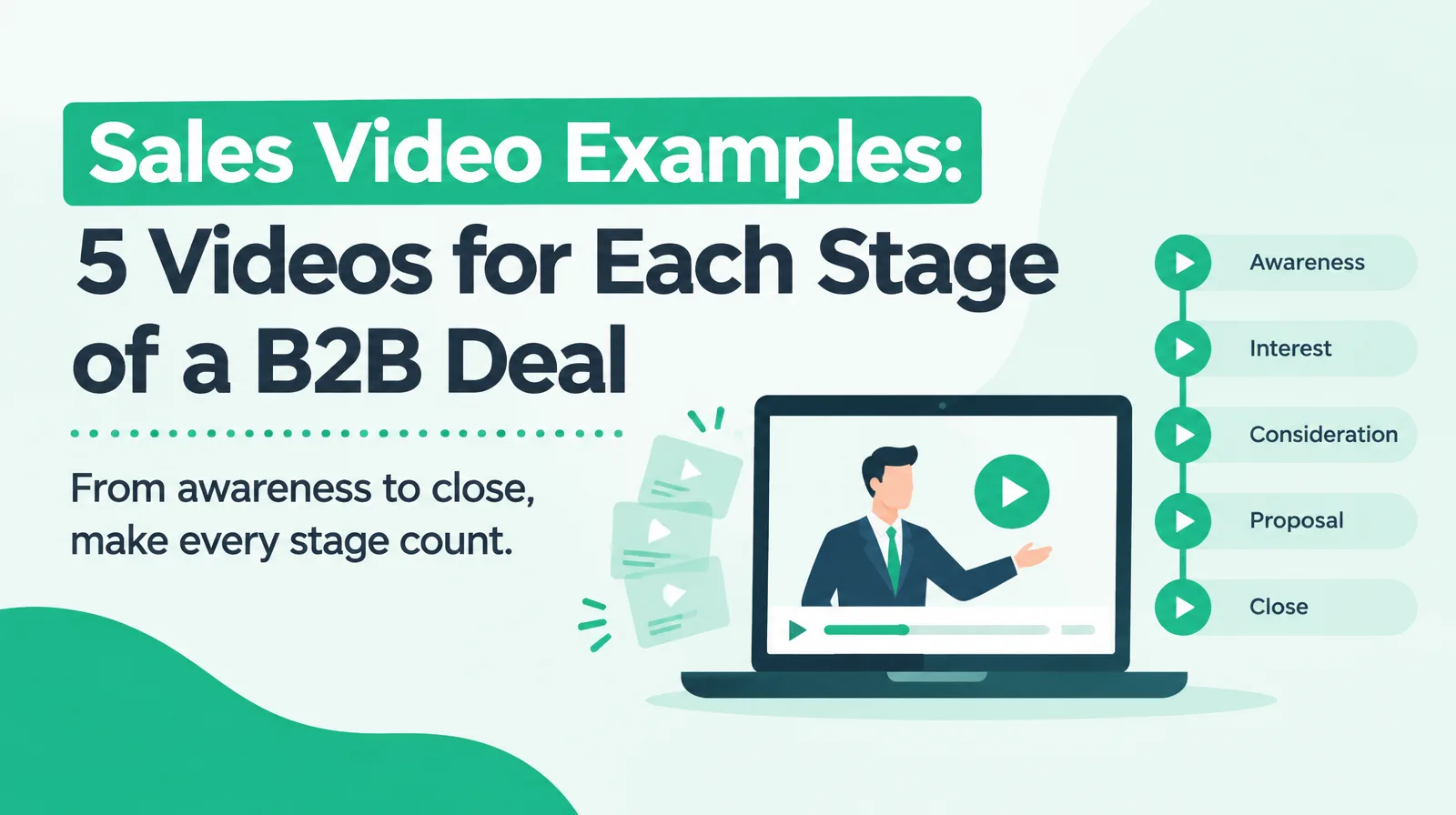
Video does a particular job in B2B: it carries your argument into meetings you are not in. The person who found you has to explain you to colleagues, and a two-minute video they can forward keeps the explanation intact. Sales video examples by stage of the deal shows five such videos, from a webinar invitation to customer results for the closing stage.
Animated or live-action marketing videos?
Neither is better in general; each does a different job. The choice comes down to what you need the viewer to see, how often the video will change and where trust has to come from.
| Choose | When | Typical uses |
|---|---|---|
| Animation | The thing you sell is hard to film: software, a process, an abstract service such as insurance or finance, an idea, or numbers. Or the video will need updating, or versions in several languages | Explainers, how-tos, FAQs, product walk-throughs, data stories |
| Live action | The viewer needs to see real people, a real place or the real product in a hand | Testimonials, team and premises, product texture and fit, events |
| Both | A real face carries trust and graphics carry the explanation | A presenter with on-screen diagrams, a customer story with figures |
Animated and generated videos also change the cost of the second and third versions. Editing a line of text or swapping a scene costs far less than reshooting, which matters for the videos in your plan that will be revised every quarter.
The two Maple Street videos are generated rather than filmed. That suits the Reel’s three signs, which any dog can illustrate, while the first-visit walk-through is the one a real salon would film in its own room.
Video marketing trends for 2026
Five changes are worth planning around. Each comes with what it means for a small team.
- Short vertical video is the first touch. YouTube Shorts average over 200 billion daily views, YouTube’s CEO Neal Mohan said in June 2025, and in HubSpot’s 2026 State of Marketing report, 48.6% of more than 1,500 marketers picked short-form video when asked which formats earned the biggest return, against 28.6% for long-form video. For you: make awareness videos vertical, and keep most of them under a minute.
- AI is part of most video production. 63% of video marketers have used AI to help create videos, up from 51% a year earlier (Wyzowl 2026). For you: use it for the videos that change often or need many versions, such as explainers, FAQs, offers and other languages, and keep real people for the moments where trust depends on a face.
- Most video is made in-house. 59% of video marketers make their videos in-house and another 32% combine in-house and outside work; 10% rely only on an outside supplier (Wyzowl 2026). For you: plan a monthly rhythm you can sustain yourself, and save outside budget for the one or two videos that need a shoot.
- Quality still decides trust. “Authentic” and lightly produced video is a common recommendation, but 89% of consumers say a video’s quality affects how much they trust a brand (Wyzowl 2026). For you: informal is fine; unclear is not. Clean sound, readable text and a steady frame matter more than polish.
- Personalized video is becoming practical. Personalized video marketing means making a version of the same video for each segment, account or person, with their name, their industry or their question in it. Built from a template, each version means changing the text and a few images rather than a new edit. For you: start with one segment that has a distinct question, such as first-time customers or one industry, rather than with individual names.
Making marketing videos as a team
If your company wants to keep a plan like this running every month across a team, NoLang can be where the stage videos are made. Teams start from a script, a slide deck or a document such as the strategy sheet above, and a finished video can be converted to another aspect ratio or another language, so the vertical and other-language versions in step 6 start from the video you already have. To talk through how it would fit your team, contact us.
Download the Brochure