Brand Story Video Production: 5 Parts, 7 Steps and an Example
Key takeaways
A brand story video is a one-to-three-minute film about why your company exists, told in five parts: the customer's problem, why you started, what you do differently, proof, and one action.
Production starts with facts, not a camera: put every fact the video may use on a one-page fact sheet, use the founder's own words, name customers only with written permission and date every number.
The seven production steps run from deciding where the video will play to cutting short versions; Demo Duck says its company story videos usually take six to eight weeks and cost $15,000 to $25,000.
Hire a studio when real people and places must be on camera, and ask about interviews, versions, revisions, footage ownership and licenses before you sign.
Our example turns a one-page fact sheet for a fictional restaurant payroll company into a two-minute brand story video, published as a NoLang template you can reuse.
SHARE
A brand story video is a short film, usually one to three minutes long, about why your company exists. It moves through five parts in order: the problem your customers had, why you decided to fix it, what you do differently, the proof that it works, and the one thing you want the viewer to do next.
That is why brand story video production starts with facts, not a camera. The studios that make these videos do most of the real work before anyone films: they choose who to interview, find the moments that explain the company, and decide the order of the story. Whether you hire a production company or make the video yourself, that groundwork decides how good the result is.
This guide covers the five parts and how long each one runs, a one-page fact sheet for collecting them, a two-minute example built from that sheet, the seven steps of production, what branded video production costs with a studio and what to ask before you hire one, and two official brand videos read part by part.
What a brand story video is
A brand story video tells the viewer who your company is, what it values and why it does the work. Production companies call the same thing a company story video, an “about us” video or a mission video. Votary Films puts the difference from advertising in two sentences: “A commercial focuses on what you offer. A brand story focuses on who you are.” (Votary Films)
The two search terms around it are broader. Branded video production covers any video a company makes to carry its brand: brand stories, product demos, explainers, customer testimonials and culture videos all count. The Manifest, a directory of production companies, defines branded videos as “marketing content, sponsored by a company, that share a message or promote a product or service naturally instead of as an advertisement” (The Manifest), which is the sense of branded content in branded content video production. A brand story video is one kind of branded video, and the one that sells least directly.
A brand story video next to other branded videos
Video
The question it answers
Who usually speaks
Brand story
Why does this company exist?
Founder, team, a customer
Commercial
Why buy this now?
Narrator or actor
Explainer
How does it work?
Narrator
Testimonial
Did it work for someone like me?
A customer
Culture video
What is it like to work here?
Employees
If the question you need to answer is “how does it work?”, you want an explainer video instead, and a time-limited offer belongs in a promotional video. Everything below is about the first row.
The five parts of a brand story video
Put the customer at the center. In a brand story, your customer is the hero and your company is the one that helps, so the video opens with the customer’s problem, not with your founding date.
The five parts, timed for a two-minute video
Part
What it answers
Facts you need
In 2 minutes
1. The customer’s problem
Who do you serve, and what goes wrong for them?
A specific customer, the moment it goes wrong, what it costs
About 35 s
2. Why you started
Why did you decide to fix it?
The founding moment, in the founder’s words
About 25 s
3. What you do differently
What do you do that others don’t?
One to three concrete practices
About 25 s
4. Proof
Why should a stranger believe it?
Dated numbers, named customers who agreed
About 20 s
5. One action
What should the viewer do next?
One action, one link
About 15 s
1. The customer’s problem. Name a specific customer and the moment things go wrong for them. “Small businesses struggle with payroll” is a category; “a restaurant owner retyping tips into a spreadsheet at 1 a.m.” is a scene a viewer can see.
2. Why you started. This is the part only you can tell, so tell it in the founder’s own words. A single scene from the day the company began does more than a mission statement.
3. What you do differently. Pick one to three practices a competitor could not claim just by copying your adjectives. “We care about our customers” is not a difference. “Support calls are answered by people who used to run restaurants” is.
4. Proof. Give a skeptic something to check: a number with a date, a customer who agreed in writing to be named, an award, a certification. Leave out anything you cannot back up.
5. One action. End with one request that fits where the video plays: book a demo from the homepage, visit the shop from a local ad, apply from a careers page. Two requests compete with each other.
On length, Votary Films says most effective brand stories run between one and three minutes, long enough to say something meaningful and short enough to keep attention. Build that master version first. Levitate Media’s advice is to plan the full set upfront and then “cut short versions for social, partner decks, recruiting, and sales” (Levitate Media), so the short versions repeat the same story rather than invent a new one.
Collect the facts on one page
Before anyone writes a script, put every fact the video may use on one page. The sheet follows the five parts, adds the tone, and ends with a line for what the video must not say. It becomes the source of truth for everyone involved: the founder checks it once, the scriptwriter works only from it, and a studio or an AI tool gets the same page.
Copy this outline and fill it in for your company:
BRAND FACT SHEETWho we are: company, what you sell, where, since when, website1. Who we serve and the problem they have - Who exactly (type of customer, size, situation) - The moment it goes wrong for them - What it costs them (time, money, stress)2. Why we started - The founding moment, in the founder's own words - When and where3. What we do differently - One to three concrete practices4. Proof we can show - Numbers, each with a date - Customers who agreed in writing to be named - Awards, certifications, press5. What we want viewers to do - One action, one linkTone:Do not say:
To fill in parts 1 and 2, interview the founder, and a customer if one agrees to take part. In a behind-the-scenes video of a brand story they made for a local wine bar, the Hill and Valley Creative team drafted talking points and questions, then went through them with the owner, telling him he knew a lot more about the business than they did. Their first question for him was the one every brand story needs answered: what made you want to start it? (Hill and Valley Creative on YouTube)
Questions for the founder:
What were you doing the day you decided to start this?
What did your customers do before you existed?
What is one thing you refuse to do, even if it would be cheaper?
What number would you show someone who doubts you?
If a viewer remembers one sentence, what should it be?
Questions for a customer:
What was going wrong before you found us?
What made you try us?
What changed, as a number or a moment you remember?
Four rules keep the facts honest, because in a brand story the whole point is that it is true:
Use the founder’s own words. Edit for length, but do not put sentences in their mouth that they never said.
Name a customer only with written permission. Do not present an invented or composite customer as a real one.
Date every number and keep its source. “1,150 restaurants (October 2026)” can be checked; “thousands of happy customers” cannot.
Fill in the “Do not say” line. List claims you cannot support, guarantees your legal team will not sign off on, and names of competitors.
If a line in the script is not on the sheet, either add the fact to the sheet, with its source, or cut the line.
Example: a two-minute brand story video from one fact sheet
Tallyhouse is a fictional company: payroll software for independent restaurants, started by Ana Ruiz, who grew up in her parents’ diner. We filled in its fact sheet with the outline above, including the line “No customer quotes: we do not have written permission yet,” and made the video in NoLang from that one page. Every fact in it comes from the sheet. It runs 2 minutes 1 second and is published as a template: open it, put in your own company’s facts, and generate your version.
Here is the text of the sheet, so you can hold the video up against it:
TALLYHOUSE — Brand fact sheetSample for a fictional companyWho we areTallyhouse: payroll software for independentrestaurants. Founded in 2021 in San Antonio, Texas.Website: tallyhouse.example1. Who we serve and the problem they have- Owners and managers of independent restaurants with 5 to 40 staff.- Every two weeks, usually after closing, they copy hours and tips from the point-of-sale system into a spreadsheet, then into payroll.- A pay run takes 2 to 3 hours, and one mistyped tip means a server is paid short.2. Why we started- Founder Ana Ruiz grew up in her parents' diner, Lupe's, in San Antonio.- Every other Sunday night, her mother did payroll at the counter with a calculator and a shoebox of tip slips.- In 2021 Ana, then a software engineer, built the first version of Tallyhouse for the diner.3. What we do differently- Hours and tips sync from the point-of-sale system every night. Nothing is retyped.- Before payroll runs, a preview shows each person's hours, tips and pay, and flags anything that changed since the last run.- Support calls are answered by former restaurant managers.4. Proof we can show- 1,150 independent restaurants run payroll on Tallyhouse (October 2026).- Median time to run payroll: 11 minutes.- Lupe's has run every payroll on Tallyhouse since 2021.- No customer quotes: we do not have written permission yet.5. What we want viewers to do- Book a 15-minute demo at tallyhouse.example/demoTone: warm and plain-spoken. No jokes about paymistakes.Do not say: "never makes mistakes", tax or complianceguarantees, names of other payroll companies.
Each part of the sheet became one stretch of the video, in the same order:
How the Tallyhouse fact sheet became the video
Part
Time
In the video
1. The customer’s problem
0:00–0:38
An empty diner after closing, then hours and tips copied by hand into payroll
2. Why you started
0:38–1:04
Lupe’s, the calculator and the shoebox of tip slips, Ana’s first version in 2021
3. What you do differently
1:04–1:29
The nightly sync, a payroll preview that flags changes, support from former managers
4. Proof
1:29–1:48
1,150 restaurants (October 2026), an 11-minute median, and Lupe’s today
5. One action
1:48–2:01
One question, then one link: book a 15-minute demo
Three choices make it a story rather than a feature list. First, it opens on the customer’s night, not on the company: the chairs are up, the last table is cleared, and for the person who runs the restaurant “one more shift is just starting.” The product itself is not explained until 1:04. Second, the founding scene is exactly the one on the sheet: the counter, the calculator, the shoebox. There is no quote from Ana and no name for her mother, because neither is on the sheet. Third, the proof part runs on numbers and on the diner where it all started, because the sheet rules out customer quotes.
Two things in the video are illustrations rather than facts: a $48.00 tip typed into payroll as $4.80, and the names and amounts in the payroll preview. Neither is on the sheet, so the video labels them “For example” and “Sample data” on screen. Labeled illustrations like these let you show a problem without inventing a customer.
How brand story video production works: 7 steps
The steps below are the same whether a studio runs them or your own team does. What changes is who does each one and how much of step 5 involves cameras. For the general stages behind any video, see video production.
Decide the job and where the video will play. A homepage video, a recruiting video and a video sent after a sales call can tell the same story, but they differ in length, shape and the one action at the end. Write the audience, the placement and the action in a sentence before anything else.
Collect the facts and interview. Fill in the fact sheet. Interview the founder and, with permission, one or more customers, and record the interviews even if nobody will appear on camera, so the words in the script are their words.
Choose who tells the story. Keyy Productions describes the usual options: a founder describing the need that started the company, a customer sharing a lived experience, or a compilation that tells the brand’s history (Keyy Productions). The founder carries part 2 best; a customer carries parts 1 and 4.
Write the script and the storyboard. Assign each part its seconds, then write the narration and the picture for each beat. Read it aloud with a timer, because a script that looks short on paper often runs long; for reference, the two-minute Tallyhouse video above carries 233 words of narration, with pauses between scenes. A video script template helps with the format.
Make the pictures. Either film or generate. Filming usually means an interview day and separate days for B-roll: the Hill and Valley team shot the wine bar owner’s interview first, then planned days for opening the bar, serving customers and close-up product shots. Top Notch Cinema’s brand story for Farberware came together over several weeks, from pre-production and storyboard revisions to two production days in New York (Top Notch Cinema). If the story can be told by a narrator over illustration or generated imagery, an animated or AI-generated video skips the shoot.
Edit, caption and check. Cut the master version, add music and captions, then check every line against the fact sheet, confirm that everyone on camera has signed a release, and confirm the music license covers every place the video will run.
Cut versions and publish. Publish the master where the job is, then cut short versions from the same story for social posts, sales decks and recruiting.
With a studio, Demo Duck says company story videos usually take six to eight weeks to produce, and that the hardest part is coordinating schedules on the day of the shoot (Demo Duck).
Branded video production: in-house, studio or AI
There are three ways to get the video made. The deciding question is whether the story needs real people and places on camera.
Three ways to produce a brand story video
Route
Best when
You pay for
Watch out for
Production company
Real people and places must be on camera
Interviews, crew, shoot days, editing
Six to eight weeks, scheduling the shoot
In-house filming
Someone on your team can film and edit
Equipment and staff time
Sound and light in interviews
AI video generation
Narration over illustrated or generated visuals works
A subscription
Checking every line against the facts
Studio pricing varies widely. Demo Duck says its company story videos typically cost $15,000 to $25,000, which, without animation, tends to include a one-day shoot at your office, interviews with your team and editing. For what sits inside a quote and what moves it, see video production cost.
What to ask before you hire a studio
Superside suggests checking an agency’s experience with brands at your scale and a portfolio whose style matches what you want, then weighing scalability, cost and turnaround (Superside). Send the studio your fact sheet, the job of the video and where it will play, then ask:
Brand stories you made for companies like ours? Ask for full videos, not a reel.
Who runs the interviews? And how many people and shoot days are in the quote?
Which versions are included? The master, short cuts, a vertical cut, captions.
How many rounds of revisions, and at which stage? Script, rough cut, final.
Who owns the footage? Can we get the raw interview files for later edits?
Where can we use the video, and for how long? Music and talent licenses decide this.
What is the timeline from kickoff to delivery? And what do they need from you, and by when?
Make a brand story video with NoLang
NoLang, from Mavericks, Inc., is an AI video generation service that turns a prompt and attached material into a finished video with narration, on-screen text and visuals. For a brand story, the useful part is that the fact sheet itself can be the input.
Save the fact sheet as a PDF or PPTX. One page is enough. Keep the five parts, the tone and the “Do not say” line on it.
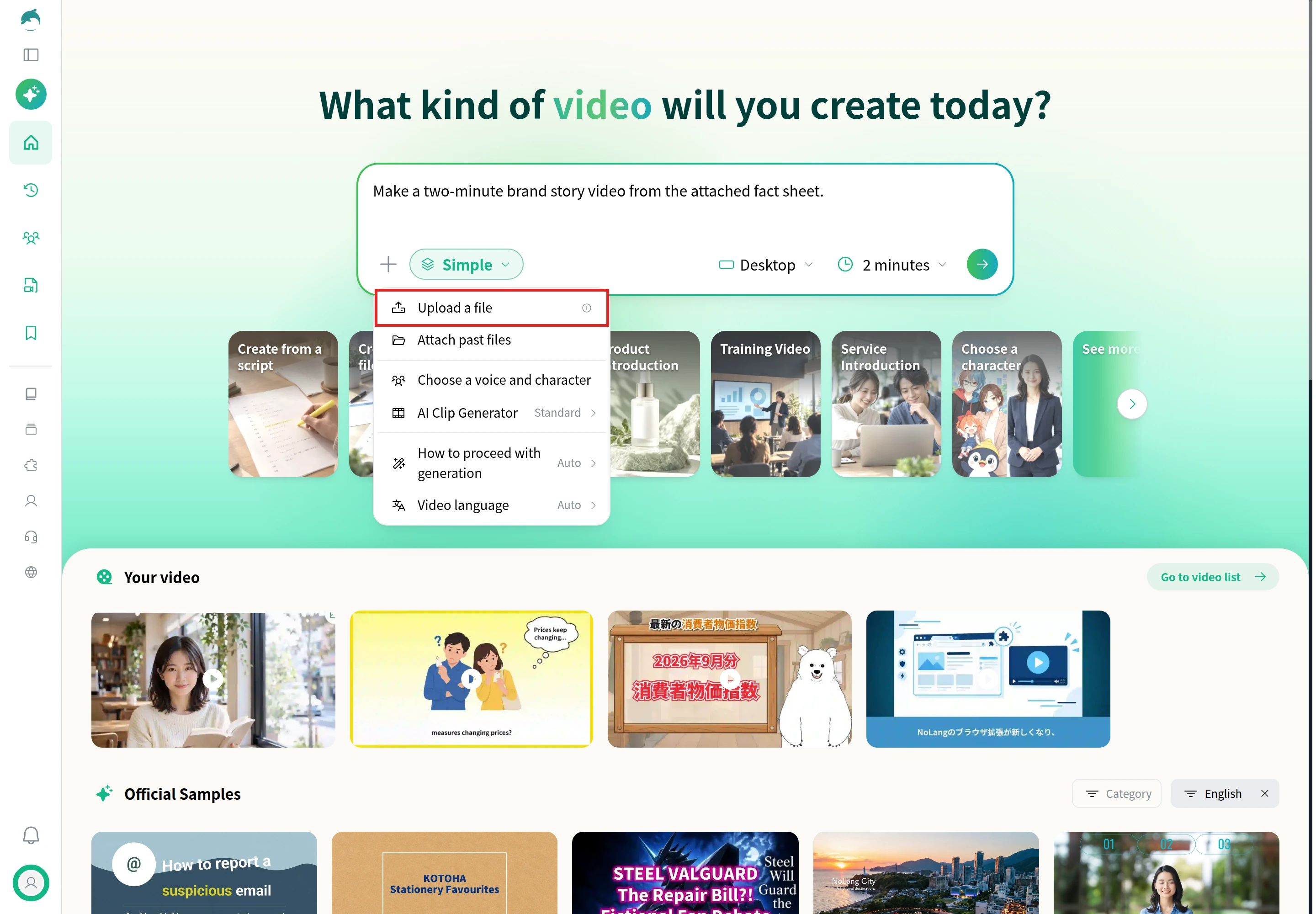
Write the prompt and attach the sheet. On the home screen, describe the video in the prompt box, for example “Make a two-minute brand story video from the attached fact sheet.” Then click + at the bottom left of the box and choose Upload a file to attach the PDF. You can attach up to four PDF or PPTX documents.
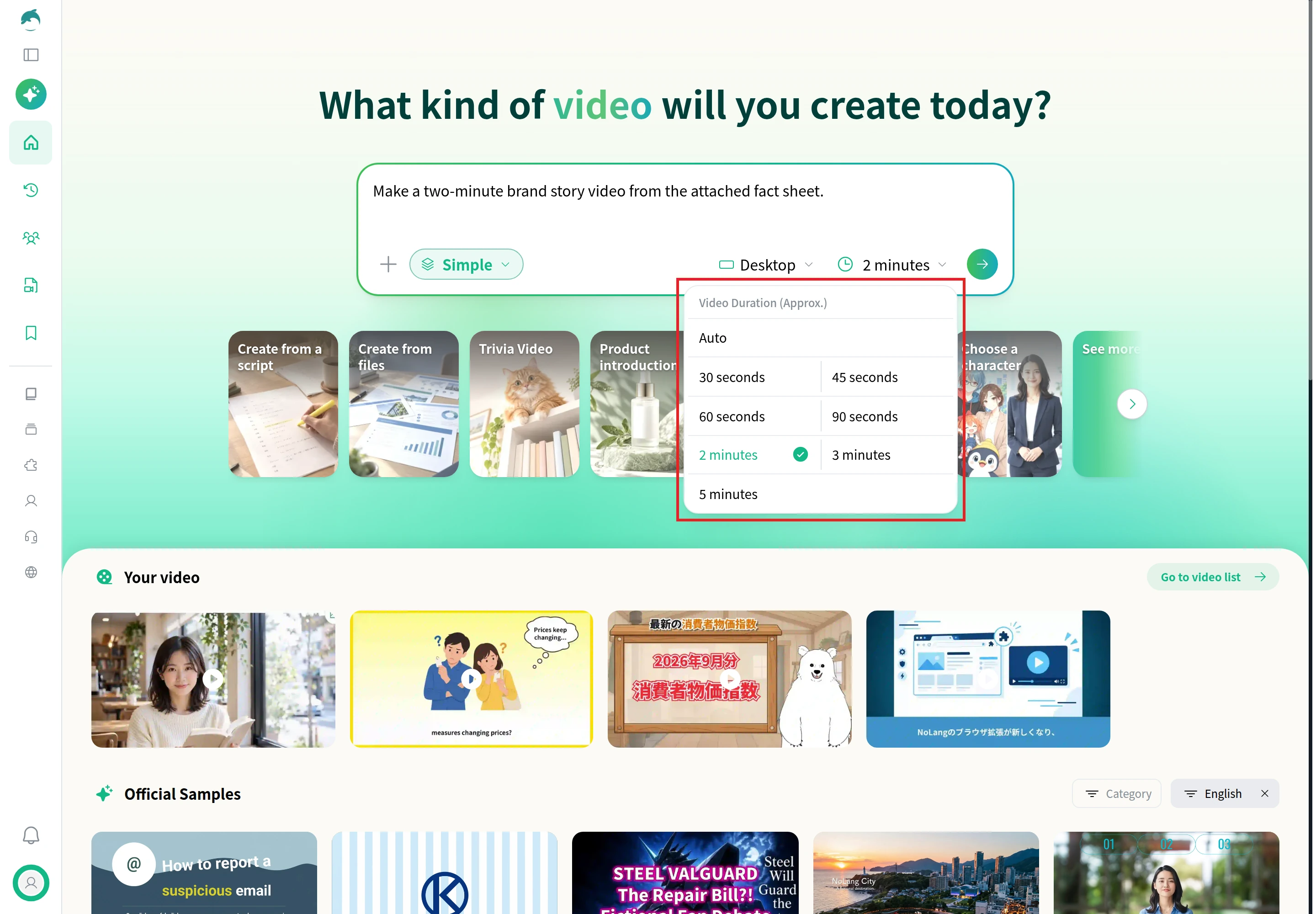
Choose the length and the shape. Open the Video Duration menu (the button that shows the current length) and choose 2 minutes. For a website, open the shape menu and choose Horizontal (16:9), which shows as Desktop. Then click the arrow button to generate the video.
Check every line against the sheet. Play the video through with the fact sheet next to you. If a line says something that is not on the sheet, open Edit and fix it there.
Make the short versions. Attach the same sheet again, choose 30 seconds and Vertical (9:16), and ask for a 30-second version of the same story for social feeds.
You can also start from the example above: open the Tallyhouse template, put in your own company’s facts, and generate your version.
Brand story video examples
Two official videos show two ways to tell a brand story: from the company’s side and from a customer’s.
Warby Parker: the company tells its mission in its own voice
Source: Warby Parker official channel
Warby Parker’s Buy a Pair, Give a Pair, published in 2011, runs about a minute and a half. It opens on why the company exists, to serve people “sick and tired of overpaying for glasses,” which covers parts 1 and 2 in one line, said on camera by people from the company rather than by an announcer. Then it widens the problem: a billion people still don’t have access to glasses at all. Part 3 is the program that answers it: for every pair sold, one is distributed to someone in need, through partners that train low-income people to start businesses selling glasses. The proof is shown rather than claimed, in footage of people putting on a pair for the first time, and the video ends on a single card: “Find out more at warbyparker.com.”
Airbnb: a customer tells the story, and the brand appears at the end
Source: Airbnb official channel
Airbnb’s Wall & Chain, published in 2014, is a 76-second animated film built on a story a guest told the company. Her father had been a guard on the Berlin Wall; she took him back to Berlin, and the host who opened the door turned out to have stood on the other side of the Wall. The customer is the hero from the first frame to the last, the company never explains its product, and the brand appears only at the end with “Belong Anywhere.” Read against the five parts, the guest’s story carries the problem and the proof on its own, the action is just “Belong Anywhere,” and why the company started and what it does differently are left unsaid. It also shows that a brand story does not need a camera crew: the whole film is illustration and a narrator.
Using brand story videos at your company
If your company needs a brand story for its website, sales team and recruiting, NoLang lets the marketing team turn one fact sheet into a master video and its short and vertical versions in-house, and the example in this article can be reused as a template. The materials below explain how companies roll NoLang out to their teams; for anything they don’t cover, contact us.
Q
How do you know if a brand story video worked?
⌃
Demo Duck judges company story videos by viewer engagement and by whether people stuck around to "meet the team," and adds a less scientific sign: because these videos are personal, viewers may mention them to you directly, even on a conference call. Then compare the numbers with the job you set for the video, such as demo bookings from the homepage or applications from a careers page.
Q
Where should I use a brand story video?
⌃
Anywhere people need to understand who you are before they buy, apply or partner with you. Votary Films lists your homepage, About page, social channels, presentations, recruitment campaigns and trade shows.
Q
How many people should appear in a brand story video?
⌃
Demo Duck says it has interviewed anywhere from three to twenty people for one company story video and usually recommends four to eight, across different levels of seniority and job function. A small company can tell the story with fewer voices: the founder for why you started, and a customer who agreed in writing for the problem and the proof.
Q
Can NoLang make a vertical version of a brand story video?
⌃
Yes. On the page of a video you made, open Other, choose Change aspect ratio, select 9:16 and click Convert. The same menu also offers 1:1, 4:5 and other ratios.